
Should I start haloalkanes practice with drills, PYQs or mocks?
Choose chapter drills if you cannot explain the product or mechanism, authentic PYQs once you can, and full-length mocks when mixed-paper execution is the problem. Haloalkanes practice questions for JEE serve different purposes: no format is universally best. Below are five original practice questions with worked solutions, not past JEE questions. Attempt them before choosing your next practice format.
How do free haloalkanes drills, PYQs and full-length mocks compare?
Drills isolate reasoning gaps, PYQs test application to actual exam questions, and mocks test execution across subjects. Choose by the mistake you need to expose, not by a “JEE-level” label. A full mock is inefficient for repairing one narrow misconception, such as losing the cyanide carbon while naming nitriles.
Read each comparison in this order: original drills on this page; authentic JEE PYQs; full-length mocks.
- Purpose: Drills expose specific misconceptions; PYQs test actual exam wording; mocks test question selection, pacing and sustained attention.
- Chapter focus: These drills cover haloalkanes with one haloarene boundary check; chapter-filtered PYQs target the topic; mocks mix chapters and subjects.
- Source authenticity: These five questions are original and explained; authentic PYQs require a traceable exam paper and question; mocks are simulated papers, not PYQs unless individual questions are identified as such.
- Solution usefulness: These drills explain answers and repair actions; PYQ explanations depend on the source, and an official key is not a worked solution; mock scores need question-by-question review to expose faulty reasoning.
- Exam conditions: Drills isolate decisions; individual PYQs reproduce authentic questions but not full-paper pressure; timed mocks practise mixed-paper execution.
- Free access: This drill is available below; not every PYQ compilation or solution is free; check which mock tests are free before choosing a source.
- Limits: Five drills cannot establish full-chapter readiness; chapter PYQs cannot establish whole-paper stamina; a mock is not guaranteed to contain a particular number of haloalkanes questions.
For mixed-paper practice, JEEnius offers 75-question, 300-mark, 180-minute full-length mocks with a scored per-subject breakdown, including free tests. These are JEE Main-style specifications, not a fixed JEE Advanced pattern.
Which practice should I choose for my current weakness?
Your explanation should decide the next step, not your class or dropper status. A correct option supported by a false rule still needs repair. You may need drills for stereochemistry and PYQs for product selection: treat those weaknesses separately.
- Class 11, chapter not yet studied: Establish bond polarity, nucleophiles, basicity and carbocation stability first. Use questions to learn these ideas, not as a timed performance test.
- Currently learning haloalkanes: If you confuse substrate effects with reagent effects, choose isolated drills. Explain what the carbon framework permits and what the reagent and conditions favour before seeking speed.
- Class 12, revising usable concepts: If you can explain substitution and elimination, move to authentic Main PYQs. Review guesses as carefully as wrong answers: a guessed correct option gives weak evidence of understanding.
- Preparing for Advanced: Use authentic Advanced questions for deeper mechanism and stereochemistry reasoning. Main-style single-correct questions are useful checks, not complete Advanced preparation.
- Dropper, strong on isolated questions: If mixed tests cause rushed reading or poor question selection, combine targeted error repair with full-length mocks. Familiar chapter drills do not test those execution skills.
Can I try five free haloalkanes practice questions before seeing the answers?
Attempt these five original, single-correct MCQs before reading the solutions. Record your option and a short reason beside each answer. This diagnostic does not predict JEE performance or rank.
Identify the decisive clue: substrate, reagent, condition, rate law or geometry. If you are guessing, write “guess” rather than supplying a reason after checking the key.
Question 1: Which product forms with KCN?
1-Bromopropane reacts with excess potassium cyanide in dry DMSO under conditions favouring SN2 substitution. Which is the major organic product?
- A. Propanenitrile
- B. Butanenitrile
- C. Propyl isocyanide
- D. Propan-1-ol
Question 2: Which elimination product is favoured?
2-Bromobutane is heated with alcoholic potassium hydroxide under ordinary elimination conditions. Considering both the double-bond position and geometrical isomerism, which is the major organic product?
- A. But-1-ene
- B. Cis-but-2-ene
- C. Trans-but-2-ene
- D. Butan-2-ol
Question 3: How does the initial rate change?
A haloalkane undergoes substitution explicitly following SN1 kinetics. Its initial concentration is doubled while temperature, solvent composition and nucleophile concentration remain unchanged. What happens to the initial rate?
- A. It remains unchanged.
- B. It doubles.
- C. It becomes four times as large.
- D. It becomes half as large.
Question 4: What configuration does the product have?
Optically pure (R)-2-bromobutane undergoes displacement by iodide in dry acetone. Consider only the product of a single, explicitly SN2 displacement, before any subsequent exchange reaction. Which product forms?
- A. (R)-2-Iodobutane
- B. An equal mixture of (R)- and (S)-2-iodobutane
- C. (S)-2-Iodobutane
- D. But-2-ene
Check the priority order in the starting material and product before assigning the descriptor.
Question 5: Where does ordinary SN2 reasoning apply?
Chloroethane and chlorobenzene are separately treated with sodium iodide in dry acetone under ordinary substitution conditions, without a catalyst or extreme heating. Which statement correctly compares their suitability for direct SN2 displacement?
- A. Chloroethane permits ordinary backside displacement; chlorobenzene does not.
- B. Chlorobenzene reacts faster because ring resonance assists ordinary SN2 attack.
- C. Both have similar SN2 reactivity because both contain chlorine.
- D. Neither permits SN2 because chloride cannot act as a leaving group.
What are the worked answers, and which mistakes do they reveal?
The answer key is 1-B, 2-C, 3-B, 4-C and 5-A. Check your written reasons before counting correct options. A correct answer obtained through incorrect reasoning is a concept gap, not mastery: a different substrate or condition can invalidate the shortcut.
Why does KCN give butanenitrile rather than propanenitrile?
Cyanide contributes a carbon to the product chain. Under the stated conditions, its carbon end attacks the primary carbon bearing bromine, displacing bromide through SN2 substitution. The three-carbon propyl group attaches to the nitrile carbon, giving the four-carbon compound butanenitrile.
Do not confuse this with the usual textbook AgCN contrast. KCN favours alkyl cyanide formation through carbon attachment, while the more covalent AgCN commonly favours nitrogen attachment and an isocyanide.
Repair label: nucleophile connectivity. Mark the attacking atom, then count every carbon in the product, including the nitrile carbon. Choosing propanenitrile loses that added carbon; choosing propyl isocyanide changes the attachment atom.
Why is trans-but-2-ene the major product?
Heated alcoholic KOH favours elimination here; trans-but-2-ene is expected to predominate because both alkene substitution and geometrical-isomer stability favour it. First choose between substitution and elimination. Then compare the possible alkenes rather than stopping at the reagent.
With this substrate and small base, the more substituted but-2-ene is favoured over but-1-ene, consistent with Zaitsev selection. Among the but-2-ene geometrical isomers, the trans form is more stable because its methyl groups are farther apart.
Repair label: elimination selectivity. Separate reaction pathway, double-bond position and geometrical isomer. Neither “Zaitsev always wins” nor “trans is always the product” is universal; base size and accessible elimination geometry can change outcomes.
Why does doubling the haloalkane concentration double the rate?
The stipulated SN1 reaction is first order in haloalkane. Its rate-determining ionisation involves the substrate, giving this rate law:
With temperature and solvent composition fixed, the rate constant remains unchanged. Doubling the substrate concentration therefore doubles the initial rate.
Repair label: rate law. Write the stated mechanism’s rate law before changing concentrations. Do not include nucleophile concentration merely because the nucleophile appears in the overall reaction.
Why does this SN2 reaction change R to S?
Backside attack inverts the reacting stereocentre, and this particular replacement also reverses its R/S descriptor. Iodide attacks opposite the carbon–bromine bond as bromide leaves. This gives geometrical inversion, not a planar carbocation intermediate and racemisation.
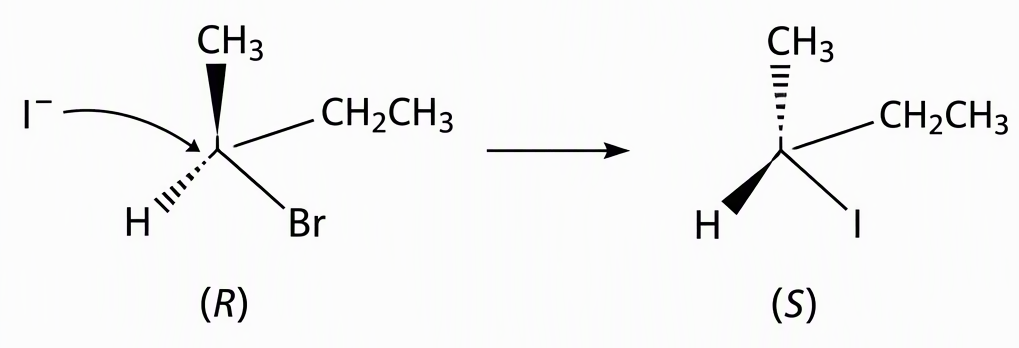
In the reactant, priority runs bromine, ethyl, methyl, hydrogen. In the product, it runs iodine, ethyl, methyl, hydrogen: ethyl outranks methyl at the next comparison, and hydrogen remains last.
Repair label: stereochemistry. Because the priority pattern is retained while geometry inverts, the descriptor changes from R to S. SN2 guarantees inversion of geometry, not an automatic R-to-S naming rule for every replacement.
Why does chloroethane allow ordinary SN2 but chlorobenzene does not?
Chloroethane has an accessible primary saturated carbon; chlorobenzene has chlorine attached directly to an aromatic carbon. The aryl carbon does not provide the ordinary backside-displacement pathway of an alkyl halide. Conjugation also gives the aryl carbon–chlorine bond partial double-bond character.
This does not mean chlorobenzene can never undergo nucleophilic substitution. Under suitable forcing conditions it can react through other pathways, not ordinary alkyl SN2 displacement.
Repair label: substrate classification. Inspect the carbon directly bonded to the leaving group before applying a mechanism rule. Matching leaving groups alone does not make two substrates equivalent.
What should I practise after this diagnostic?
Repair a wrong explanation before increasing difficulty; move to traceable PYQs when your reasoning is sound. If chapter questions are manageable but mixed-paper execution remains weak, use a full-length mock. Choose the next format by the error you need to test.
- Explanation wrong or guessed: Revise that concept and solve a fresh analogous question before mixed practice. Change the alkyl chain in the KCN problem and check whether you still count the nitrile carbon.
- Explanation sound: Attempt chapter-relevant Main PYQs, then authentic Advanced questions if that is your target. Keep the exam paper and question identity; “JEE-level” is not proof of origin.
- Chapter work sound, mixed-paper work weak: Take a full-length mock and manually review haloalkanes errors, including rushed reading and unsupported guesses.
Use official answer keys to establish the accepted answers. Check third-party worked solutions for mechanism and condition assumptions.
Keep an error log with the question source, mistaken reasoning, corrected principle and result on a later fresh question. A copied solution is not evidence of repair; solving the fresh question with a sound explanation is.
For the mixed-paper step, JEEnius includes free full-length tests: 75 questions, 300 marks, 180 minutes and a scored per-subject breakdown. After the paper, select one haloalkanes error, write the corrected principle and test it on a fresh question.
Next step: full-length mock tests on JEEnius and sit a full 75-question, 300-mark, 180-minute paper and get a scored per-subject breakdown (free tests included).
Read next: D- and f-block Elements JEE 2018: Hybridisation Matching.
Frequently asked questions
Should I practise haloalkanes drills, PYQs or mocks first?
Start with chapter drills if you cannot explain the product or mechanism. Move to authentic PYQs when your reasoning is sound, and use full-length mocks when pacing or question selection across subjects is the problem. Review guessed answers even when the option is correct.
Are these haloalkanes questions actual JEE PYQs?
No. These are five original, single-correct MCQs with worked solutions, not past JEE questions. Authentic PYQs need a traceable exam paper and question identity; a JEE-level label does not establish their source.
Why does 1-bromopropane react with KCN to give butanenitrile?
Under the stated SN2 conditions, cyanide attacks through carbon and displaces bromide. The nitrile carbon adds one carbon to the three-carbon propyl group, producing four-carbon butanenitrile rather than propanenitrile.
Does SN2 always change R configuration to S?
SN2 causes geometrical inversion at the reacting stereocentre, but it does not guarantee an R-to-S descriptor change for every replacement. Check the priority order in both reactant and product. For the specified single displacement of (R)-2-bromobutane by iodide, the priority pattern is retained and the product is (S)-2-iodobutane.