
Should I start with ellipse questions or a full mock?
Start with worked ellipse drills if you confuse axes, eccentricity or tangent conditions. For students searching “ellipse practice questions JEE”, this article provides six free original questions, answers and worked solutions. Attempt everything here without registration or leaving the page.
Choose authenticated previous-year questions, or PYQs, once the basics are secure. Choose full-length mocks when your difficulty is question selection, pacing or subject switching.
These are complementary stages, not competing products with one universal winner. Diagnose the chapter first, check repaired concepts against authentic exam questions, then test whole-paper execution.
How do worked ellipse drills compare with PYQs and full-length mocks?
Worked drills isolate conceptual gaps; authenticated PYQs show exam demands; mocks test whole-paper execution. Choose by the problem you need to fix, not the size of a question collection. A full paper cannot diagnose an ellipse skill it does not test.
Read each comparison in this order: this article’s original worked drills; authenticated ellipse PYQs; full-length mocks.
- Primary purpose: Targeted diagnosis; exam calibration; selection, pacing and subject switching.
- Prerequisite knowledge: Standard ellipse equation; secure basic concepts; enough syllabus coverage for a meaningful whole-paper attempt.
- Chapter focus: Six ellipse questions; selected, verified ellipse questions; mixed subjects, with no guaranteed number of ellipse questions.
- Solution feedback: Full worked solutions below; worked-solution availability depends on the source; feedback depends on the provider.
- Exam authenticity: Original instructional questions, not past exam questions; authentic only when exam, paper, year and wording can be verified; simulated exam conditions, not automatically a past paper.
- Main limitation: Cannot establish exam readiness alone; familiar solutions can disguise weak recall; a subject score cannot isolate every ellipse misconception.
Separate question authenticity from solution quality. A correct solution does not prove that its question appeared in an exam.
For the whole-paper stage, JEEnius includes free full-length tests with 75 questions, 300 marks, 180 minutes and a scored per-subject breakdown. That is a paper-level check, not a promise of ellipse coverage.
Which practice format should I choose for my mistakes?
Choose from the errors in your written work, not your class or attempt number. A Class 12 student may need an axis drill, while a Class 11 student with secure basics may benefit from PYQs.
- Class 11, axes confused: Use worked drills before a mixed bank if you identify the major axis incorrectly or write this incorrect relation:
- Class 12, standard forms secure: If an added line or focal condition stops you, attempt the extension drills below, repair the missing idea, then move to authenticated PYQs.
- Dropper, solutions look familiar: Attempt unseen questions closed-book. Redo failed questions from a blank page rather than rereading until the steps feel familiar.
- Accurate in isolation, weak across papers: Use full-length mocks. Examine the Mathematics score within the per-subject breakdown alongside your choices about attempts and time.
- Advanced aspirant: Treat the final two questions as readiness checks for extension work, not proof of Advanced readiness. Use authentic Advanced questions for exam calibration.
For parents, the useful measure is what the student can solve independently, not how many PDFs or platforms they have collected. Ask which step failed and whether the student can reproduce the corrected method without help.
Which free ellipse questions should I attempt before reading the solutions?
Attempt all six closed-book and mark each attempt independent, hint-assisted or not solved. These are original instructional questions, not PYQs. Six is an editorial choice for covering different skills, not a claim about exam frequency or expected weightage.
If you stop, record the last step you could justify. Keep your original working when checking solutions so you can locate the error rather than replace it with copied steps.
Question 1: Axes and foci
Find the major-axis length, minor-axis length, eccentricity and coordinates of the foci of:
Question 2: Tangent at a point
Find the tangent to the following ellipse at the specified point:
Question 3: Tangents with a given slope
Find both tangents of slope 1 to:
Question 4: Chord length
Find the length of the chord cut by the given line on the ellipse:
Question 5: Extension, midpoint locus
Find the locus of the midpoints of all non-degenerate chords of slope 2 in the following ellipse. Include the restriction on the locus, not just its equation.
Question 6: Extension, focal-distance product
A point varies over the following ellipse, whose foci are labelled below. Find the minimum and maximum of the product of its distances from the foci, and state where each occurs.
Stop here until you have recorded an attempt status for every question. This set has no score-to-rank conversion or readiness threshold.
What are the answers, and which errors do they reveal?
Use the key to check results and the worked steps to locate errors. Each solution names the skill to repair. Questions 5 and 6 are extensions, not authenticated Advanced-level questions.
- Question 1:
- Question 2:
- Question 3:
- Question 4:
- Question 5:
- Question 6:
How do I identify the axes and foci in Question 1?
The larger denominator lies under the horizontal coordinate, so the major axis is horizontal. The square roots of the denominators give semi-axis lengths, not full axis lengths.
The centre is the origin. The foci lie four units to either side along the horizontal axis.
Error label: axis identification. Answers of 5 and 3 give the semi-axis lengths, not the requested axis lengths.
How do I find the tangent at the point in Question 2?
Verify that the supplied point belongs to the ellipse, then use the point-tangent equation. Each squared coordinate becomes the product of the variable coordinate and the corresponding point coordinate.
Multiplying throughout by 75 gives:
Error label: point-tangent substitution. Keep the coordinate products over their corresponding denominators.
Why are there two tangents in Question 3?
Lines with the same slope can touch opposite sides of the ellipse. Write the line with an unknown intercept and require a repeated root in its intersection equation.
Substitution and multiplication by 225 give:
Tangency requires zero discriminant:
Error label: tangent condition. Intersecting the ellipse is not enough: the intersection root must be repeated.
How do I calculate the chord length in Question 4?
Find both intersection points, then use the distance formula. Neither one coordinate difference nor the distance from the centre is the full chord length.
The endpoints are:
Error label: chord distance. Use both coordinate differences.
Why does the midpoint locus in Question 5 need a restriction?
The locus is a straight-line segment strictly inside the ellipse. Its unrestricted line also contains points that cannot be midpoints of genuine chords.
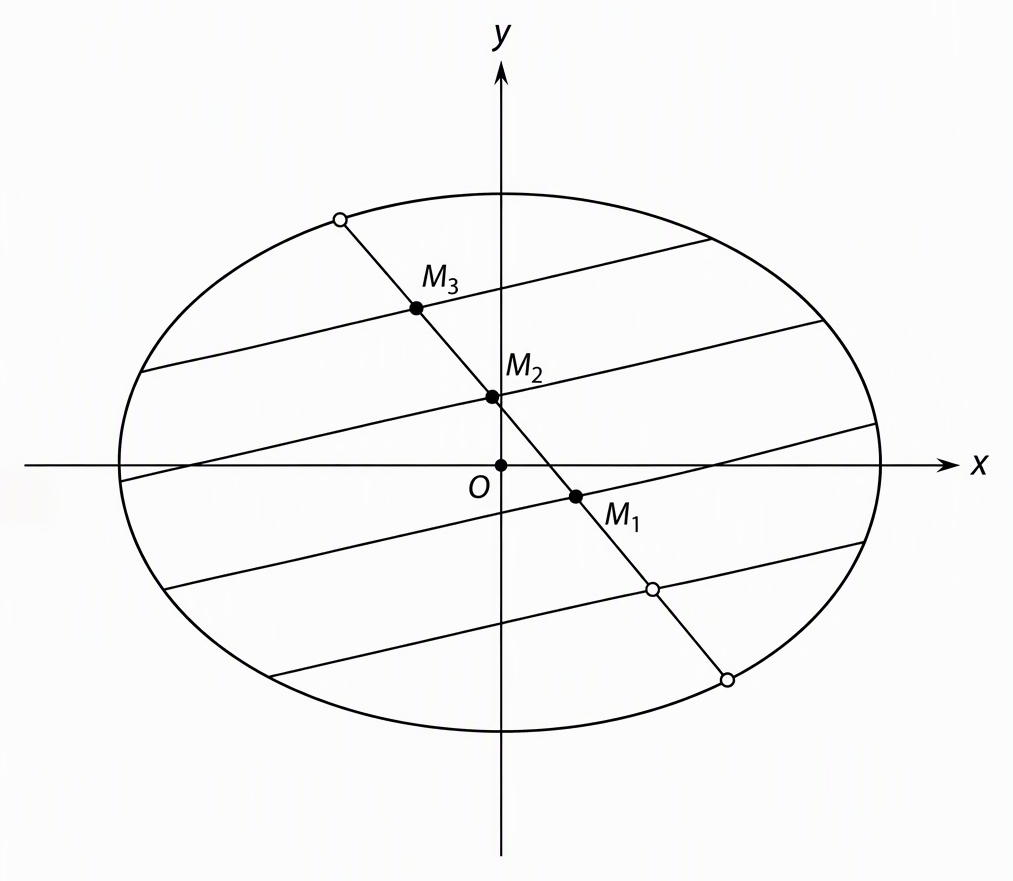
Represent points on a chord through its midpoint by:
Substitution gives:
The endpoint parameters must be equal and opposite. Their sum is zero, so the linear coefficient vanishes:
The positive quadratic coefficient gives two distinct opposite roots exactly when the constant term is negative:
Equality gives a repeated zero parameter: a limiting tangent point, not a non-degenerate chord. The strict interior restriction excludes these boundary points.
Error label: midpoint symmetry. Both the locus equation and its restriction are required.
How do focal distances give the extrema in Question 6?
Parameterise the ellipse to express both focal distances using a cosine. Their product then depends on its square, whose bounds give the extrema.
Both distance expressions are positive, so:
The minimum is 9 at the major-axis endpoints; the maximum is 25 at the minor-axis endpoints.
Error label: focal-distance interpretation. A constant sum of distances does not imply a constant product.
What should I practise next based on my actual mistakes?
Repair the failed principle, then attempt authenticated ellipse PYQs. Use your attempt labels to separate methods you can produce independently from those you recognise only after a hint.
- Axes or eccentricity failed: Reconstruct the major semi-axis, minor semi-axis and focal distance from the equation before attempting another variant.
- Tangents failed: Distinguish a tangent at a known point from tangents of a given slope. The first uses a verified point; the second needs a tangency condition.
- Extensions failed: Review midpoint symmetry and focal geometry. Direct formula substitutions alone do not address these gaps.
For PYQs, record the exam, year and paper or shift details. Check the wording against the source paper rather than trusting a PYQ label.
Use Coordinate Geometry JEE 2024: Tangent-Line Triangle as an optional related follow-up, not a verified ellipse question. For Advanced calibration, use authentic Advanced papers and their own marking instructions, since question types and marking vary by year.
Once independent chapter work is secure, a free JEEnius full-length mock can check whether the repaired skill survives whole-paper conditions. Its verified feedback is per-subject, not an ellipse-specific diagnosis.
Finish every repair with this error-log routine:
- Record the exact failed step.
- Write the corrected principle in one sentence.
- Redo the question from a blank page without looking at the solution.
Next step: full-length mock tests on JEEnius and sit a full 75-question, 300-mark, 180-minute paper and get a scored per-subject breakdown (free tests included).
Frequently asked questions
Are these ellipse questions JEE previous-year questions?
No. These are six original instructional questions with answers and worked solutions, not authenticated PYQs. For exam calibration, use questions whose exam, year, paper or shift, and wording can be verified against the source paper.
Should I practise ellipse questions or take a full mock?
Start with worked ellipse drills if you confuse axes, eccentricity or tangent conditions. Move to authenticated PYQs once those basics are secure. Use full-length mocks when your main difficulty is question selection, pacing or switching between subjects.
How do I find tangents to an ellipse with a given slope?
Write the line as y = mx + d, using the given slope m and an unknown intercept d. Substitute it into the ellipse equation and set the resulting quadratic's discriminant to zero. For x²/25 + y²/9 = 1 with slope 1, the two tangents are y = x ± √34.
Why does an ellipse chord midpoint locus need a restriction?
The locus equation alone can include points that are not midpoints of non-degenerate chords. For chords of slope 2 in x²/25 + y²/9 = 1, the midpoint (h, k) satisfies 9h + 50k = 0 and h²/25 + k²/9 < 1. The strict inequality excludes boundary points where the chord degenerates to a tangent point.