
Should I start with a diagnostic or another electrochemistry PDF?
Start with a diagnostic, unless you already solve unfamiliar chapter questions independently. These free electrochemistry practice questions for JEE include six original questions with worked solutions.
Use concept drills to locate formula and unit errors, authenticated previous-year questions (PYQs) to test exam application, and full-length mocks to test whole-paper performance. Independent solvers should go straight to PYQs. No single route is best for every stage.
How do concept drills, PYQs and full-length mocks compare?
Choose by the mistake you need to expose, not by the number of questions offered. This page’s diagnostic isolates foundation errors, authenticated JEE electrochemistry PYQs test actual exam tasks, and free full-length mocks test execution across subjects.
- Purpose
- Original diagnostic: Find errors in formulas, signs and units.
- Authenticated PYQs: Apply knowledge to actual exam tasks.
- Free full-length mocks: Test selection, pacing and performance across subjects.
- Prerequisites
- Diagnostic: Redox balancing, concentration terms and chapter formulas.
- PYQs: Independent setup of standard chapter problems.
- Mocks: Enough preparation across subjects for meaningful paper-level practice.
- Chapter focus
- Diagnostic: Six isolated electrochemistry skills.
- PYQs: Chapter-focused when selected by topic.
- Mocks: Whole-paper practice, with no guarantee of comprehensive electrochemistry coverage.
- Solution review
- Diagnostic: Inspect every setup and unit.
- PYQs: Compare reasoning against a reliable solution and official key where available.
- Mocks: Review skipped questions and time use alongside chemistry errors.
- Main versus Advanced
- Diagnostic: Foundations for both, not an Advanced-readiness test.
- PYQs: Choose authenticated questions from the target exam.
- Mocks: Match the format to the target exam.
- Main limitation
- Diagnostic: Original drills do not establish historical exam difficulty.
- PYQs: Familiar answers can exaggerate readiness.
- Mocks: Paper-level results can hide specific chapter gaps.
The diagnostic is free original material, not PYQs. JEEnius full-length mocks include free tests offering a 75-question, 300-mark, 180-minute paper with a scored per-subject breakdown. This does not imply a free chapter-wise electrochemistry bank or that every mock contains electrochemistry.
Which route should Class 11, Class 12 students and droppers choose?
Choose by what you can set up independently, not by your class label. Formula and unit errors call for drills; independent chapter solving calls for PYQs; weak whole-paper execution calls for mocks.
- Class 11 or an early learner: Start concept drills after learning redox balancing, concentration terms and the relevant electrochemistry formulas. If these prerequisites are missing, repair them first.
- Class 12 with formula confusion: Use the diagnostic if reaction quotient, electron count or conductivity units still cause errors. Repair the exact mistake before mixed PYQs.
- An independent standard-exercise solver: Choose unseen or not-recently-attempted PYQs. Keep solutions closed until you have made a complete attempt.
- A dropper who remembers answers: Use fresh original questions to test whether the method transfers. Recognition is not independent solving.
- A strong chapter solver with weak complete papers: Choose full-length mocks. Review question selection and time spent, not just incorrect chemistry answers.
- An Advanced aspirant: Treat this diagnostic as a foundation check, then attempt authenticated Advanced questions. Advanced has no fixed question-type or marking pattern.
Can I try six free electrochemistry practice questions for JEE now?
Attempt these before reading the solutions, and write the setup rather than only the answer. This set is a foundation diagnostic, not complete chapter coverage or an Advanced-readiness test. Every question is original practice, not an official JEE question or a verified question-bank item.
All numerical inputs below are supplied problem assumptions, not exam statistics. Questions 1 and 5 are single-correct MCQs; the others require numerical answers.
Question 1: Original practice, Nernst equation, single-correct MCQ
For the reaction as written, calculate the cell potential. Approximate activities using the supplied concentration ratios relative to the standard concentration.
Use the supplied base-10 Nernst coefficient:
Question 2: Original practice, thermodynamics, numerical answer
Calculate the standard Gibbs energy change for the reaction as written. Report the answer in kilojoules per mole of reaction.
Question 3: Original practice, conductivity, numerical answer
A conductivity cell has the following resistance and cell constant. Find its conductivity in siemens per centimetre.
Question 4: Original practice, molar conductivity, numerical answer
Find the molar conductivity from these independently supplied values. Do not carry your Question 3 answer into this question.
Report the result in:
Question 5: Original practice, Kohlrausch’s law, single-correct MCQ
Select the limiting molar conductivity of calcium chloride. Each ionic symbol below represents the limiting ionic molar conductivity of the named ion.
Question 6: Original practice, electrolysis, numerical answer
Calculate the deposited silver mass in grams. Assume 100% current efficiency, so all the supplied charge goes into the stated reduction.
How do I solve the six questions and spot the wrong setups?
Check the reaction, governing relation and units before checking the final number. If your answer differs, locate the first incorrect step rather than copying the final calculation.
Question 1: Correct option B
Zinc is oxidised and copper ions are reduced, transferring two electrons. Pure solids are omitted from the reaction quotient.
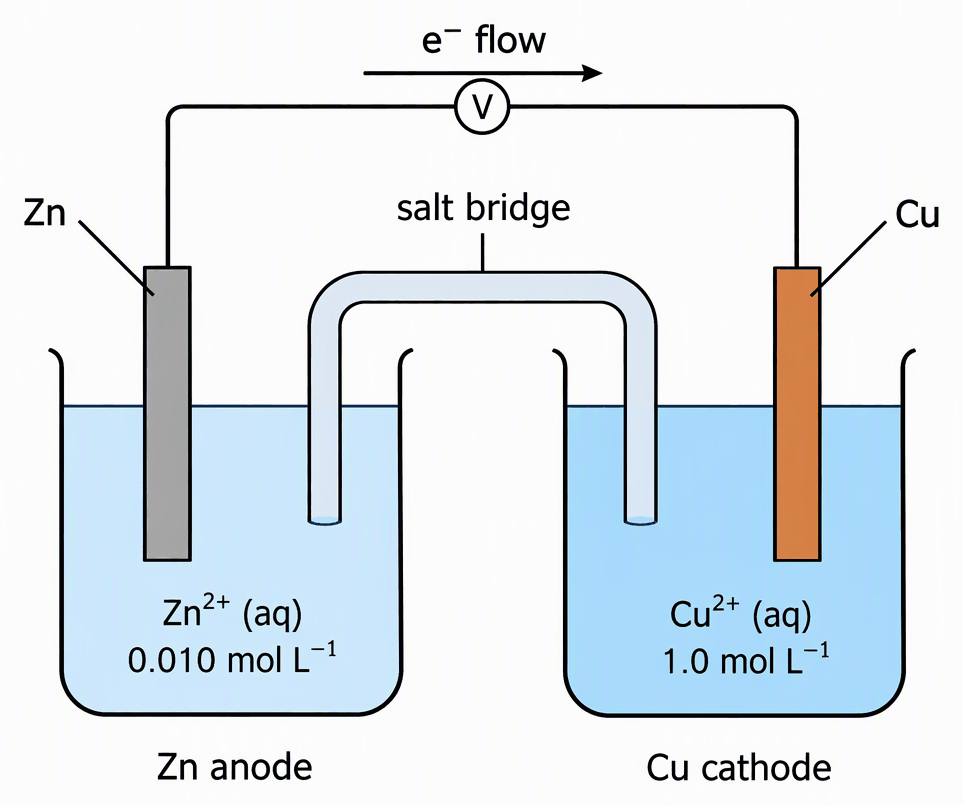
The quotient is below unity, so its logarithm is negative. Subtracting that negative correction raises the potential for the reaction as written.
Option A reverses the correction, often through an inverted quotient. Option C uses one electron instead of two; option D ignores concentration dependence.
Question 2: Negative 96.5 kilojoules per mole
A positive standard cell potential corresponds to a negative standard Gibbs energy change for the forward reaction. The electron count belongs to the reaction as written.
Check the negative sign separately from the joule-to-kilojoule conversion. A wrong sign is a thermodynamics error, not a unit error.
Question 3: Conductivity
Resistance opposes current; conductance is its reciprocal. Conductivity accounts for the cell’s geometry through the cell constant, so it is not another name for conductance.
The numerical values happen to match here because of the supplied cell constant. Their units and meanings remain different.
Question 4: Molar conductivity
The conversion factor below applies when conductivity is in siemens per centimetre and concentration is in moles per litre. It converts the concentration convention to match centimetre-based units.
Do not attach this factor automatically to a calculation using SI units. Write the unit convention first.
Question 5: Correct option C
One formula unit produces one calcium ion and two chloride ions. Kohlrausch’s law therefore gives:
Option A loses the second chloride ion. Option B assigns the coefficient to the wrong ion; option D incorrectly doubles the calcium contribution. The coefficients come from dissociation stoichiometry, not from multiplying each ionic contribution by its charge again.
Question 6: Deposited mass
Each silver ion accepts one electron, so use an electron count of one. Charge first determines the amount of electrons, then the amount and mass of silver.
Here the charge symbol represents coulombs passed through the cell. In Question 1, the same letter denotes a dimensionless reaction quotient. They are not interchangeable.
What should I practise next after checking my errors?
Choose your next session by the failed step, not your total score. This is faculty advice, not a validated scoring system. Six foundation questions cannot predict marks, percentile or rank, and a guessed answer or a solution read beforehand leaves that skill unverified.
- Question 1 error: Revisit reaction direction, quotient construction, electron count and logarithms. Predict whether the potential should rise or fall before calculating.
- Question 2 error: Repair the link between cell potential and reaction thermodynamics. Check sign and energy units separately.
- Questions 3–4 errors: Use a unit-first conductivity drill. Distinguish resistance, conductance, conductivity and molar conductivity before substitution.
- Question 5 error: Write the dissociation equation before adding ionic contributions.
- Question 6 error: Balance the half-reaction, convert charge to moles of electrons, then convert to deposited mass.
After correcting the method, solve a fresh variant without the solution visible. Move to mixed authenticated PYQs when you can write the setup independently, rather than after reaching an invented score threshold.
Build a broader checklist covering cell notation, concentration dependence, equilibrium relationships, batteries, fuel cells and corrosion. Align exam-specific inclusion with the applicable official syllabus: use jeemain.nta.nic.in for Main and the official JEE Advanced website for Advanced.
What should I check before downloading a PDF or taking a mock?
Check provenance and solution access before spending time on a resource. A PDF labelled as electrochemistry practice questions for JEE is not evidence that its contents are authentic PYQs. Free questions without usable solutions can leave errors uncorrected.
- Trace the source. Claimed PYQs should identify the exam, year and paper or shift. Official wording must be distinguished from adapted or memory-based questions.
- Inspect one worked solution. It should explain reaction direction, units and assumptions, not merely provide an option letter.
- Check what “free” includes. Confirm that solutions are accessible, rather than only question previews.
- Match the resource to the task. A chapter drill cannot test whole-paper pacing, and a whole-paper subject breakdown is not a chapter-level electrochemistry diagnosis.
Once paper-level execution is the problem, JEEnius full-length mocks include free tests with a 75-question, 300-mark, 180-minute paper and a scored per-subject breakdown. Use one for complete-paper practice, then review question selection alongside chemistry mistakes. If the diagnostic exposed a setup error, solve a fresh variant of that question first.
Next step: full-length mock tests on JEEnius and sit a full 75-question, 300-mark, 180-minute paper and get a scored per-subject breakdown (free tests included).
If that step was the hard part, work through Quadratic Equations JEE 2024: Checking a Flawed Solution.
Frequently asked questions
Should I solve electrochemistry PYQs or concept questions first?
Start with concept drills if you still make formula, sign or unit errors. If you can set up unfamiliar standard chapter problems independently, move to authenticated PYQs. Use full-length mocks when question selection and whole-paper pacing are the main problems.
Are these electrochemistry questions official JEE PYQs?
No. All six questions are original foundation drills with worked solutions, not official JEE questions or verified question-bank items. For claimed PYQs, check the exam, year and paper or shift, and distinguish official wording from adapted or memory-based questions.
Are six electrochemistry questions enough for JEE Advanced?
No. This diagnostic checks six foundation skills; it neither covers the complete chapter nor establishes Advanced readiness. After repairing setup errors, attempt authenticated JEE Advanced questions and check your broader coverage against the applicable official syllabus.
How do I avoid unit errors in molar conductivity questions?
Write the conductivity and concentration units before substituting values. Use molar conductivity = 1000 × conductivity ÷ concentration when conductivity is in S/cm and concentration is in mol/L; the result is in S cm²/mol. Do not automatically use the factor of 1000 with SI units.