
Should I start with chapter drills, PYQs or full mocks?
Start with differential equations practice questions for JEE that isolate method selection if you cannot reliably distinguish separable, homogeneous and linear equations. Move to previous-year questions (PYQs) once you can choose and execute a method unaided. Use full mocks when chapter questions are manageable but question selection and whole-paper performance remain weak.
Below are five original questions you can attempt free, with worked solutions and no registration prompt. They are original practice, not PYQs or predictions of the next paper.
How do chapter drills, JEE PYQs and full mocks compare?
Drills isolate a skill, PYQs preserve exam wording, and mocks test decisions across a paper. Choose by the weakness you need to expose, not by how many questions a resource claims to contain.
- Main skill tested
- Original chapter drills: Recognising structure and executing a method.
- Previous-year JEE questions: Applying methods to actual exam wording.
- Full-length mocks: Selection, pacing and performance across subjects.
- Usefulness for learning methods
- Original chapter drills: Best for focused repetition.
- Previous-year JEE questions: Better after basic methods are secure.
- Full-length mocks: Poor as a first lesson in the chapter.
- Authenticity of exam wording
- Original chapter drills: Author-created, not historical exam evidence.
- Previous-year JEE questions: Authentic when checked against the original paper.
- Full-length mocks: Simulated wording, not an actual past paper.
- Isolation of chapter weaknesses
- Original chapter drills: Direct and focused.
- Previous-year JEE questions: Focused when filtered by chapter.
- Full-length mocks: Cannot guarantee meaningful differential equations coverage.
- Whole-paper decision practice
- Original chapter drills: Absent.
- Previous-year JEE questions: Absent in chapter-filtered collections.
- Full-length mocks: The main benefit.
- Solution quality to check
- Original chapter drills: Method cue and complete reasoning.
- Previous-year JEE questions: Verified answer plus a worked explanation.
- Full-length mocks: Reasoning for relevant questions, not just scores.
Labelled drills help beginners, but “linear equations practice” gives away the first decision. A chapter-filtered PYQ collection removes the task of finding that question within a paper. An official answer key checks the answer; a worked solution explains the method.
Which practice format fits my current mistake?
Choose by what breaks in your solution, not by your school year. Separate missing prerequisites, needing a method hint, execution errors and difficulty under whole-paper conditions.
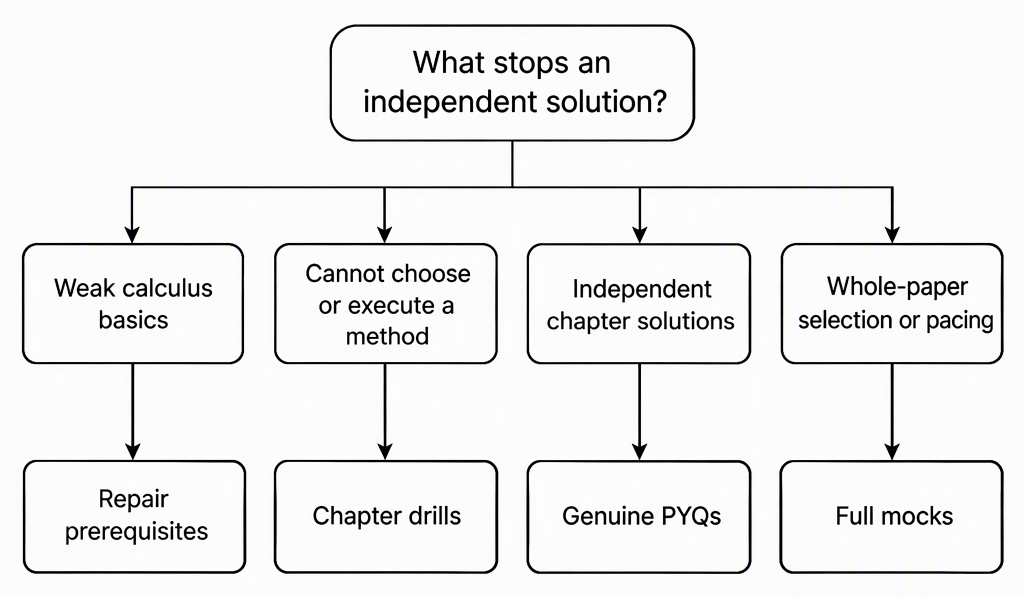
- Class 11, studying ahead: If differentiation and integration are not comfortable yet, repair those prerequisites first. Timed differential equations practice mixes calculus gaps with method-selection errors, making them harder to separate.
- Class 12, needing the solution’s first line: Use unlabelled drills. Write your intended method and the feature that supports it before doing any algebra.
- Independent with textbook-style questions: Move to genuine Main PYQs. Inspect initial conditions, equivalent answer forms and domain restrictions rather than checking only the final expression.
- Dropper who remembers PYQ answers: Choose unfamiliar original questions. Recalling a result is not evidence that you can reconstruct the method.
- Comfortable with the chapter, weak across Mathematics or the whole paper: Use full mocks. Review which questions you selected, postponed or abandoned, alongside calculation errors.
- Advanced aspirant: Practise Advanced PYQs separately and read each paper’s instructions. Success on this short diagnostic is not proof of Advanced readiness.
If a method label supplies the first step you cannot find yourself, choose unlabelled drills before harder questions. The immediate task is independent recognition, not longer algebra.
Can I solve these five free questions without a hint?
Attempt all five before reading any solution, and record the reason for your first step. This is a foundation diagnostic, not a representative Main paper, an Advanced-level test or evidence of chapter weightage. It checks definitions, method selection, initial conditions and solutions that careless division can lose.
Q1. Find the order and degree of this equation.
Q2. Solve the initial-value problem.
Q3. Solve for the stated domain and initial condition.
Q4. Find the solution satisfying the given condition.
Q5. Find the solution satisfying the given condition.
Before continuing, mark any question where you needed help choosing the first step. Keep that separate from a question where your method was sound but the calculation failed.
What are the worked solutions and what does each question diagnose?
The key decisions are to identify the highest derivative, separate variables, recognise overlapping methods, use an integrating factor and check constant solutions before dividing. Compare these decisions with your own first lines. A matching final answer is not enough if your working omitted a condition or relied on recall.
Q1 solution
The cue is that the equation is already polynomial in its derivatives. The highest derivative present is the second derivative, and its power is two.
The cubic first-derivative term does not determine the degree. Degree is the power of the highest-order derivative, not the largest power anywhere in the equation.
Diagnoses: Confusing derivative order with polynomial power.
Q2 solution
The right-hand side is a product of a function of the independent variable and a function of the dependent variable. That is the separation cue; the denominator below is positive for every real value of the dependent variable.
Integrating gives:
The initial condition makes the integration constant zero:
This is the maximal interval containing zero on which the solution remains finite. Do not extend the initial-value solution across a tangent pole.
Diagnoses: Missing separation, forgetting the inverse-tangent integral, or ignoring the solution’s interval.
Q3 solution
The right-hand side depends only on the ratio of the dependent variable to the independent variable. Use the homogeneous-equation substitution:
Substituting and simplifying gives:
Since the domain is positive:
Applying the initial condition gives:
A linear-equation approach is equally valid: move the ratio term to the left and use the reciprocal of the independent variable as the integrating factor. Do not reject a correct method because the displayed solution uses another.
Diagnoses: Rigid method recognition or incorrect differentiation of a product.
Q4 solution
The dependent variable and its first derivative appear linearly. The integrating factor is:
Multiply the whole equation by it:
Integrating and rearranging gives:
The initial condition gives:
Hence, with the initial condition verified:
Diagnoses: An incorrect integrating factor, incomplete multiplication, integration error or mishandled initial condition.
Q5 solution
The factorised right-hand side tells you to check constant solutions before dividing. Both of these make the derivative and the right-hand side zero:
Only the first satisfies the given initial condition:
Dividing by the product on the right would discard both equilibrium solutions. The smooth polynomial right-hand side ensures uniqueness through the initial point, so a nonconstant solution cannot also satisfy this initial condition.
Diagnoses: Losing valid solutions through division and applying a memorised general formula without checking its exclusions.
What should I practise after checking my mistakes?
Choose your next session by the error, not by a total out of five. A recognition failure needs different practice from an integration slip. Performance on these questions does not justify a predicted percentile, marks gain or chapter-completion claim.
- Q1 went wrong: Revisit order and degree definitions before adding more integration-heavy questions. Identify the highest-order derivative first, then inspect its power.
- Q2 or Q3 needed a hint: Practise identifying equation structure before solving. Write a method and its cue, while allowing more than one valid method for the same equation.
- Q4 went wrong: Locate the exact failure: integrating factor, integration or initial-condition substitution. Repeat that step rather than copying the entire solution.
- Q5 went wrong: Whenever you divide by an expression involving the dependent variable, check whether setting that expression to zero gives a valid solution.
Use a compact error log with these four fields for each question:
- Recognition error: What structure did I miss?
- Algebra or integration error: Which step first became incorrect?
- Condition or domain error: What restriction or substitution did I overlook?
- Successful independent reattempt: Could I reproduce and justify the method unaided?
Remembering the displayed answer on a reattempt is insufficient. Reproduce the reasoning, then solve a fresh variation with a changed coefficient or initial condition and check it in that variation’s equation.
How should I move from these questions to PYQs and mocks?
Use PYQs to check exam wording after repairing the errors above, then use full mocks to check exam transfer. Keep original practice and historical exam questions labelled separately. Neither is evidence about what the next paper will contain.
For a question labelled as a PYQ, check its stated exam, year and paper or shift against the original paper where available. Attempt it without method labels, inspect the answer key after solving, and use a worked explanation to resolve reasoning errors rather than copy a result.
Do not pool Main and Advanced PYQs as though they share one fixed format. Advanced has two compulsory three-hour papers, with question types and marking schemes that vary. Read each paper’s instructions rather than applying a Main mock’s format to it.
For whole-paper practice, JEEnius full-length mock tests include free tests: a 75-question, 300-mark, 180-minute paper with a scored per-subject breakdown. This recommendation is for whole-paper practice only.
A Mathematics subject score alone cannot diagnose differential equations. Review any relevant questions actually present in the mock, including whether you selected them sensibly and where your reasoning failed.
Your next action: attempt the on-page set without solutions, classify the errors, and select the next practice format from the comparison.
Next step: full-length mock tests on JEEnius and sit a full 75-question, 300-mark, 180-minute paper and get a scored per-subject breakdown (free tests included).
If that step was the hard part, work through Conic Sections JEE 2024: Focus, Area and Missing Data.
Frequently asked questions
Should I start differential equations practice with chapter drills or JEE PYQs?
Start with unlabelled chapter drills if you cannot independently recognise and solve separable, homogeneous and linear equations. Move to genuine JEE Main PYQs once you can choose and execute a method unaided. Use full mocks when chapter questions are manageable but whole-paper selection and pacing remain weak.
Are these differential equations questions actual JEE PYQs?
No. These are five original foundation questions with worked solutions, not historical JEE questions or predictions. They diagnose specific errors but do not establish Main or Advanced readiness.
How do I choose the method for a differential equation?
Look for the equation's structure before starting algebra: a separable product, dependence on y/x, or a first-order linear form. Write down the intended method and the feature that supports it. Some equations permit more than one valid method, so do not reject a correct approach just because a worked solution uses another.
Can dividing a differential equation by y lose a solution?
Yes: dividing by y excludes y = 0, which may be a valid constant solution. Before dividing by any expression involving y, check whether its zeros satisfy the original equation. For dy/dx = y(1-y), both y = 0 and y = 1 are constant solutions, and the condition y(0) = 0 selects y = 0.