
Which determinants practice questions should I choose for JEE?
Choose property-focused determinants practice questions for JEE if you expand every determinant or repeatedly lose signs. Choose chapterwise previous-year questions (PYQs) when your basics are secure, and full-length mocks when you struggle to apply those skills in a mixed paper.
These routes serve different purposes; none is universally best. Below is an original, free diagnostic mini-set with worked solutions, not a collection of actual JEE PYQs.
How do free drills, chapterwise PYQs and full-length mocks compare?
Drills repair methods, PYQs test you on authentic exam questions, and mocks test decisions across subjects. A correct answer in an isolated drill does not establish exam readiness. A mock score alone does not identify which determinant property needs repair.
- Purpose
- Original property-focused drills: Isolate row-operation, factorisation and sign errors.
- Chapterwise JEE PYQs: Apply your methods to authentic exam questions.
- Full-length mocks: Test question selection and performance across subjects.
- Prerequisite knowledge
- Drills: The basic determinant formula is enough to begin.
- PYQs: Understand determinant properties and solve fresh examples independently.
- Mocks: Prepare across the subjects being tested, not just determinants.
- Feedback needed
- Drills: Why each operation is valid and how it affects the determinant.
- PYQs: A worked method, a reliable answer and verified paper identification.
- Mocks: A scored breakdown plus your review of attempted, skipped and mishandled questions.
- Exam relevance
- Drills: Strong for repairing a selected skill, weak as evidence of exam performance.
- PYQs: Authentic questions from the named exam. Keep Main and Advanced questions identified separately.
- Mocks: Practice applying knowledge under mixed-paper conditions.
- Main limitation
- Drills: The intended method may already be obvious.
- PYQs: Remembering a previously seen answer is not independent solving.
- Mocks: Inefficient as the sole method for repairing one chapter.
- When to move on
- Drills: When you can choose and explain the opening operation on fresh variations.
- PYQs: When your next concern is applying the skill inside a mixed paper.
- Mocks: Return to targeted practice when review exposes a specific gap.
Free access, a downloadable PDF, an answer key and a worked solution are separate features. Do not assume a source offers all four. An answer key checks the result; a useful solution explains the method.
For the later mixed-paper stage, JEEnius documents full-length mocks, including free tests: 75 questions, 300 marks, 180 minutes and a scored per-subject breakdown. This is the JEE Main Paper 1 format, not a determinants-only bank or an Advanced format.
Which route matches the mistakes I am making?
Choose from your written work, not your class or repeat-year status. Check whether you recognise structure, apply row rules correctly and reproduce the method without help.
- Learning the chapter for the first time in Class 11 or Class 12: Begin with drills until row swaps, row scaling and row replacement have distinct meanings. A swap reverses the sign; scaling one row scales the determinant; adding a multiple of another row leaves it unchanged.
- Getting correct answers through long expansions: Choose property-first exercises. Compare your opening move with the solution before comparing the final answer.
- Solving fresh drills independently: Move to chapterwise Main PYQs, then Advanced PYQs if Advanced is your target. This is a practice sequence, not a claim that every Advanced question is harder than every Main question.
- Dropping a year and recognising most PYQs: Use familiar questions to review methods, not as evidence of fresh-solving readiness. Check that with unseen variations.
- Solving determinants alone but skipping or mishandling them in mixed papers: Use full-length mocks. Review whether the failure was recognition, calculation or question selection.
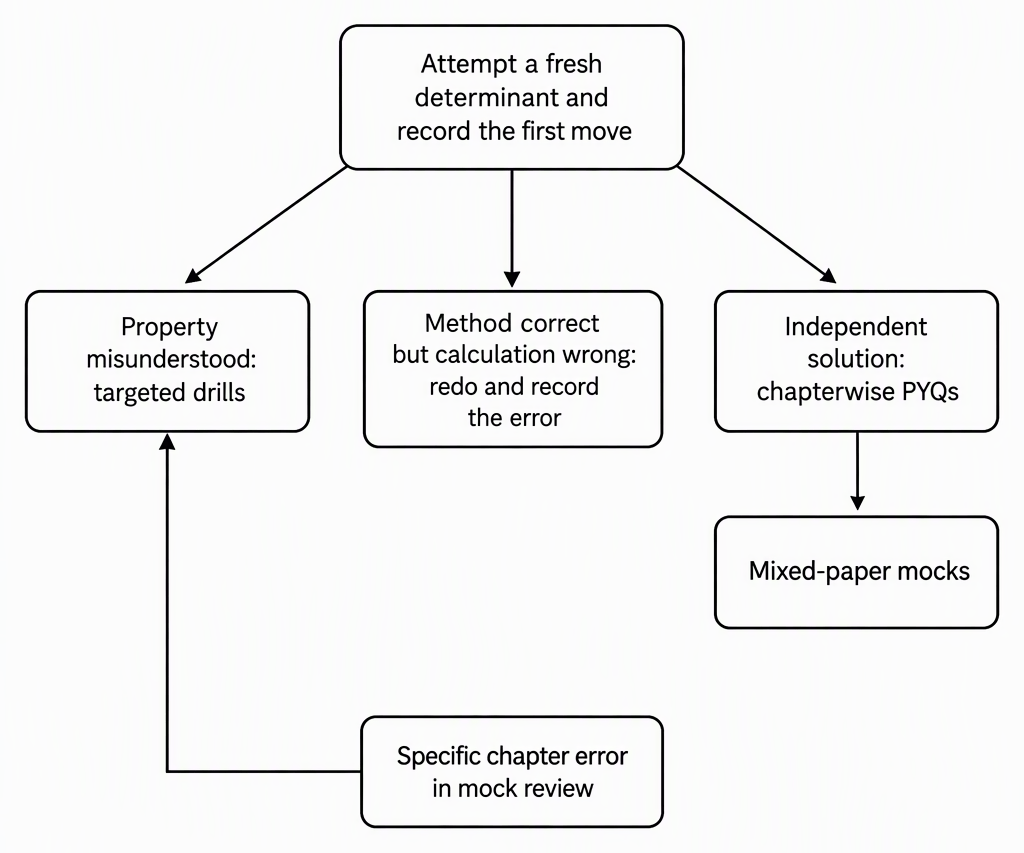
Use error patterns, not an arbitrary accuracy threshold or daily quota. Move on when fresh work shows that you have corrected the relevant error, not merely finished a PDF.
Can I try free determinants questions before opening another PDF?
Attempt these five questions before reading the solutions, and record your first intended operation beside each answer. That note separates structural recognition from a lucky result or a long expansion. For the consistency question, record any relation you notice between the equations.
Every exercise below is an original diagnostic question, not a JEE PYQ or an official difficulty classification. Keep your working, including abandoned steps, for review.
Question 1: Original diagnostic question
Evaluate the determinant.
Question 2: Original diagnostic question
A three-by-three matrix has the following determinant and original rows.
Find the determinant of the matrix whose rows are defined below.
Question 3: Original diagnostic question
Solve for the real parameter.
Question 4: Original diagnostic question
Determine exactly when the determinant vanishes for real entries.
Question 5: Original diagnostic question
Determine the parameter values for which the system is consistent. State whether the solution is unique.
How do I solve these determinants without unnecessary expansion?
Look for dependence first, then row operations and factors. Expansion is valid, but it should not be your automatic opening move. Compare your result and first operation with the solutions below without replacing your original working.
Why is the first determinant zero?
The second row is twice the first, so the determinant is zero. Proportional rows are dependent; expansion adds work without adding information.
Expansion along the first row provides an independent check:
Diagnosis: missed dependence. If you expanded immediately, practise fresh drills on equal, proportional and linearly dependent rows before moving to PYQs.
Which row operation changes the second answer?
The answer is 6: row replacement preserves the determinant, while doubling one row doubles it. Apply the replacement first, then scale the first row.
Linearity gives a separate check before scaling:
Diagnosis: confused row rules. Practise replacement, swapping and scaling as separate drills until you can state each effect before calculating.
How do properties factor the third determinant?
The real solutions are 1 and negative 2. Subtract the first row from each of the other rows to expose a repeated factor. A column operation then makes the remaining determinant triangular; no eigenvalue knowledge is needed.
Factoring from the last two rows gives:
Now add the other columns to the first:
These steps factor rather than divide, so the repeated root is not lost. Direct expansion gives the same polynomial:
Diagnosis: unnecessary expansion. Choose property-first drills if your method created a cubic before noticing the repeated structure.
When is the determinant in Question 4 zero?
Either the three entries sum to zero, or all three are equal. Both conditions must be included. Expansion is reasonable here because it produces a standard factorisation, but stopping after the first factor misses an entire family of solutions.
Expanding along the first row:
For real entries:
A sum of real squares is zero exactly when every square is zero. Therefore:
As a check, the first condition makes every row sum zero, so the columns are dependent. The second makes the rows identical.
Diagnosis: incomplete factor conditions. Practise fresh factorisation questions that require every real zero case, not just one convenient factor.
Does a zero coefficient determinant mean no solution?
No. This system is consistent only when the parameter equals 3, and then it has infinitely many solutions. A zero coefficient determinant rules out a unique solution, not every solution. Check whether the right-hand sides obey the dependence between the left-hand sides.
The third left-hand side is the sum of the first two:
Consistency therefore requires:
Subtracting the first equation from the second gives:
Taking the third variable as a free real parameter yields:
Substitution checks all three equations:
Diagnosis: confused singularity and inconsistency. Choose drills on dependent equations with both matching and mismatching right-hand sides.
What should I do in my next determinants practice session?
Choose one route from the error you made, then check for that error on a fresh question. This mini-set diagnoses selected skills; it is not comprehensive chapter coverage or proof of JEE readiness.
- A property was misunderstood: Practise fresh variations of that property before returning to mixed questions. Explain why each operation is allowed.
- The method was sound but arithmetic failed: Redo the question without looking. Write the exact error, such as a reversed cofactor sign or an incorrectly extracted factor.
- The set was independently comfortable: Move to chapterwise PYQs. Verify claimed year, paper and shift against the original paper, and use the official answer key where available.
- Isolated questions are comfortable but mixed papers are not: Review recognition, calculation and selection separately. A skipped question needs a different repair from a wrong calculation.
Keep an error log with question reference, first attempted move, missed structure and corrected method. Use those entries to decide what the next exercise must test.
Once targeted practice has repaired the gap, use a JEEnius free full-length mock as the later mixed-paper check, not as a substitute for determinants drills. Afterward, choose the next exercise from a recorded failure, not from another PDF collection.
Next step: full-length mock tests on JEEnius and sit a full 75-question, 300-mark, 180-minute paper and get a scored per-subject breakdown (free tests included).
If that step was the hard part, work through Geometry of Rectangles JEE 2024: Why the Answer Is 72.
Frequently asked questions
Which determinants practice questions should I solve for JEE?
Start with property-focused drills if you confuse row operations, lose signs or expand every determinant. Move to chapterwise PYQs when you can solve fresh examples independently. Use full-length mocks when isolated questions are comfortable but mixed-paper performance is not.
Are these determinants questions actual JEE PYQs?
No. These are five original diagnostic questions with worked solutions, not actual JEE PYQs or officially classified difficulty levels. They test selected skills and do not provide comprehensive chapter coverage.
How do I solve determinants without expanding every time?
Check for equal, proportional or dependent rows first. Then look for row or column operations that expose factors or create a triangular determinant. Expansion remains valid, but it should not be your automatic first move.
Does a zero coefficient determinant mean no solution?
No: a zero coefficient determinant rules out a unique solution, not every solution. Check whether the right-hand sides satisfy the same dependence as the left-hand sides. In the article's system, consistency requires k = 3, which gives infinitely many solutions; other values give no solution.