
Should I start with chapter questions, PYQs or full mocks?
Start with concept drills if your circuit setup is unreliable, verified PYQs if you can solve independently, and full mocks if mixed-paper execution is the problem. These free Current Electricity practice questions for JEE include an original set with worked solutions below.
No single format replaces the other two. Chapter questions expose weak reasoning, previous-year questions test it against authentic exam demands, and full mocks test selection and concentration across subjects.
The set below is original practice, not official JEE questions. Use your first incorrect step to choose your next practice format.
How do concept drills, verified PYQs and full mocks compare?
Drills expose circuit errors, PYQs test application against past exam demands, and mocks expose whole-paper execution problems. Choose by the weakness you need to diagnose, not the size of the collection.
- Best use
- Original chapter drills here: Repair circuit setup.
- Verified Main or Advanced PYQs: Test independent reasoning against past exam demands.
- Full-length Main mocks: Practise whole-paper execution.
- Chapter focus
- Drills: Narrow and deliberate.
- PYQs: Chapter-selected, sometimes combining ideas.
- Mocks: Physics, Chemistry and Mathematics together.
- Errors exposed
- Drills: Wrong nodes, assumptions and governing equations.
- PYQs: Misread conditions and difficulty applying familiar ideas.
- Mocks: Poor selection, rushed work and concentration loss.
- Exam authenticity
- Drills: Original, not official or difficulty-calibrated.
- PYQs: Authentic when the paper attribution is verified.
- Mocks: Simulated papers, not past exam papers.
- Solution requirements
- Drills: Explain the setup and misconception.
- PYQs: Check against the official key; check worked reasoning separately.
- Mocks: Review attempted, skipped and poorly selected questions.
- Principal limitation
- Drills: Cannot establish exam readiness.
- PYQs: Remembered solutions can inflate confidence.
- Mocks: Inefficient for repairing one chapter.
Main PYQs test application under Main’s instructions. Advanced PYQs test deeper circuit reasoning; do not treat both collections as one difficulty level.
For whole-paper practice, JEEnius includes free full-length tests with 75 questions, 300 marks, 180 minutes and a scored per-subject breakdown.
Which practice format fits my situation?
Choose drills when you need help setting up circuits, PYQs when routine solving is independent, and mocks when mixed papers expose the weakness. Class or attempt year alone does not decide the format.
- Class 11 student studying ahead or Class 12 first-time learner: Choose concept drills if identifying nodes, current directions or potential differences still needs help. Explain each connection before calculating.
- Class 12 student solving routine circuits independently: Choose verified Main PYQs. Test unfamiliar wording and combinations of familiar ideas without opening the solution.
- Advanced aspirant with secure basics: Move to verified Advanced PYQs for deeper reasoning. Read each paper’s question types and marking instructions rather than assuming a fixed scheme.
- Dropper who recognises most PYQs: Use unfamiliar original questions. Write the setup before calculating, because recognising an answer is not independent solving.
- Student accurate in chapter work but weak in mixed papers: Prioritise full mocks and paper review. More isolated questions may miss the real problem.
For parents, choosing simpler questions to repair a specific weakness is not lowering the target. It is fixing the step that harder problems depend on.
Can I try free Current Electricity questions before seeing the answers?
Attempt these five original questions before reading the solutions. This is a focused diagnostic, not complete chapter coverage or an official difficulty-calibrated Main or Advanced paper. Record your circuit setup, governing equation and answer.
Assume ideal connecting wires and steady direct current. All stated resistances are positive. The first four questions are single-correct MCQs; the fifth is open response.
1. What changes when a wire is stretched?
A uniform wire is stretched to the stated multiple of its original length. Volume and resistivity remain unchanged. Find its new resistance.
2. What does loading do to a potential divider?
An ideal source feeds one resistor from its positive terminal to node A. Two separate resistors connect A to the source’s negative terminal, taken as zero potential. All three resistors have the same resistance.
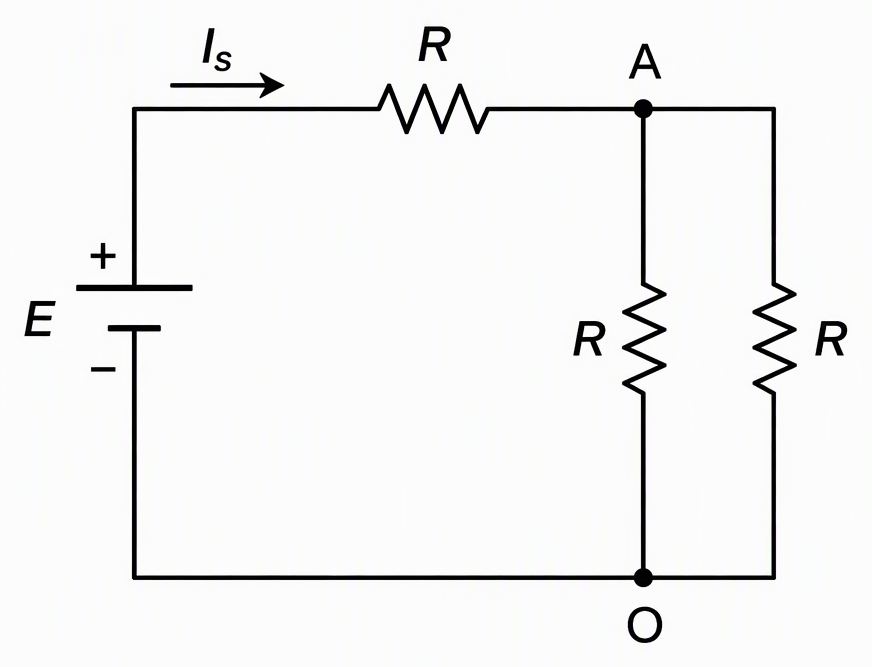
Choose the ordered pair:
3. Which load receives maximum power?
A cell supplies a variable positive load resistance. Find the load giving maximum load power and the corresponding terminal voltage.
4. Which opposing cell absorbs electrical energy?
Two cells and an external resistor form one series loop, with the emfs opposing. Find the current magnitude and the cell absorbing electrical energy.
5. When does current enter a source’s positive terminal?
Two ideal sources share a zero-potential reference node at their negative terminals. Their positive terminals maintain nodes B and C at the potentials defined below. Separate resistors connect B to A, C to A, and A to reference.
Find the potential of A and the condition for current to enter the positive terminal of the source connected to C.
How do I solve these questions without choosing the wrong formula?
Identify the physical constraint or circuit connections first, then write the equation. Each solution below links the calculation to the misconception it tests.
The symbolic MCQs practise single-correct reasoning. They do not reproduce Main numerical-answer entry, which requires a numerical value.
1. Correct option: B. Repair material assumptions.
Define the original dimensions and resistivity, with primes marking the stretched dimensions:
Constant volume forces the area to decrease:
Changing length while keeping area fixed gives the first option. The volume constraint rules that out.
2. Correct option: C. Repair circuit topology.
The two lower resistors share both endpoints, so they are parallel. Their equivalent resistance is in series with the upper resistor.
An unloaded equal-resistor divider gives half the source voltage. Here, the extra lower branch changes the equivalent resistance and loads the divider.
3. Correct option: B. Repair power-versus-current reasoning.
Let the circuit current be:
Load power depends on both current and load resistance:
The derivative changes from positive to negative at the matching load:
Maximum current is approached as the load tends to zero. Maximum efficiency is approached as the load tends to infinity, not at maximum load power.
4. Correct option: D. Repair emf signs.
Choose the current direction driven by the higher-emf cell. The other emf opposes it, while all three resistances contribute to the voltage drop.
Current enters the positive terminal of the lower-emf cell. It therefore absorbs electrical energy in this circuit model.
5. Repair Kirchhoff current directions.
Assume currents leave A through all three resistors. Kirchhoff’s current law gives:
Current enters the positive terminal of the source at C when the current from A to C is positive:
A negative branch current is not a failed solution. It means the true direction is opposite to the assumed arrow.
How should my mistakes decide the next practice session?
Use the first wrong step, not the total correct, to choose your next task. This short set cannot establish a marks target, percentile, chapter weightage or readiness threshold.
- Wrong circuit or governing equation: Return to concept drills. Redraw the connections and identify shared nodes before substituting quantities.
- Correct setup, failed algebra, units or signs: Solve a fresh variation, then reattempt the original without looking at its solution.
- Reliable independent chapter work: Move to verified PYQs. Retain the year and paper or shift attribution. An official answer key verifies the answer; a third-party worked solution supplies reasoning that still needs checking.
- Correct chapter work, weak mixed-paper performance: Attempt a full mock. Review subject switching, selection decisions and sustained concentration, not just incorrect answers.
For Main, scoring is +4 correct, -1 wrong and 0 unattempted. Do not treat a full mock as a requirement to answer every question.
Advanced has two compulsory three-hour papers, with question types and marking that vary. Never apply the Main mock format to Advanced.
What else should I know about free Current Electricity practice?
Free access does not guarantee quality: complete statements, checkable answers and clear reasoning matter more than collection size. These questions and solutions are available directly in this article; no external question bank or download is needed.
Are PYQs alone enough?
No, if conceptual errors remain. PYQs provide exposure to past exam demands, but repeating remembered solutions does not repair weak node identification or emf signs. Use drills for repair, then return to unseen PYQs.
Should Main and Advanced practice use different reasoning?
Build the same fundamentals, then increase reasoning depth for Advanced. Follow each paper’s instructions rather than treating one symbolic question type as the definition of either exam.
What should I record when the same mistake returns?
Log the first incorrect step, not the entire solution. Write the wrong assumption, its correction and one fresh question that tests it. “Called unequal branches an equal divider” gives you a repair task; “careless mistake” does not.
When execution is the remaining concern, use a JEEnius free full-length mock and its scored per-subject breakdown to choose which subject’s paper decisions to review first.
Next step: full-length mock tests on JEEnius and sit a full 75-question, 300-mark, 180-minute paper and get a scored per-subject breakdown (free tests included).
If that step was the hard part, work through Differentiation Rules JEE 2025: Worked Tangent-Sum Limit.
Frequently asked questions
Should I start Current Electricity with chapter questions, PYQs or mocks?
Start with concept drills if identifying nodes, current directions or governing equations still needs help. Move to verified PYQs when you can solve routine circuits independently. Prioritise full mocks when chapter work is accurate but question selection or concentration breaks down in mixed papers.
Are these Current Electricity questions official JEE PYQs?
No. These five questions are original practice with worked solutions, not official JEE questions or a difficulty-calibrated paper. They diagnose selected weaknesses and do not provide complete chapter coverage or establish exam readiness.
Are PYQs alone enough for Current Electricity?
Not if conceptual errors remain. Repeating remembered solutions does not repair weak node identification or incorrect emf signs. Use concept drills to fix those errors, then return to unseen, verified PYQs.
How do I stop repeating mistakes in Current Electricity?
Record the first incorrect step, the wrong assumption behind it and its correction. Solve one fresh question that tests the same idea, then reattempt the original without its solution. If your circuit setup was wrong, redraw the connections and identify shared nodes before calculating.