
Should I start with concept drills or JEE previous-year questions?
For Complex Numbers practice questions for JEE, start with targeted drills if conjugates, modulus or elementary loci still cause errors. Start with verified chapter-wise JEE Main PYQs if those methods are secure. Use mixed, multi-step sets after the basics are secure, especially when building towards Advanced.
Six free original questions with worked solutions follow. They are not PYQs. Use them to identify the practice you need.
These formats do different jobs: drills repair concepts, PYQs check exam relevance, and mixed sets test method selection. No single format replaces the others.
How do concept drills, PYQs and mixed sets compare?
Choose by the weakness you need to expose, not the size of the question bank. A tagged conjugate drill tells you which tool to use; a mixed set removes that cue. An authentic PYQ establishes what was actually asked, but recognising its published solution does not prove you can solve it independently.
- Targeted concept drills
- Starting prerequisite: Familiarity with the definition or operation being practised.
- Principal benefit: Repeating one skill while correcting its exact failure point.
- Exam provenance: Often original exercises, not official exam questions.
- Weakness revealed: Sign errors, misunderstood conjugates and faulty distance interpretations.
- Main limitation: The topic tag cues the method; it does not test independent method selection.
- Verified chapter-wise PYQs
- Starting prerequisite: Secure basic operations and standard methods.
- Principal benefit: Checking your work against authentic exam demands.
- Exam provenance: Traceable to an identified examination paper.
- Weakness revealed: Trouble interpreting exam wording or completing a solution independently.
- Main limitation: Familiarity can disguise dependence on remembered solutions.
- Mixed multi-step sets
- Starting prerequisite: Reliable basics without formula lookup.
- Principal benefit: Choosing and combining methods.
- Exam provenance: May be original; verify any separate PYQ claim.
- Weakness revealed: Failure to connect algebra, geometry and restrictions.
- Main limitation: Excessive difficulty can obscure a basic gap.
Original questions can be useful without being official, and a difficult-looking expression is not automatically Advanced-standard. In every free resource, check whether worked solutions justify restrictions, equality cases and all possible answers.
Which practice format fits my current preparation?
Your observed skill should decide the format, not your class or drop-year status. A dropper with shaky conjugate operations needs drills more than another difficult set. A Class 11 student who can explain and apply the standard methods independently can move beyond tagged exercises.
- Class 11, learning the chapter: Choose drills if moving between algebraic form, conjugates and modulus still requires looking up formulas. Write the reason for each transformation.
- Class 12, revising for Main: Choose unseen, verified Main PYQs if operations are secure but performance under exam-style conditions is uncertain. Attempt them before opening the solution.
- Dropper, recognising most PYQs: Choose unseen mixed questions. State your proposed method before calculating, rather than repeatedly solving familiar questions.
- Advanced aspirant: Add geometric and algebraic multi-step problems after basic competence. Completing this short diagnostic does not establish Advanced readiness.
For parents: purchasing more questions does not repair a failure to analyse existing mistakes. Review the first failed step in the existing set before choosing another resource.
Can I solve these three foundation questions without help?
These three original foundation checks test powers, conjugate relations and modulus as distance. They are neither past-paper questions nor a comprehensive chapter test. Attempt all three before reading the solutions, and keep your working: a correct answer reached through a faulty step still needs repair.
Question 1, skill: powers of the imaginary unit. Evaluate:
Question 2, skill: recovering a complex number from conjugate relations. Find all complex numbers satisfying:
Question 3, skill: converting modulus into distance. Describe the locus:
How do I solve the three foundation checks?
Use successive squaring for Question 1, real and imaginary parts for Question 2, and equal distances for Question 3. Compare each line with your working to find the first incorrect or unjustified step, not just a mismatched final answer.
Solution 1
Trap: Losing the negative sign when squaring the imaginary unit changes the intermediate result. Write each squaring step rather than handling the exponent mentally.
Solution 2
Write the complex number in algebraic form, with real coordinates:
Trap: Keeping only the positive imaginary part loses a valid answer. Both values satisfy both original conditions.
Solution 3
Squaring the equal, non-negative moduli gives:
The locus is the imaginary axis. Points equidistant from the real-axis points at positive one and negative one lie on their perpendicular bisector.
Trap: Zero real part means the imaginary axis, not the real axis. Check which coordinate remains free.
Can I choose the method for these three mixed questions?
These original mixed questions test whether you can choose a useful first step without a topic cue. Attempt all three before reading the solution block, and write why you chose your opening step. They provide multi-step practice, but that does not mean all three match Advanced difficulty.
Question 4, single-correct MCQ. Under the condition below, find the maximum value of the requested modulus.
Question 5. Find all complex numbers satisfying:
Question 6, numerical-answer style. Evaluate the expression under the given conditions:
How do I solve the mixed questions completely?
Question 4 needs a bound and an equality check. Question 5 converts a ratio into a circle, then finds an intersection. Question 6 uses a polynomial relation to reduce powers. Choose these methods over lengthy expansion because each uses the given condition directly.
Solution 4: triangle inequality and attainability
Split the expression around the modulus already given:
Verify that the bound can occur:
A bound alone is incomplete. Without an allowed point attaining it, you have shown only that the maximum cannot exceed that value.
Solution 5: real part followed by circle intersection
Write the complex number in algebraic form and rationalise the denominator:
The denominator is positive because the excluded value is the only point where it vanishes. The real-part condition therefore gives:
The remaining modulus gives a second unit circle:
The required points lie on both unit circles: one centred at the origin, the other one unit above it. Solve their equations together.
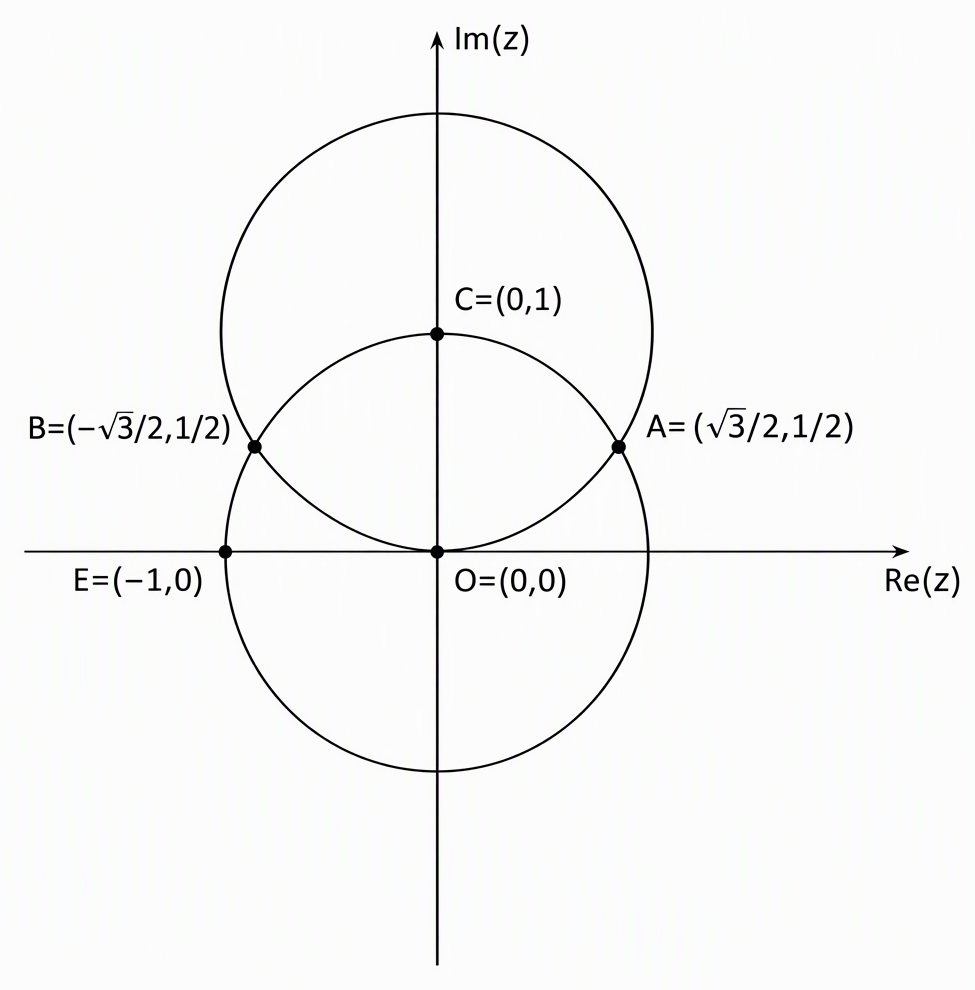
Subtract the circle equations:
Neither answer is the excluded value; both satisfy the two circles and hence the original conditions. For more work on this intersection step, use Circles Practice Questions JEE: 5 Worked Examples.
Solution 6: polynomial relation and periodic powers
The modulus condition guarantees a nonzero complex number, so multiplying by it is valid:
Reduce the exponents using the period:
From the earlier relations:
How should my mistakes decide the next practice set?
Choose the next set from the first failed step, not your total correct answers. This diagnostic does not cover the entire chapter, predict marks or establish a percentile. Separate errors by their cause before choosing more questions.
- Concept error: You used an incorrect property of conjugates, modulus or powers. If Questions 1 or 2 exposed this, return to targeted operations and conjugate drills before harder mixed sets.
- Method-selection error: You understood the solution but could not choose its opening step. If Question 3 was manageable but Questions 4 and 5 were not, practise translating distances and ratios into geometry, not merely revising formulas.
- Algebra or arithmetic error: Your plan was valid, but a sign, expansion or subtraction failed. Redo the affected operation and check it against the original condition.
- Missed restriction or completeness check: You ignored a denominator, discarded a valid sign or claimed a maximum without checking attainability. Add the missing check to your written solution.
If Question 6 stalled, practise deriving polynomial relations and reducing powers. Do not expand large expressions when a short relation reduces them.
For every error, record the first incorrect step, the corrected principle and a later independent reattempt. Then solve an unseen variation before calling the weakness repaired. Rereading this solution is not a successful reattempt.
When should I move to verified PYQs and a full mock?
Move to unseen verified PYQs once you can apply and explain the repaired method without help. Check each claimed PYQ for an identifiable exam and year, an official paper or traceable source, and an answer consistent with the official key where available. For official JEE Main material, start at jeemain.nta.nic.in.
A full mock tests chapter skills amid subject switching and time pressure. It cannot substitute for repairing a specific misconception about conjugates or loci.
For that full-paper check, JEEnius offers full-length mock tests, with free tests included, using a 75-question, 300-mark, 180-minute paper and providing a scored per-subject breakdown. Those paper numbers describe JEE Main Paper 1, not Advanced. JEE Advanced has no fixed question-type or marking pattern.
Repair the identified gap, attempt unseen verified PYQs, then test transfer through mixed practice and a full mock.
Next step: full-length mock tests on JEEnius and sit a full 75-question, 300-mark, 180-minute paper and get a scored per-subject breakdown (free tests included).
Frequently asked questions
Should I start complex numbers practice with drills or JEE PYQs?
Start with targeted drills if conjugates, modulus or elementary loci still cause errors. If those methods are secure, attempt unseen, verified chapter-wise JEE Main PYQs before opening the solutions. Add mixed sets to practise choosing and combining methods without topic cues.
Are these complex numbers questions actual JEE PYQs?
No. All six questions are original exercises with worked solutions, not previous-year questions. They test selected foundation skills and multi-step methods, but they are not a comprehensive chapter test.
Are six complex numbers questions enough for JEE Advanced preparation?
No; this short diagnostic does not establish JEE Advanced readiness. It helps identify specific gaps in concepts, method selection, algebra and completeness checks. Build towards Advanced with geometric and algebraic multi-step problems after securing the basics.
How should I analyse mistakes in complex numbers practice?
Find the first incorrect or unjustified step rather than checking only the final answer. Record that step, the corrected principle and a later independent reattempt. Then solve an unseen variation before treating the weakness as repaired.