
What is the rectangle-inside-a-rectangle question asking?
The requested answer is 72, not the maximum enclosing area of 18 square units. The question listed as “geometry of rectangles jee 2024” asks you to enclose a fixed rectangle ABCD, with adjacent sides AB and AD of lengths 4 and 2, inside rectangle PQRS. One inner vertex lies on each outer side. Find the square of the sum of the outer side lengths when the outer area is greatest.
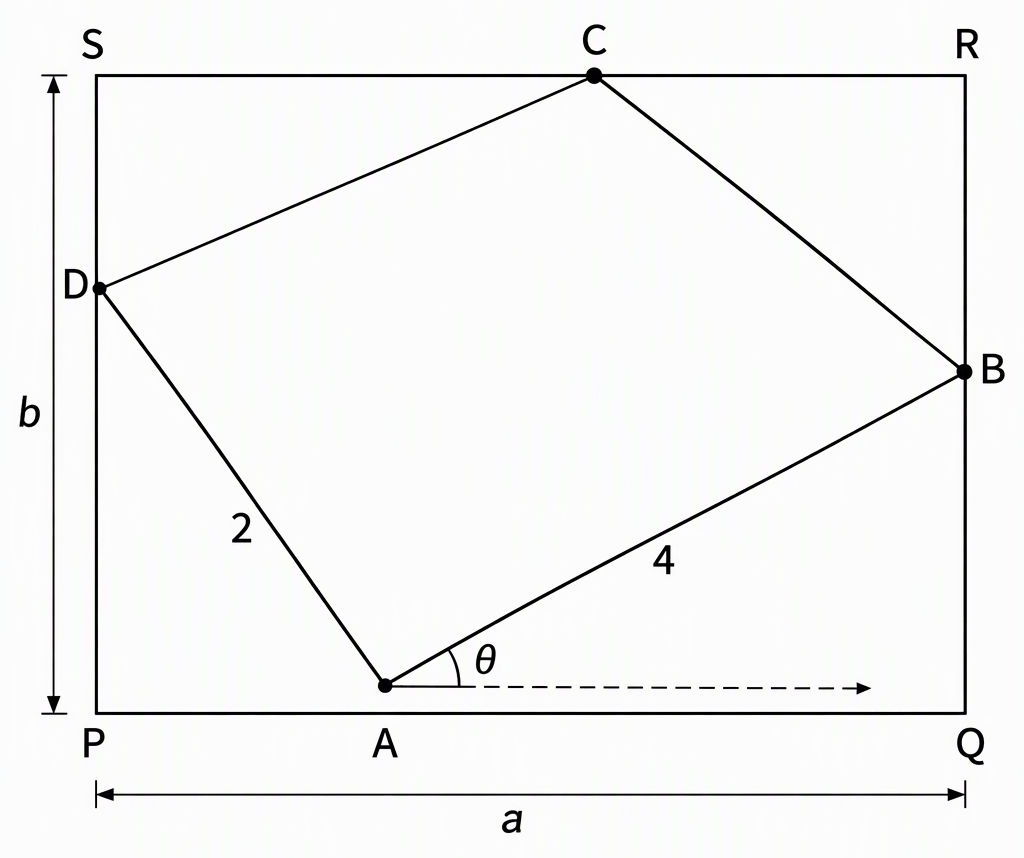
The inner area stays at 8 square units. The variable outer area is:
The bank tags this JEE Main, Coordinate Geometry, Hard, with a suggested time of 240 seconds. Its Year 2024 field conflicts with its date, 2023-01-24. Confirm the original paper before asserting an exact year-date-shift attribution.
How do you choose coordinates without losing the rotation?
Choose axes along the outer rectangle’s sides, then express the inner sides using their horizontal and vertical components. Axis alignment is our choice, not a consequence of inscription. Aligning both rectangles with the same axes would remove the rotation we must optimise.
The inner side of length 4 points upward and rightward. Its perpendicular neighbour of length 2 points upward and leftward:
Since A lies on the bottom side, its vertical coordinate is zero. Since D lies on the left side, subtracting the horizontal component of AD must bring us to zero:
Add the vector AB to A to locate B. Adding that same vector to D locates C:
B touches the right side, giving the outer width. C touches the top side, giving the outer height:
All four vertices lie within these spans. The midpoints of AC and BD also coincide with the outer centre, confirming the shared symmetry without assuming equal diagonals.
Why is the enclosing area greatest at 45 degrees?
The enclosing area is at most 18 square units, and that bound is attained at 45 degrees. Multiply the derived dimensions to prove this; do not assume that a square must maximise the area.
Combine the two squared terms using the identity below. The remaining two terms are multiples of the same sine-cosine product.
The sine term cannot exceed one. This gives an upper bound that is attained within the chosen angle range:
At this angle, sine and cosine are equal, so the derived width and height are equal. The maximising outer rectangle is therefore a square, rather than being assumed to be one. The aligned case has outer area 8 square units; the rotated maximum has area 18 square units.
How does the maximum-area orientation give 72?
At 45 degrees, squaring the sum of the outer sides gives 72 square units. Multiplying those sides instead gives the maximum outer area, 18 square units.
72 is the supplied answer, associated with option A. The complete option list was not supplied.
The supplied solution needs two intermediate-step corrections: inscription does not imply equal inner and outer diagonals, and its arithmetic is incorrect. The coordinate proof replaces those steps while retaining the final answer.
Why does treating the enclosing perimeter as fixed give a wrong answer?
The fixed-perimeter approach wrongly transfers the inner side sum to the outer rectangle. The inner lengths stay fixed, but their horizontal and vertical spans change during rotation. The incorrect assumption produces:
Add the actual width and height expressions instead. Their sum depends on the rotation angle:
In the aligned configuration, the factor in brackets is one. Thus 36 describes that configuration, whose outer area is 8 square units, not the maximum of 18.
36 is a derived wrong result, not a verified answer option. The supplied data contains no distractor values.
Editorial check: Matching this method error to an actual wrong option requires the original option list; that match remains unverified. In your solution, write the two projection sums before attempting a perimeter or diagonal shortcut.
How can you apply the same method to two related questions?
Use the same projection expressions with the new inner side lengths; both exercises below reach their maximum at 45 degrees, as the calculations show. These are original practice exercises, not additional verified PYQs. Keep the same arrangement, with one inner vertex on each outer side.
Original practice 1: Replace the inner dimensions by 3 and 5. Find the greatest enclosing area and the squared sum of the outer sides at that orientation.
The greatest area is 32 square units. At that orientation, the squared sum is 128 square units.
Original practice 2: For arbitrary positive inner side lengths, derive the greatest enclosing area and the corresponding squared sum. Name the lengths and write their projections:
Multiply the expressions and bound the sine-cosine product. The bound is attained because the chosen angle range includes 45 degrees.
Before using these final formulas, reproduce the two projection expressions without looking. Those expressions, not a remembered square or diagonal rule, are the reusable method.
Next step: photograph a doubt on JEEnius and photograph any question you are stuck on and get a step-by-step solution, with a free-body diagram when the question needs one (20 free).
Read next: Mole Fraction and Molarity JEE 2019: Urea Solution.
Frequently asked questions
Why is the answer 72 and not 18 in the rectangle problem?
The question asks for the square of the sum of the outer side lengths at the maximum-area orientation, not the maximum area itself. At that orientation, both outer sides measure 3√2, so their squared sum is (6√2)² = 72. Their product, 18, is the maximum outer area.
How do I find the outer rectangle's dimensions?
Choose coordinate axes along the outer rectangle and let θ be the angle its horizontal side makes with the inner side of length 4. Adding the horizontal and vertical projections of the inner sides gives a = 4 cos θ + 2 sin θ and b = 4 sin θ + 2 cos θ. These expressions retain the rotation that must be optimised.
Why is the enclosing area maximum at 45 degrees?
Multiplying the outer dimensions gives ab = 8 + 10 sin 2θ. Since sin 2θ ≤ 1, the area cannot exceed 18, and equality holds at θ = 45° within the allowed range. The outer dimensions are equal at this angle, so the maximising rectangle is a square.
Why does assuming a fixed outer perimeter give 36?
Setting a + b = 4 + 2 incorrectly transfers the inner side sum to the outer rectangle. The actual outer side sum is 6(cos θ + sin θ), which changes with rotation. Its square is 36 in the aligned configuration, but that configuration has area 8 rather than the maximum area of 18.