
Which electrostatics practice questions should I choose for JEE?
Choose electrostatics practice questions for JEE by your mistakes, not difficulty labels. Pick concept-repair questions if field directions, potential signs or capacitor constraints are unclear; JEE Main previous-year questions (PYQs) if you understand concepts but apply them unreliably; Advanced PYQs once you handle Main applications independently.
These are complementary routes, not competing books or a website ranking. Five free original questions with worked solutions follow below. They are diagnostic practice, not previous-year questions.
How do concept drills, Main PYQs and Advanced PYQs compare?
Concept drills isolate reasoning gaps, Main PYQs test application, and Advanced PYQs develop connections between ideas. Choose the route that addresses your present mistake. Following a difficult solution is not evidence that you can set up the problem independently.
- Prerequisite readiness
- Concept drills: Relevant theory and basic vector directions.
- Main PYQs: Ability to explain the underlying concept without copying a solution.
- Advanced PYQs: Independent handling of Main-level applications.
- Main learning benefit
- Concept drills: Isolate one idea, making errors easier to diagnose.
- Main PYQs: Authentic wording and answer formats test application.
- Advanced PYQs: Build deeper reasoning and links between ideas, not merely longer calculations.
- Typical limitation
- Concept drills: Success does not establish full exam readiness.
- Main PYQs: Memorised solutions can create false confidence.
- Advanced PYQs: Missing foundations can turn practice into solution-reading.
- Best use of solutions
- Concept drills: Check the physical explanation first.
- Main PYQs: Compare your setup before checking arithmetic.
- Advanced PYQs: Identify the symmetry, constraint or connection that simplified the problem.
- Evidence you can move on
- Concept drills: Explain the repaired idea and solve a fresh variation.
- Main PYQs: Set up unfamiliar applications independently.
- Advanced PYQs: Transfer the argument when conditions change.
- Free access
- Concept drills: The original starter set is on this page.
- Main PYQs: Use available official NTA papers and answer keys.
- Advanced PYQs: Use the official examination archive and available keys.
Official sources do not necessarily provide chapter filters or worked solutions. Advanced question types and marking are paper-specific: read that paper’s instructions rather than assuming a fixed pattern.
Who should start with each practice route?
Start with drills if you cannot explain the physics, Main PYQs if you struggle with unfamiliar setups, and Advanced PYQs once Main applications are independent. Your class does not determine the route. Use what you can explain and solve without help.
- Class 11 student studying ahead: Begin with concept drills after studying the relevant theory and vector prerequisites. Do not use Advanced PYQs as your first lesson in electrostatics. Establish field directions and potential signs before tackling several linked conditions.
- Class 12 student adding field magnitudes without directions: Repair superposition before attempting another mixed set. State each field’s direction at the observation point, then combine components. More arithmetic does not repair a missing vector argument.
- Student who understands examples but cannot start unfamiliar questions: Use Main PYQs independently. Write the governing relation before substituting values, commit to an answer, and only then open the solution. Recognising someone else’s first step is not the same as choosing it yourself.
- Advanced aspirant handling Main applications independently: Use Advanced PYQs for symmetry, constraints and linked reasoning. Consult that paper’s marking instructions before deciding how to answer, especially for questions with multiple possible selections.
- Dropper who recognises most PYQ answers: Hide the solution and reconstruct the argument. Explain why an alternative approach fails. Remembered answers are not evidence of mastery, even when they arrive instantly.
Move on when you can explain why your original approach failed and independently solve a fresh question testing the same idea. Apply that rule to the topic you repaired, not to your identity as a “Main” or “Advanced” student.
Can I try five free electrostatics practice questions for JEE now?
Attempt the five questions below before reading the solutions in the next section. This is original diagnostic practice, not PYQs, an official exam sample or a complete electrostatics question bank. Record your physical reasoning, not just five final expressions.
Use the Coulomb constant defined below, where the denominator contains vacuum permittivity:
The following quantities are positive wherever used:
Take increasing horizontal position as the positive direction. For each answer, record the physical reason, the governing relation and the result. If you cannot start, write the exact decision you cannot make.
Question 1: Superposition
Two positive point charges are fixed on the horizontal axis:
Find the finite point on this axis where the net electric field vanishes. Justify which region can contain the point before solving.
Question 2: Field versus potential
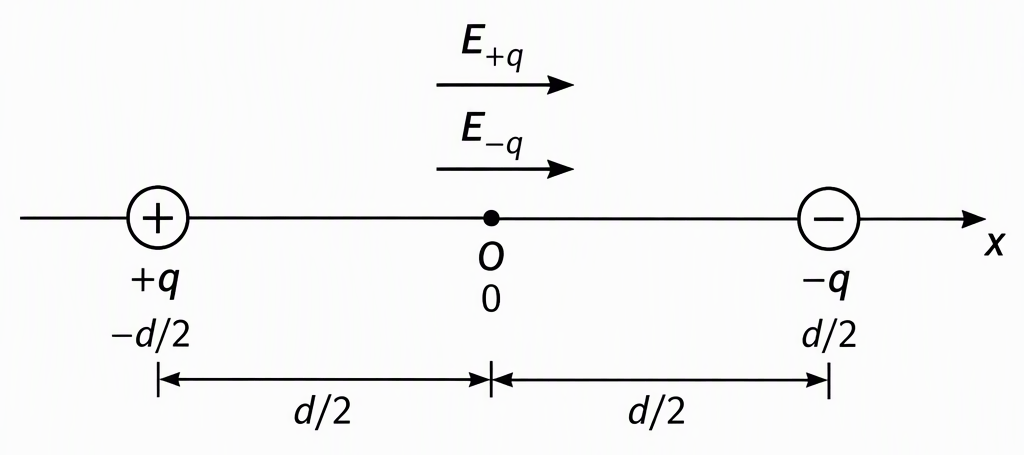
Two point charges are fixed at:
Find the electric potential and electric-field vector at the midpoint. Take potential to be zero at infinity and show how you combine each quantity.
Question 3: Gauss’s law
A positive point charge lies inside an imaginary spherical Gaussian surface, away from its centre:
Find the total outward electric flux. Explain whether the field magnitude can be taken outside the surface integral as a constant.
Question 4: Conductor equilibrium
An isolated conducting sphere in electrostatic equilibrium has radius and total charge:
With no external charges present, find the field and potential at its centre. Compare the centre’s potential with the surface potential, taking zero potential at infinity.
Question 5: Capacitor constraints
An ideal parallel-plate capacitor is charged and then disconnected from its battery:
A dielectric completely fills the gap:
Find the new capacitance, charge, voltage and stored energy, neglecting fringing. State which quantity remains fixed and why.
What do the worked solutions reveal about my mistakes?
Check the physical setup before checking your final expression. A correct answer reached through a wrong argument still needs repair. A sound setup followed by an algebra slip calls for application practice rather than restarting theory. Use the error labels below to choose the next task.
Question 1: Direction error
The fields oppose only between the charges. To the left of both positive charges, both fields point left; to the right, both point right. Neither outside region permits cancellation.
Between the charges, equate magnitudes:
Since both distances are positive:
The cancellation point is closer to the smaller charge.
Question 2: Scalar/vector confusion
Potential adds algebraically, so equal-distance contributions from opposite charges cancel. Electric field adds as a vector: at the midpoint, the positive charge pushes a positive test charge right, and the negative charge pulls it right.
Question 3: Unjustified symmetry
Gauss’s law gives total flux from the enclosed charge, regardless of its position inside the surface. It does not establish a constant field magnitude:
The off-centre charge produces neither uniform field magnitude over the sphere nor a field everywhere normal to it. You therefore cannot replace this integral by field magnitude times the sphere’s area. A spherical surface alone does not guarantee spherical symmetry of the field.
Question 4: Field/potential confusion
At electrostatic equilibrium, the field inside the conductor is zero. Its potential is spatially constant and equals the surface potential:
Zero field means no spatial change in potential, not necessarily zero potential. The reference at infinity fixes its value.
Question 5: Wrong conserved quantity
Disconnection prevents charge exchange with the battery. Charge stays fixed while the dielectric increases capacitance:
A connected ideal battery would instead hold voltage fixed and allow charge to change. Identify the connection before choosing the energy expression.
Choose your route by the error, not a score. Conceptual errors call for targeted drills; correct setups with execution errors call for Main-style application practice; secure reasoning supports beginning Advanced PYQs.
This short set does not assess the whole chapter. Continuous charge distributions, dipole torque and capacitor networks still need separate practice.
What should I practise next, and when should I take a full mock?
Repair the identified error, solve a fresh question, then return to mixed practice. Use a full mock to test subject switching and time management, not merely electrostatics understanding. It cannot replace focused practice on field versus potential or fixed charge versus fixed voltage.
Use this sequence for your next practice session:
- Attempt independently and preserve your working.
- Compare your setup with the worked solution.
- Classify the error: concept, setup, algebra or reading.
- Repair the specific idea with a focused question.
- Solve a fresh question before returning to mixed practice.
For authentic PYQs, use available papers and answer keys from official NTA/JEE Main sources at jeemain.nta.nic.in and the JEE Advanced examination archive at jeeadv.ac.in. These materials are not necessarily organised chapter-wise, and answer keys are not worked solutions. Keep the paper’s instructions alongside its questions.
For Main full-paper practice, there is no optional question selection within the 75-question paper. An unattempted question still receives zero marks; the paper structure is not a reason to guess blindly.
When you are ready to assess full-paper execution, JEEnius full-length mocks, including free tests, offer a 75-question, 300-mark, 180-minute paper with a scored per-subject breakdown. Use that next step after repairing your diagnostic error and solving a fresh question independently.
Next step: full-length mock tests on JEEnius and sit a full 75-question, 300-mark, 180-minute paper and get a scored per-subject breakdown (free tests included).
Read next: Coordinate Geometry JEE 2024: Tangent-Line Triangle.
Frequently asked questions
Should I start electrostatics with concept questions or JEE PYQs?
Start with concept drills if field directions, potential signs or capacitor constraints are unclear. Use JEE Main PYQs when you understand the concepts but struggle to apply them independently. Begin Advanced PYQs once you can handle Main-level applications without help.
Are these five electrostatics questions JEE previous-year questions?
No, these are original diagnostic questions with worked solutions, not PYQs or an official exam sample. They test superposition, field versus potential, Gauss’s law, conductor equilibrium and capacitor constraints. They do not cover the whole chapter.
Where can I get free official JEE electrostatics PYQs?
Use available papers and answer keys from official NTA/JEE Main sources at jeemain.nta.nic.in and the JEE Advanced examination archive at jeeadv.ac.in. These materials are not necessarily filtered by chapter, and answer keys are not worked solutions. Read each paper’s instructions because question types and marking can vary.
What stays constant when a dielectric is inserted into a disconnected capacitor?
For an ideal capacitor disconnected from its battery, charge stays constant because there is no charge exchange with the battery. If a dielectric of relative permittivity κ completely fills the gap, capacitance becomes κC, while voltage and stored energy fall to 1/κ of their initial values.