How do you solve the coordinate geometry JEE 2024 tangent-line triangle question?
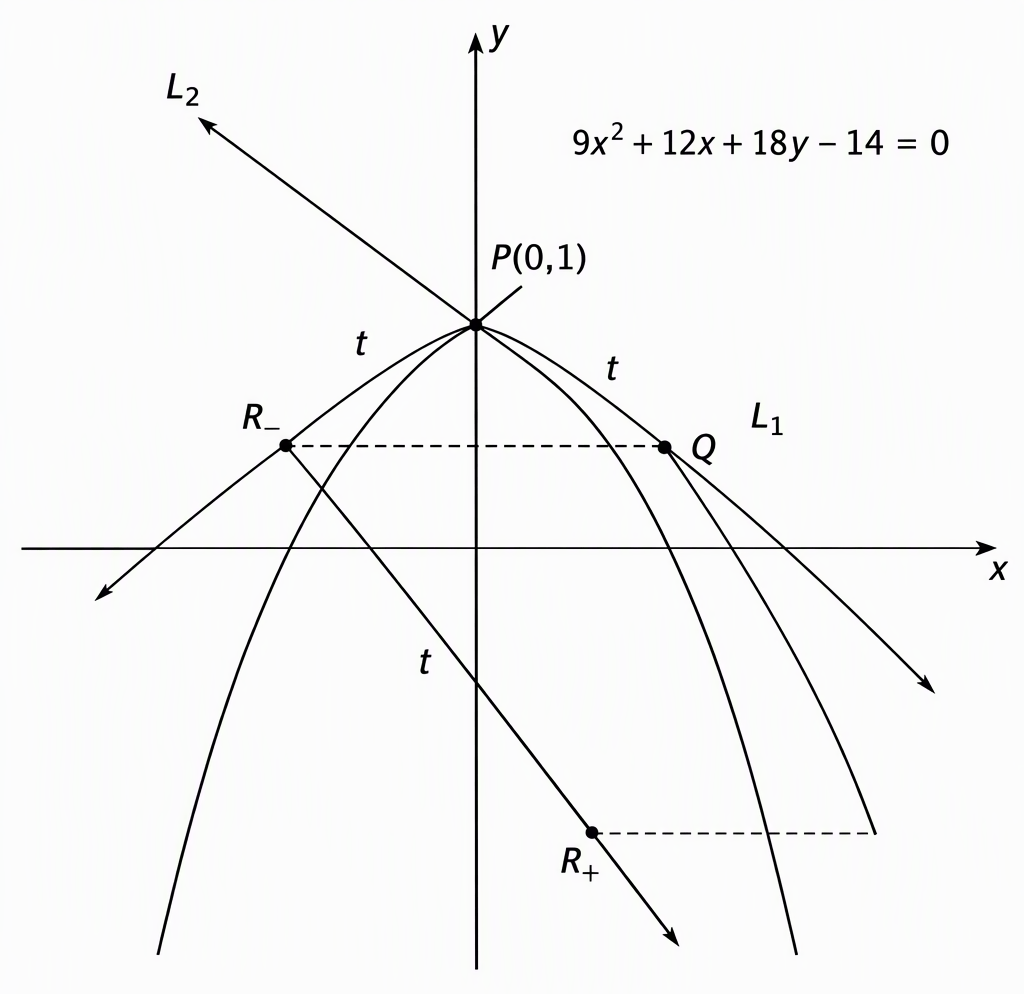
Equal side lengths allow two base directions, not just one, in this coordinate geometry JEE 2024 problem. Two tangents through P, whose coordinates are zero and one, touch the given parabola. Choose Q on one tangent and R on the other so that PQ and PR are equal, making QR the base of an isosceles triangle.
The answer is 68. This is a numerical-answer question, not an MCQ. For the given parabola, find the expression below, where the two numbered slopes are the possible slopes of QR:
The bank labels this question JEE Main 2024, but its date field reads 2023-01-24. That pairing is not independently confirmed; Hard is the bank’s difficulty tag, not evidence that most students answered incorrectly.
How do you find both tangent slopes using the discriminant?
The tangent slopes are zero and negative four-thirds. To derive them, substitute a general line through P into the parabola and require a repeated intersection. First complete the square:
The negative coefficient makes the parabola open downward, as shown. Its vertex is:
Every nonvertical line through P has the form:
The only vertical line through P is:
It is not a tangent: this downward-opening parabola has no vertical tangent at a finite point. Substituting the nonvertical line gives:
Tangency requires a repeated intersection, so the discriminant must vanish:
Thus:
How do equal distances give the correct coordinates on both tangents?
Use unit direction vectors, then multiply by the common side length. Each tangent has two rays from P, so each gives two possible points.
Set:
Zero is excluded because it collapses the triangle. On the horizontal tangent:
A direction vector along the second tangent and its length are:
Divide by its length to obtain the two unit directions:
Moving the same distance from P gives:
The distance formula confirms the construction:
The opposite direction has the same length. Q and R lie on the tangent lines; they need not be the points of contact with the parabola.
Why do four point choices give only two base slopes?
Reversing both rays reflects the triangle through P, preserving the base slope. The four ray combinations therefore produce two repeated slopes. Keep the subtraction order consistent:
- Positive Q, positive R:
- Positive Q, negative R:
- Negative Q, positive R:
- Negative Q, negative R:
The common length cancels because changing it scales the triangle without changing its base direction. Hence:
The product checks that the two base directions are perpendicular:
Use this as a check, not as a replacement for accounting for all four ray choices.
Why does using the same parameter fail to guarantee equal distances?
A multiplier of a direction vector measures distance only when that vector has unit length. This numerical question has no supplied wrong options, so the calculation below is an explicitly constructed mistake.
Consider the invalid assignment:
Both points lie on the required tangent lines, but:
The triangle is not isosceles with QR as its base. Extending this invalid construction to both directions produces the apparent slopes:
Reversing both rays repeats those values, leading to:
80 is an illustrative wrong result, not an official distractor or an observed student response. Repair the geometry before calculating slopes: divide the direction vector by five, then multiply by the desired distance.
Which three practice questions test the same method?
The questions below test distance normalisation, ray choices and discriminant tangency separately. All three are original related practice questions, not additional verified PYQs.
How do you find both points at distance 10 on the sloping tangent?
Move 10 units from P in each of the line’s two unit directions. Find both possible coordinates of R under these conditions:
The coordinate calculation is:
Therefore:
What are the base slopes if the second tangent is replaced by a rising line?
The possible slopes are negative three and one-third. Take Q and R on the respective lines through P, with equal positive distances:
Use the rising line’s unit direction:
Fix Q on the rightward ray and check both choices for R:
Reversing both rays gives the same slopes.
How do you find tangent slopes for the shifted parabola?
The slopes are zero and negative two. For tangents from P to the following parabola, substitute the general nonvertical line through P:
Then:
Set the discriminant to zero:
Before calculating any base slope, check the direction vector’s length and mark both rays. Normalise the vector before multiplying by the common side length.
Next step: the past-paper archive on JEEnius and search every JEE Main paper from 2002 and every Advanced paper from 2007, by year, subject or chapter, each with a worked solution (free).
Related on JEEnius: Chemical Bonding JEE 2019: Bonds Between Like Atoms.
Frequently asked questions
How do I find the tangent slopes from P(0,1) to the given parabola?
Substitute y = mx + 1 into 9x² + 12x + 18y - 14 = 0 to obtain 9x² + (12 + 18m)x + 4 = 0. Set its discriminant to zero: (12 + 18m)² - 144 = 0. The tangent slopes are 0 and -4/3; the vertical line x = 0 is not a tangent.
Why are there two possible slopes of QR?
Each tangent has two rays from P, so equal distances PQ = PR allow four ray combinations. Reversing both rays reflects the triangle through P and preserves the base slope. The four combinations therefore give only two distinct slopes: 2 and -1/2.
Why does using the same parameter on both lines give the wrong answer?
A parameter represents distance only when it multiplies a unit direction vector. Taking Q = (t,1) and R = (3t,1-4t) gives PQ = t but PR = 5t, so the required equal-side condition fails. Divide the direction vector (3,-4) by 5 before multiplying it by t.
What is the answer to the tangent-line triangle question?
The two possible base slopes are m₁ = 2 and m₂ = -1/2. Therefore, 16(m₁² + m₂²) = 16(4 + 1/4) = 68.