
What is the answer to this Three Dimensional Geometry JEE 2024 question?
The answer to this Three Dimensional Geometry JEE 2024 question is 0, corresponding to A in the supplied key: both lines intersect at the origin. The entry is tagged “Skew lines, Equation of a line” and “Hard”, but the equations determine the geometry.
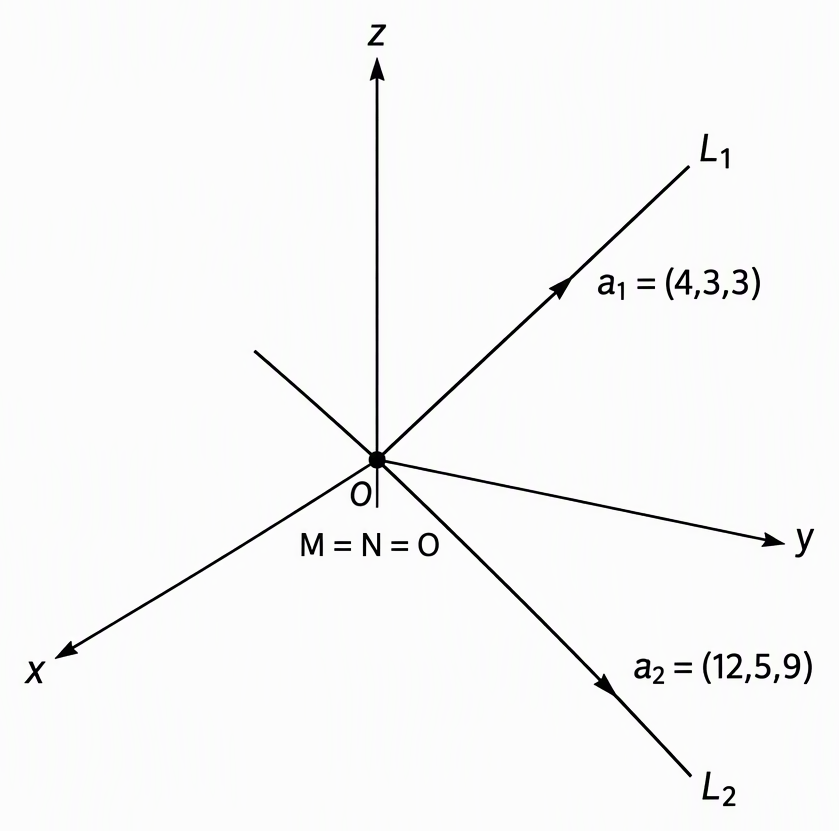
Take O as the origin. Choose M on the first line and N on the second to minimise their separation, then find the dot product of their position vectors.
The supplied question-bank entry is labelled JEE Main 2024, but its date field reads 2023-01-24. Exact paper-date and shift attribution therefore remain unresolved. The worked solution gives 0; the other option texts are absent, so a complete option list cannot be reconstructed.
How do you write the two points using parameters?
Because both lines pass through the origin, multiply each direction vector by its own real parameter to obtain a point’s position vector. The direction vectors specify which way the lines run, not where the closest points lie.
Setting both parameters to zero places both points at the origin. The direction vectors are not proportional, so these are distinct intersecting lines, not skew lines, regardless of the question-bank label.
Subtract the position vectors in the correct order:
The shared origin already establishes where the minimum occurs. The supplied solution’s perpendicularity method confirms it without treating direction vectors as position vectors.
How do both perpendicularity conditions give the closest points?
At minimum separation, the joining vector has zero dot product with each line’s direction. Otherwise, moving an endpoint along its line could reduce the separation. A zero joining vector satisfies both equations too, so this method applies even though the lines intersect.
Both conditions are needed to determine the closest points. The first alone only removes the joining vector’s component along the first line.
First condition:
Expand each product and collect terms:
Second condition:
Expanding and collecting terms gives:
Substitute the expression from the first condition to leave one unknown:
Multiply through by 17:
Do not divide by either parameter: that would discard the zero solution required here. Both closest points are therefore at the intersection already identified from the line equations.
How do you calculate the dot product and verify the minimum?
Substituting the solved parameters makes both position vectors zero, so their dot product is zero. This gives answer A in the supplied key.
A distance cannot be negative, so this is the global minimum. There is no nonzero common-perpendicular segment here: the minimum-length segment degenerates to a point.
Intersection gives zero shortest distance. The requested position-vector dot product is zero here specifically because that intersection is the origin.
Why is using the direction-vector dot product a mistake?
The calculation giving 90 uses the line directions, not the position vectors of the closest points. Here, each position vector includes a parameter that must be fixed by the minimum-distance condition.
The incorrect-result pathway is:
The actual requested expression is:
Using the direction vectors directly silently assumes:
That selects two points without showing that they minimise separation. Restore the parameters found from perpendicularity:
90 is a derived wrong result, not a verified wrong option. The supplied material omits the distractor values and gives no evidence about how often students select any answer.
Which three related questions should you practise next?
Use these original drills, not additional verified PYQs, to practise the three distinctions in this solution:
- Drill 1: A line’s fixed point versus its direction.
- Drill 2: Zero shortest distance versus zero position-vector dot product.
- Drill 3: Intersecting lines versus genuinely skew lines.
How do you write the line through a point parallel to a given direction in Drill 1?
Add a variable multiple of the direction vector to the given point’s position vector. For the point and direction below, this gives both vector and symmetric forms.
What is the position-vector dot product at minimum separation in Drill 2?
The answer is 14 for the lines below. Both contain the same fixed point and have nonparallel directions, so their closest points coincide there.
The shortest distance is zero, but the position-vector dot product is not. The intersection is away from the origin.
How do you find the closest points and shortest distance in Drill 3?
For the lines below, both parameters must be zero at minimum separation, giving a shortest distance of 1. Subtract the position vectors and impose perpendicularity to both directions.
These lines are nonparallel and never intersect, so they are genuinely skew. Before using perpendicularity on your next question, write each line’s fixed point and direction vector separately, then check for an intersection.
Next step: the past-paper archive on JEEnius and search every JEE Main paper from 2002 and every Advanced paper from 2007, by year, subject or chapter, each with a worked solution (free).
Read next: Kinetic Theory of Gases JEE 2019: Why A, B and D Are Correct.
Frequently asked questions
What is the answer to this Three Dimensional Geometry JEE 2024 question?
The answer is 0, corresponding to A in the supplied key. Both given lines pass through the origin, so their minimum separation occurs at M = N = O. Both position vectors are therefore zero, making their dot product zero.
Why are the given lines intersecting and not skew?
The lines x/4 = y/3 = z/3 and x/12 = y/5 = z/9 both contain the origin. Their direction vectors are not proportional, so they are distinct intersecting lines. The question-bank label saying “skew lines” does not match the equations.
Why is the dot product 0 instead of 90?
The value 90 is the dot product of the direction vectors (4,3,3) and (12,5,9), not the requested position vectors. Writing OM = λ(4,3,3) and ON = μ(12,5,9) gives OM · ON = 90λμ. Minimum separation requires λ = μ = 0, so the answer is 0.
Does zero shortest distance always mean the position-vector dot product is zero?
No. If two lines intersect at P, their closest points coincide at P, so the position-vector dot product is OP · OP = |OP|². It is zero only when P is the origin; at P = (1,2,3), it equals 14.
How do perpendicularity conditions give the closest points on two lines?
Write a point on each line using a separate parameter, then subtract their position vectors to form MN. Set the dot product of MN with each line’s direction vector to zero and solve both equations. For the given lines, this gives λ = μ = 0, confirming that both closest points are the origin.