Which molecules contain a covalent bond between like atoms?
Four molecules qualify in this JEE Advanced 2019 chemical bonding question: nitrous oxide, dinitrogen tetroxide, thiosulfuric acid and peroxodisulfuric acid. Diborane and borazine do not qualify because neither contains a direct covalent bond between atoms of the same element.
The source is JEE Advanced 2019, Paper 1, Chemistry, Chemical Bonding and Molecular Structure. Inspect these six molecules and determine how many contain at least one direct same-element covalent bond:
This is a numerical-answer question, not a multiple-choice question; no answer options are supplied. “Medium” is the question bank’s difficulty classification, not an official JEE rating. Its expected solving time is 120 seconds, a question-bank target, not a measured student average.
Why do diborane and borazine not count?
Both lack a direct same-element bond. The structures below show which atoms are actually joined: having two atoms of an element in a molecular formula is insufficient. Follow the official solution’s structure-first method rather than deciding from subscripts.
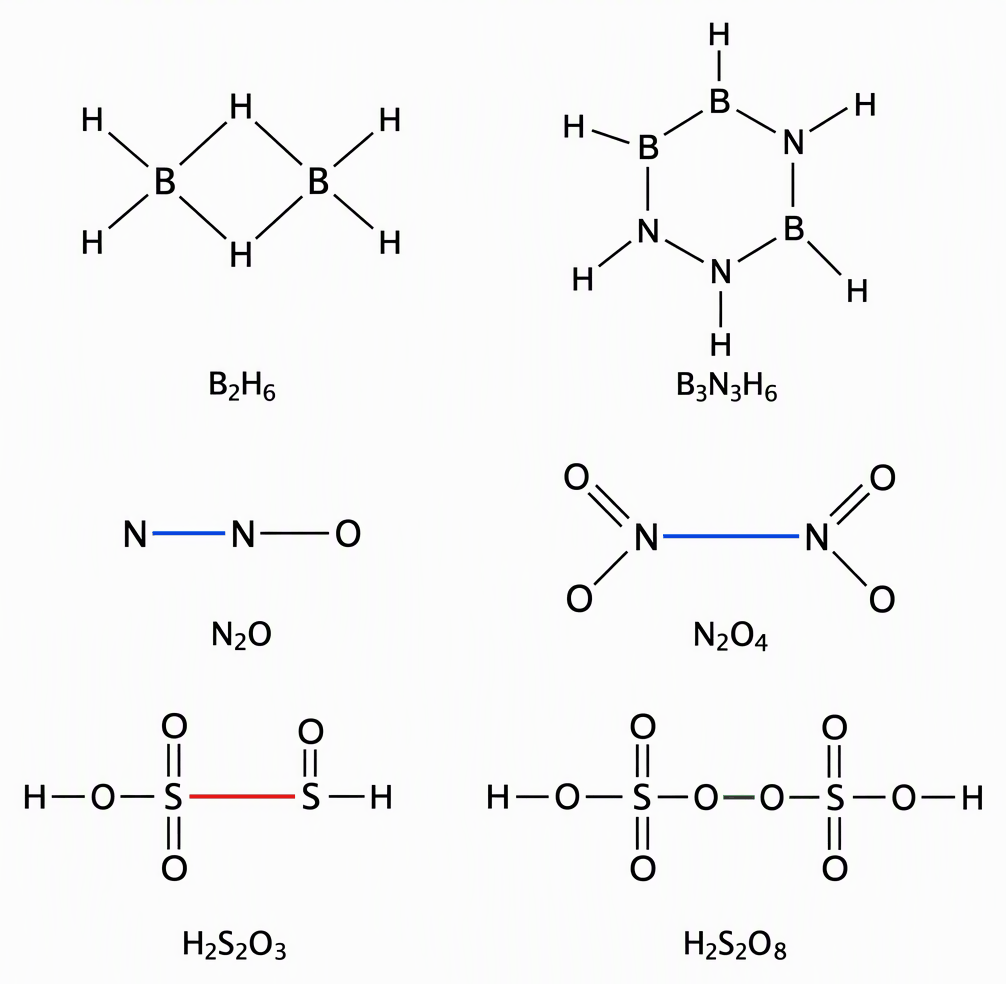
Identify a direct same-element covalent connection, then assign that molecule one yes or one no. Do not count how many times an element appears.
Diborane has four terminal boron–hydrogen bonds and two bridging hydrogen atoms. Each bridge involves three-centre, two-electron bonding, not two ordinary, independent two-centre bonds:
Following the supplied solution, diborane has no direct boron–boron bond, so exclude it. A connection through hydrogen does not establish a direct bond between the boron atoms.
Borazine has a six-membered ring with boron and nitrogen alternating around it. Each ring atom also carries one hydrogen. There is neither a boron–boron nor a nitrogen–nitrogen bond, so exclude it despite its three atoms of each of those elements.
Why do the remaining four molecules count?
The qualifying connections are nitrogen–nitrogen in each nitrogen oxide, sulfur–sulfur in thiosulfuric acid, and oxygen–oxygen in peroxodisulfuric acid. Check them in the supplied order: the two acids qualify through different bonds, even though both contain two sulfur atoms.
Nitrous oxide qualifies through its nitrogen–nitrogen connection. Its connectivity is:
This skeleton states which atoms are neighbours, not that every bond is single. Selecting one resonance contributor is unnecessary: the two nitrogen atoms are directly bonded, so count the molecule once.
Dinitrogen tetroxide qualifies through a nitrogen–nitrogen bond. It consists of two nitrogen dioxide units joined through their nitrogen atoms:
The central connection directly joins like atoms. Count this molecule once.
Thiosulfuric acid qualifies through a sulfur–sulfur bond. Its structural formula makes that connection explicit:
The central sulfur is directly bonded to the sulfur carrying hydrogen. Count this molecule once, regardless of the unlike-element bonds elsewhere in it.
Peroxodisulfuric acid qualifies through its peroxide oxygen–oxygen linkage. Its structure is:
There is no direct sulfur–sulfur bond in this structure. Count it through oxygen–oxygen, whereas thiosulfuric acid qualifies through sulfur–sulfur.
How does the final count become four?
The six-molecule audit gives two exclusions and four inclusions. Each line records the molecule, its qualifying same-element bond and the decision:
- Diborane: no qualifying bond; excluded.
- Borazine: no qualifying bond; excluded.
- Nitrous oxide: nitrogen–nitrogen; counted.
- Dinitrogen tetroxide: nitrogen–nitrogen; counted.
- Thiosulfuric acid: sulfur–sulfur; counted.
- Peroxodisulfuric acid: oxygen–oxygen; counted.
The task counts molecules containing at least one qualifying bond, not the total number of such bonds. The final numerical answer is:
How does treating a bridge as a direct bond give the wrong answer five?
The wrong entry five results from adding diborane to the four valid molecules. This numerical question has no listed wrong options, so five is a derived wrong entry, not a published distractor.
The error is to correctly include both nitrogen oxides and both acids, then falsely include diborane because its boron atoms participate in hydrogen bridges. That adds one molecule without identifying a direct same-element bond:
The mistake is confusing a path through an intervening atom with a direct bond. Repair it by tracing the actual bonded atoms and checking the element at each end: a path through hydrogen does not establish a direct boron–boron bond.
Which three practice questions check the same method?
These original practice questions from the same chapter test ring connectivity, peroxide linkages and molecule counting. They are not additional verified JEE PYQs; each answer includes its structural reason.
- In borazine’s six-membered ring, how many ring bonds join unlike elements and how many join like elements?
Answer: six boron–nitrogen ring bonds and zero same-element ring bonds. Boron and nitrogen alternate all the way around the ring, including the bond that closes it.
- In the following linkage of peroxodisulfuric acid, which bond makes the molecule qualify, and is there a direct sulfur–sulfur bond?
Answer: the oxygen–oxygen bond qualifies; there is no direct sulfur–sulfur bond. The sulfur atoms are connected through two oxygen atoms, not bonded directly to one another.
- How many of the following molecules contain a covalent bond between like atoms?
Answer: two, nitrous oxide and thiosulfuric acid. They qualify through nitrogen–nitrogen and sulfur–sulfur bonds respectively; diborane’s hydrogen bridges do not qualify.
Cover the connectivity sheet and reconstruct those three structures before checking your count. For every yes, name the exact same-element connection that earns it.
Next step: photograph a doubt on JEEnius and photograph any question you are stuck on and get a step-by-step solution, with a free-body diagram when the question needs one (20 free).
Keep going with Electromagnetic Induction JEE 2023: LCR Matching Solution.
Frequently asked questions
What is the answer to the JEE Advanced 2019 like-atom bonding question?
The numerical answer is 4.00: nitrous oxide, dinitrogen tetroxide, thiosulfuric acid and peroxodisulfuric acid qualify. Their qualifying bonds are N–N, N–N, S–S and O–O, respectively. Count each qualifying molecule once, not its total number of same-element bonds.
Why is diborane not counted as having a bond between like atoms?
Diborane has hydrogen bridges involving three-centre, two-electron bonding, not a direct B–B bond in the structure used for this question. A B–H–B connection passes through hydrogen and does not establish a direct bond between the boron atoms.
Does borazine have any bonds between like atoms?
No. Borazine has an alternating boron–nitrogen six-membered ring, with one hydrogen attached to each ring atom. Its six ring bonds are all B–N, so neither B–B nor N–N occurs.
Does peroxodisulfuric acid contain an S–S bond or an O–O bond?
Peroxodisulfuric acid contains an O–O peroxide bond in its S–O–O–S linkage and no direct S–S bond. It therefore qualifies through oxygen–oxygen bonding. Thiosulfuric acid, by contrast, qualifies through a direct S–S bond.