
What is the correct answer to the electromagnetic induction JEE 2023 LCR question?
Option B is correct for this electromagnetic induction JEE 2023 matching question: the off-resonance current ratio gives a resistance of approximately 112.6 ohms. The source is JEE Advanced 2023, Paper 1, Physics. “Medium difficulty” is the question bank’s classification, not an official exam rating.
A resistor, an inductor of 50 mH and a capacitor are connected in series across a sinusoidal source of peak voltage 45 V. The resonant angular frequency is 100,000 radians per second, and the resonant current amplitude is denoted below by a subscript zero. At 80,000 radians per second, the current amplitude is five per cent of its resonant value.
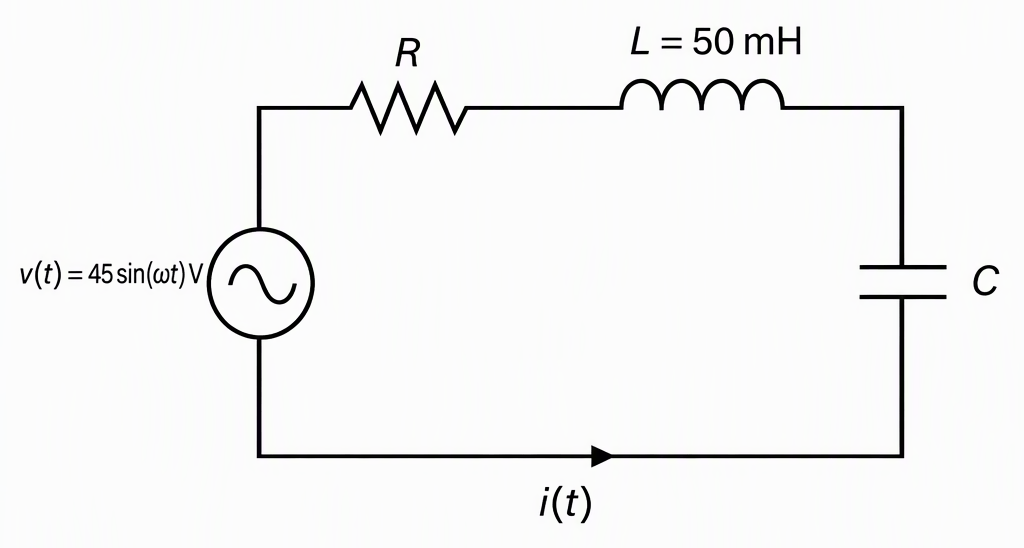
Match these List-I entries:
- P: Resonant current amplitude in mA.
- Q: Quality factor.
- R: Angular-frequency bandwidth in radians per second.
- S: Peak power dissipated at resonance in W.
List-II values:
- (1) 44.4
- (2) 18
- (3) 400
- (4) 2250
- (5) 500
Choose from the original mappings:
- A:
- B:
- C:
- D:
How do you find capacitance and off-resonance reactance?
The capacitance is 2 nF, and the reactance magnitude at the lower frequency is 2250 ohms. Follow the official method: use resonance to find capacitance, then calculate both reactances. First convert the inductance into henries.
At the specified lower frequency:
Below resonance, capacitive reactance exceeds inductive reactance, so the circuit is capacitive. Following the official solution, use the positive reactance magnitude:
The resistance symbol is unrelated to List-I label R, which asks for bandwidth. The signed reactance is negative, but its square gives the same impedance magnitude.
How does the current ratio determine resistance?
The current falls to five per cent because impedance becomes twenty times the resistance. The source amplitude remains 45 V at both frequencies, so it cancels from the ratio. Both current expressions use amplitudes, not RMS values.
At resonance, the reactances cancel:
At the lower frequency:
Using numerical resistance and impedance values in ohms:
Taking the positive root:
Keep resistance inside the impedance expression until the equation is solved. Approximating impedance by reactance alone is unnecessary here and does not follow the official calculation.
How do all four quantities give option B?
The four requested values are approximately 400 mA, 44.4, 2250 radians per second and 18 W. Calculate each from the resistance, keeping angular bandwidth separate from bandwidth in hertz and peak power separate from cycle-average power.
- P, resonant current amplitude:
- Q, dimensionless quality factor:
- R, angular-frequency bandwidth:
The listed values are rounded. Retaining the unrounded resistance gives:
This matches the supplied 2250 value. Check the bandwidth independently using:
No factor of two pi belongs in the angular-bandwidth formula because the requested unit is radians per second. Convert only when bandwidth is requested in hertz:
- S, peak dissipated power:
At resonance, voltage and current are in phase. Their product reaches its maximum when the squared sine is one:
Cycle-average power is approximately 9 W, not the requested peak power. The cycle average of squared sine is one-half:
The matches are:
The correct option is B.
Why is option A’s quality-factor match wrong?
Option A assigns quality factor to entry (3), namely 400. Copying the resonant current’s numerical value in milliamperes into the quality-factor entry produces this false match. Quality factor is not resonant current amplitude, even though both describe resonance.
Apply a unit-invariance test:
Changing the current unit changes its numerical value. A dimensionless quality factor cannot change with that choice.
The correct calculation is:
This explains one false match, which is sufficient to reject A. It does not generate A’s entire mapping.
How do you solve two related resonance variations?
The same circuit gives an RMS current of about 0.283 A and average power of 9 W. Doubling resistance leaves resonance frequency unchanged, halves resonant current and quality factor, and doubles angular bandwidth. These are original follow-ups, not additional verified PYQs.
Original follow-up 1: What are the RMS current and average power at resonance?
Divide the sinusoidal current amplitude by the square root of two to get approximately 0.283 A. Use RMS current for average resistor power:
Original follow-up 2: What changes if resistance doubles while inductance, capacitance and source amplitude stay fixed?
Resonance frequency stays fixed because it depends only on inductance and capacitance. Current and quality factor vary inversely with resistance; angular bandwidth varies directly with it.
- Resonance frequency remains unchanged:
- Resonant current halves:
- Quality factor halves:
- Angular bandwidth doubles:
Next, attempt Electromagnetic Induction Practice Questions JEE: 5 Drills, writing “peak” or “RMS” beside every current and voltage before calculating power.
Frequently asked questions
What is the correct option for the JEE Advanced 2023 LCR matching question?
Option B is correct: P→3, Q→1, R→4 and S→2. The values are approximately 400 mA for resonant current amplitude, 44.4 for quality factor, 2250 rad/s for angular bandwidth and 18 W for peak power.
How do you find resistance when the current is 5% of its resonant value?
For a fixed source amplitude, I/I₀ = R/Z = 0.05, so Z = 20R. With an off-resonance reactance magnitude of 2250 ohms, solve R² + 2250² = 400R² to obtain R ≈ 112.6 ohms.
Why is the peak power 18 W and not 9 W in this LCR question?
At resonance, peak dissipated power is V₀²/R, which gives 45²/112.6 ≈ 18 W. Cycle-average power is V₀²/(2R) ≈ 9 W because the average of the squared sine over a cycle is one-half.
What is the difference between angular bandwidth and bandwidth in hertz?
For a series LCR circuit, angular bandwidth is Δω = R/L and is measured in rad/s. Bandwidth in hertz is Δf = Δω/(2π). This question asks for angular bandwidth, so the matching value is approximately 2250 rad/s without dividing by 2π.