
Which electromagnetic induction practice questions should JEE students start with?
Start with diagnostic drills, then repair EMI with authentic PYQs, not a full mock. The electromagnetic induction practice questions JEE students start with should expose errors in flux, current direction and energy conservation. Five free original exercises follow, with worked explanations on this page.
Use diagnostics to locate gaps, authentic previous-year questions to calibrate exam-level preparation, and full-length mocks to test performance across the paper. If your flux, direction and energy checks are already secure, move directly to PYQs.
The exercises below are original diagnostics, not questions attributed to an actual JEE paper. Attempt them before reading the solutions.
How do diagnostic drills, Main PYQs, Advanced PYQs and mocks compare?
Drills isolate reasoning errors; authentic PYQs show what an exam actually asked; mocks test selection and pacing across subjects. Use chapter practice to repair EMI and full papers to assess execution. Original drills cannot prove exam readiness, and a full mock is inefficient for repairing one misconception.
- Best use: This page’s drills: locate misconceptions. Main PYQs: calibrate Main preparation. Advanced PYQs: test connected reasoning. Full mocks: assess whole-paper execution.
- Chapter focus: Drills: tightly targeted EMI. Main PYQs: EMI when selected chapter-wise. Advanced PYQs: EMI, sometimes connected with other topics. Mocks: the whole paper, without guaranteed EMI inclusion.
- Feedback needed: Drills: worked reasoning. Main PYQs: solutions and official keys. Advanced PYQs: solutions, keys and paper instructions. Mocks: scored feedback plus review of attempted and skipped questions.
- Exam-format fidelity: Drills: symbolic diagnostics, not exam replicas. Main PYQs: authentic to their source paper. Advanced PYQs: authentic to that year’s variable question types and marking. Mocks: simulated exam conditions.
- What they cannot establish: Drills: exam readiness. Main PYQs: Advanced readiness. Advanced PYQs: whole-paper pacing when practised chapter-wise. Mocks: a precise diagnosis of one EMI misconception.
For PYQs, require paper/year provenance and check the official answer key where available. Past questions do not guarantee future chapter weightage.
JEEnius offers full-length mocks with free tests included: 75 questions, 300 marks, 180 minutes and a scored per-subject breakdown. That breakdown is not a chapter-level EMI diagnostic.
Which option should Class 11, Class 12 and dropper students choose?
Choose from your demonstrated errors, not your class label, coaching batch or a resource’s prestige. Understanding induction but losing time across subjects calls for a different task from repeatedly reversing current direction. Use these starting points, then let your written errors decide the next step.
- Class 11, studying ahead: Attempt the diagnostic after learning magnetic force, flux and basic circuits. Unfamiliar EMI is not evidence of weak overall Physics.
- Class 12, first learning EMI: Start with the original drills. Explain current direction in words before substituting into formulas.
- Main-focused, basics secure: Choose authentic Main PYQs covering both single-correct and numerical-answer questions.
- Advanced-focused, basics secure: Choose authentic Advanced PYQs for connected reasoning. Follow the instructions printed on the relevant paper, since question types and marking vary by year.
- Droppers: Separate an EMI knowledge gap from a whole-paper execution problem. Use targeted drills or PYQs for the first, full-paper mocks for the second.
Can you solve these five free EMI diagnostic questions?
Attempt these five symbolic short-answer drills before reading the next section. They are diagnostics, not reproductions of JEE Main’s numerical-answer format. All stated parameters and time intervals are positive; time starts at zero where relevant. State directions as viewed on the page.
Drill A: changing field
A stationary single-turn loop lies in the page. Its area, resistance and uniform into-page field are:
Self-inductance is negligible. Find the induced-current magnitude and state clockwise or anticlockwise.
Drill B: moving rod
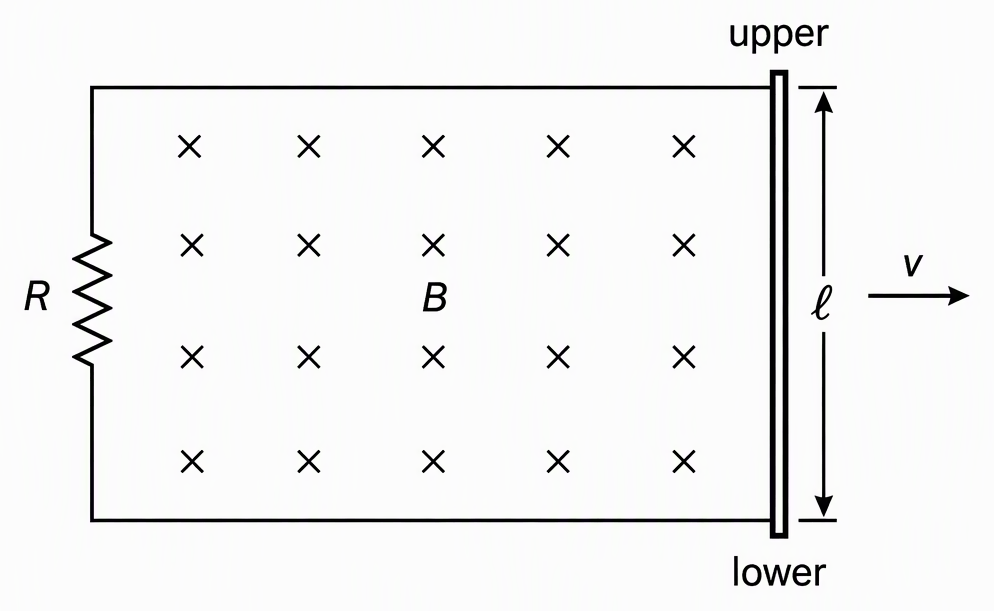
A rod, vertical on the page, slides right at constant speed on horizontal rails. A resistor closes the circuit at the left; the uniform field points into the page.
The rails are ideal and sufficiently long; rod and contact resistance are negligible. Neglect inductance. Find rod polarity, current, magnetic-force direction and the external power needed to maintain the speed.
Drill C: entering and leaving
A rectangular loop moves right at constant speed through a sharp-edged field strip. The strip extends beyond the loop vertically; its field points into the page and is zero outside.
Neglect inductance. Find current magnitude and direction during entry, fully inside and during exit.
Drill D: self-induction
An ideal inductor’s current decreases uniformly to zero during the stated interval. Its parameters are:
Find the average induced-emf magnitude and whether it supports or opposes the original current. Also find the decrease in stored magnetic energy.
Drill E: coupled-reasoning extension
Use the closed rod-and-rail arrangement from B, now without external driving. The rails lie on a frictionless horizontal surface, and the field points into the page.
The ideal rails are sufficiently long; contact resistance and inductance are negligible. Resistance stays constant. Find speed versus time and total heat as time tends to infinity. This is an extension, not an authentic Advanced PYQ.
How do you solve the diagnostic using flux, direction and energy?
Identify what changes the flux, use Lenz’s law to fix direction, then check forces and energy where motion is involved. A correct magnitude with the wrong direction still signals a gap. Each solution below names the reasoning error to repair; symbols alone do not make an exercise “Advanced level”.
Why is the current anticlockwise in Drill A?
The into-page flux increases, so the induced field points out of the page. The right-hand rule gives anticlockwise current. The loop is stationary, but its flux changes because the field changes.
Error diagnosis: flux-change error. Using the field’s instantaneous value instead of its rate of change confuses flux with induced emf.
Which end of the moving rod is positive in Drill B?
The upper end is at higher potential. For positive charges, the magnetic force from rightward motion in an into-page field points upward. Current therefore flows upward through the rod and anticlockwise around the circuit.
The magnetic force on the current-carrying rod points left, opposing the imposed motion. An equal rightward external force maintains constant speed.
The mechanical input must match resistive heating. This gives an independent power check:
Error diagnosis: cross-product or polarity error. Check the force on a positive charge before assigning conventional current.
Why does current vanish while Drill C’s loop is fully inside?
Rigid translation entirely within a uniform field leaves the loop’s flux unchanged. Motion through a magnetic field does not automatically produce a net loop emf. During entry and exit, the area overlapping the field changes.
Excluding the idealised boundary instants, the current magnitudes are:
- Entry: Anticlockwise, opposing increasing into-page flux.
- Fully inside: No induced current because flux is constant.
- Exit: Clockwise, opposing decreasing into-page flux.
Error diagnosis: failure to separate motion stages. Track overlap area rather than treating all rightward motion alike.
Does self-induced emf oppose the current in Drill D?
The emf supports the original current because that current is falling. Self-induction opposes the change in current, not necessarily the current itself. Taking the original current direction as positive:
The final magnetic energy is zero. The stored-energy decrease is therefore:
Error diagnosis: self-induction sign error. “Opposes current” is not a valid replacement for Lenz’s law.
How does magnetic braking change the speed in Drill E?
The braking force weakens as the rod slows because induced current is proportional to speed. Constant-deceleration equations therefore do not apply. Taking rightward as positive, Newton’s second law gives:
Separate variables and apply the initial speed. Integration gives:
The rod approaches rest asymptotically, not at a finite stopping time. With no external work or other losses, its initial kinetic energy becomes heat:
Error diagnosis: failure to connect force with changing velocity. Recalculate current and force using the instantaneous speed.
What should you practise after checking your mistakes?
Choose the next task from the failed reasoning step, not the number of correct answers. This small diagnostic cannot establish a percentile, a chapter-mastery score or a guaranteed exam outcome. An isolated difficulty calls for targeted repair, not restarting the entire chapter.
- Wrong direction in A or C: Sketch the external flux change and the opposing induced field. Only then assign current direction.
- Correct current but wrong power in B: Rebuild the chain: emf, current, magnetic force, mechanical power. Verify:
- Wrong D: Revise the distinction between opposing a change in current and opposing current itself.
- Difficulty with E alone: Practise force equations with velocity-dependent magnetic braking, then attempt related Advanced PYQs.
- Diagnostic secure: Move to authentic PYQs. Classify errors as modelling, algebra or answer-format mistakes.
Use a full-length mock when the issue is handling Physics, Chemistry and Mathematics together under the 180-minute Main limit. A scored per-subject breakdown helps compare subject performance, not isolate EMI errors.
For Main-format mocks, marking is +4 correct, −1 wrong and 0 unattempted. The absence of optional questions does not require guessing every answer.
What else should you know about free EMI practice for JEE?
The original diagnostic and worked solutions are on this page; no separate PDF or question bank is provided. Use Main PYQs to calibrate Main preparation, not to certify Advanced readiness. Judge progress by unfamiliar variations solved with correct reasoning, rather than a fixed question count.
- Are Main PYQs enough for Advanced? No. They cannot alone establish readiness for Advanced’s connected reasoning and year-specific formats.
- How many questions should I solve? There is no universal target. Progress means solving unfamiliar variations with correct directions, assumptions and checks, not accumulating repeated substitutions.
- Should I take a mock now? Repair a demonstrated EMI misconception first. If the remaining question is whole-paper execution, use a JEEnius full-length mock: free tests are included, with 75 questions, 300 marks, 180 minutes and a scored per-subject breakdown. Review your attempted and skipped questions before choosing the next chapter to repair.
Next step: full-length mock tests on JEEnius and sit a full 75-question, 300-mark, 180-minute paper and get a scored per-subject breakdown (free tests included).
If that step was the hard part, work through Cartesian Coordinates JEE 2024: Auditing the Answer.
Frequently asked questions
Which electromagnetic induction questions should I practise first for JEE?
Start with diagnostic drills that test flux change, current direction and energy conservation. This article provides five original exercises with worked solutions, not authentic JEE PYQs. If those checks are already secure, move directly to authentic previous-year questions.
How do I find induced current direction using Lenz's law?
Identify whether the external magnetic flux through the loop is increasing or decreasing. The induced field opposes that change; use the right-hand rule to translate its direction into clockwise or anticlockwise current. For increasing into-page flux, the induced field points out of the page and the current is anticlockwise.
Are JEE Main EMI PYQs enough for JEE Advanced?
No. Main PYQs help calibrate Main preparation but cannot alone establish Advanced readiness. Once the basics are secure, practise authentic Advanced PYQs for connected reasoning and follow each source paper's question types and marking instructions.
Should I take a full mock test to improve electromagnetic induction?
Repair a specific EMI misconception with targeted drills or chapter-wise PYQs first. Use a full-length mock when the problem is selection, pacing or handling Physics, Chemistry and Mathematics together. A scored per-subject breakdown compares subject performance but does not isolate EMI errors.