
Which free equilibrium practice route should I choose for JEE?
For free equilibrium practice questions for JEE, choose NCERT exercises for unclear concepts, worked drills for equation-selection or approximation errors, and official previous-year questions for exam application. These routes repair different weaknesses; none is universally best.
Here, equilibrium means chemical and ionic equilibrium, not mechanical equilibrium. Free original questions with worked solutions appear below, covering reaction direction, dissociation, weak acids, buffers, solubility and very dilute strong acids.
Attempt the diagnostic before collecting another worksheet. Choose your next source by the first reasoning step you cannot explain, not by how many questions it contains.
How do NCERT exercises, official PYQs and worked drills compare?
Use NCERT to repair foundations, official papers to test exam application, and the drills below to check your setup. Compare the routes by the criteria below. Each bullet follows the same order: official NCERT Equilibrium chapter exercises, equilibrium questions selected from official JEE papers, then this article’s original worked drills.
- Best use: NCERT builds concepts; official PYQs test exam application; these drills diagnose reasoning errors.
- Prerequisite knowledge: NCERT needs the corresponding chapter reading; PYQs need dependable equilibrium setup; the drills need basic formula recognition and written working.
- Chemical and ionic coverage: NCERT covers both within the chapter; PYQ coverage depends on your selection; these drills sample both without covering every subtopic.
- Solution support: Official NCERT digital textbooks provide exercises, but not necessarily full worked solutions for every exercise; official papers and answer keys establish authentic questions and official answers, not necessarily explanations; every drill below has a worked solution.
- Exam fidelity: NCERT is textbook practice; official Main questions test Main tasks and official Advanced questions test Advanced tasks; these drills are instructional, not PYQs.
- Access effort: Find the official NCERT digital textbook; locate official JEE papers and keys, then select equilibrium questions; attempt these drills immediately below.
- Main limitation: NCERT alone cannot establish exam readiness; PYQs may require separate chapter filtering and worked explanations; this diagnostic has deliberately limited coverage.
A generic “JEE level” label is not equivalent to an authentic Main or Advanced question. Use questions from your target exam to test exam application.
Which route fits Class 11, Class 12, droppers and Advanced aspirants?
Class 11 students with weak foundations should start with NCERT; revising students should diagnose before restarting the chapter. Droppers who remember answers need unfamiliar questions, while Advanced aspirants need dependable setup and approximation checks before authentic Advanced PYQs.
- Class 11, learning the chapter: Use NCERT-led practice if writing equilibrium expressions or distinguishing strong and weak electrolytes is unreliable. Identify the species present before choosing an equation.
- Class 12, revising: Attempt the diagnostic first. Repair the failed skill, then move to relevant Main PYQs instead of automatically restarting the entire chapter.
- Dropper, remembering PYQ answers: Use the worked drills to check your derivation. Then attempt unfamiliar questions: recognising an answer is not the same as producing it.
- Advanced aspirant: Progress to authentic Advanced PYQs once equilibrium setup, conservation relations and approximation checks are dependable. Familiarity with Main questions is not a substitute.
Your readiness test is concrete: explain why the equation applies and why each neglected term is small. Correct substitution into a remembered formula does not pass that test.
For parents, another large worksheet is not the remedy for a repeated setup error. Ask the student to show the failed line and its correction, rather than only counting completed questions.
Can I solve these free equilibrium questions without looking at the solutions?
Attempt all six prompts before reading the solution block. These conceptual and symbolic short-answer drills test equation selection and assumptions, not Main’s numerical-answer interface. Every item is an original instructional question, not a PYQ or a claim about actual exam difficulty.
Assume ideal gases where relevant and ideal dilute-solution behaviour for concentration-based ionic relations. Show your governing equation and any approximation checks.
- Original instructional question: reaction direction. For a gaseous reaction at fixed temperature, predict the direction of net change in each case. State what happens to the equilibrium constant.
- Original instructional question: dissociation. Begin with pure dinitrogen tetroxide. Find equilibrium mole fractions and the dimensionless pressure equilibrium constant using partial pressures divided by standard pressure.
- Original instructional question: weak acid. For a monoprotic weak acid, neglect water autoionisation initially. Derive the quadratic for hydrogen-ion concentration and state when small dissociation can be assumed.
- Original instructional question: buffer. Add strong base to a mixture of weak acid and its conjugate base. Find the final buffer relation after accounting for neutralisation, and state its applicability assumptions.
- Original instructional question: solubility. A sparingly soluble salt dissolves in a solution already containing its cation. With no competing reactions, write the exact solubility-product relation and justify any approximation.
- Original instructional question: dilute strong acid. For a fully dissociated monoprotic acid, retain water autoionisation. Use charge balance to explain when acid concentration alone fails to give hydrogen-ion concentration.
What are the worked solutions and the traps in each question?
Check the governing relation before the final answer: reaction quotient, mole balance, acid equilibrium, neutralisation, solubility product and charge balance, respectively. Compare your first equation with each solution. A matching answer with an unjustified assumption still counts as a reasoning error.
- Reaction direction
When the quotient differs from the constant, composition changes towards equilibrium. At fixed temperature, the equilibrium constant stays fixed; forward and reverse reactions continue at equilibrium.
Trap: moving the constant. A composition change alters the quotient, not the constant.
- Dissociation and mole balance
Start with an initial amount of pure reactant. Account for both the reactant consumed and the product formed:
Partial pressure is mole fraction times total pressure. Using the specified dimensionless convention:
An unnormalised pressure-product convention would instead carry pressure units. Do not mix the conventions.
Trap: unchanged total moles. Dissociation increases the total amount of gas.
- Weak-acid quadratic
Neglect water initially. Charge balance and acid conservation then give:
The small-dissociation result requires two separate checks. One tests acid depletion; the other tests neglect of water:
Trap: automatic square-root formula. Weak acid does not automatically mean negligible dissociation.
- Buffer after strong-base addition
Neutralisation comes first. Added hydroxide consumes weak acid and produces conjugate base before the remaining mixture establishes equilibrium.
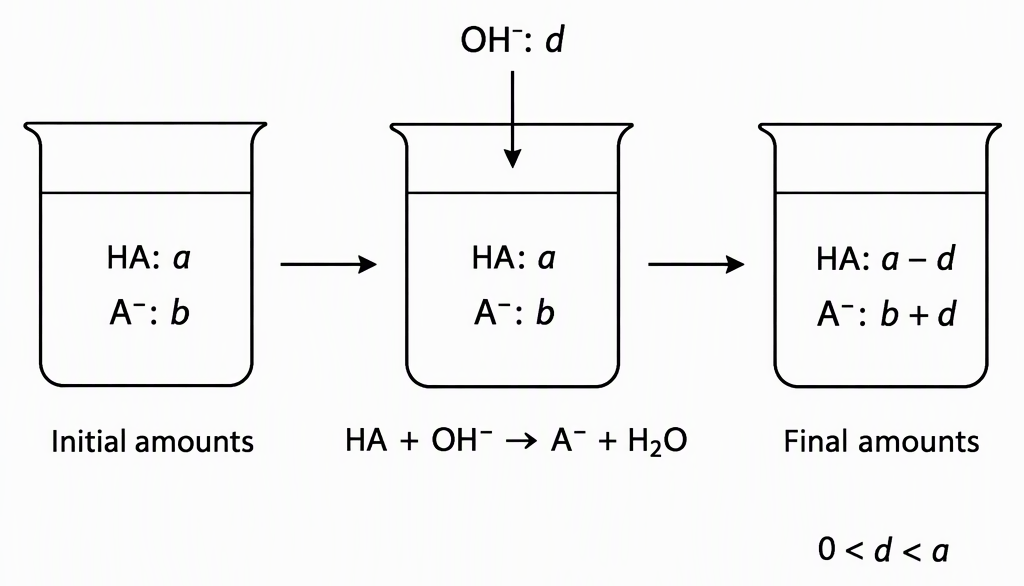
The common final volume cancels. Assume complete neutralisation, both buffer components remain, negligible activity corrections, and subsequent dissociation and water contributions are small relative to their concentrations.
Trap: using initial amounts. The buffer relation needs post-reaction amounts.
- Common-ion solubility
Each dissolved formula unit adds equal concentrations of cation and anion. Include the cation already present:
The common-ion approximation requires dissolved salt to contribute much less cation than was initially present:
Trap: dropping a term before checking it. Substitute the approximate result back into the size comparison.
- Very dilute strong acid
The acid anion concentration equals analytical acid concentration. Charge balance therefore includes hydroxide:
Neglecting water requires acid concentration to be much larger than the neutral-water hydrogen-ion concentration:
As acid concentration approaches zero, hydrogen-ion concentration approaches the neutral-water value. Acid concentration alone is therefore insufficient in this limit.
Trap: strong means water is irrelevant. Complete dissociation does not remove water’s contribution.
How should my mistakes decide the next question set?
Choose the next set from the failed step, not a total score. Repair that step, then test it on a fresh question without looking at the solution. Use this mapping rather than collecting more sources indiscriminately.
- Wrong reaction direction or equilibrium expression: Return to NCERT concept repair, then attempt another direct application.
- Incorrect mole fractions or dissociation setup: Use fresh worked chemical-equilibrium drills before timed PYQs. Write species amounts and total moles separately.
- Weak-acid or dilute-acid errors: Rebuild equilibrium equations, charge balance and approximation checks rather than memorising more pH shortcuts.
- Buffer errors: Complete reaction stoichiometry before applying equilibrium.
- Common-ion errors: Write the full solubility expression before dropping any term.
- Sound reasoning throughout: Move to unfamiliar Main PYQs or authentic Advanced problems for Advanced preparation.
Keep an error log with four fields: failed step, incorrect assumption, corrected relation, next-attempt check. A common-ion entry should identify the prematurely discarded solubility term and require checking its size against the initial cation concentration next time.
This short set diagnoses selected skills; it does not finish the chapter. On the next attempt, write the corrected relation and its validity check without referring to the log.
How do I transfer chapter practice to the actual exam?
Move from untimed reasoning to authentic question formats, then to a full paper. Main Chemistry contains 20 single-correct MCQs and 5 numerical-answer questions, so chapter practice should include both. Main awards 4 marks for a correct answer, deducts 1 for a wrong answer and gives 0 for an unattempted question.
For MCQs, reject options using the governing relation. For numerical-answer questions, finish the calculation and follow the stated rounding instructions. Neither format excuses an unchecked approximation.
Advanced has two compulsory three-hour papers, with variable question types and marking schemes. Read the instructions for the specific paper you attempt; do not transfer Main’s rules to Advanced.
Where can I get free equilibrium questions with solutions?
The original drills above include worked solutions. Official NCERT digital textbooks supply chapter exercises; official JEE papers and answer keys supply authentic questions and answers. For Main papers, start at jeemain.nta.nic.in; use the official JEE Advanced website for Advanced papers.
An answer key confirms the answer, not your reasoning. Write the derivation yourself or consult a worked explanation and check each assumption.
Are NCERT exercises enough for JEE equilibrium?
Use them to repair weak foundations, but do not stop there. Follow them with authentic questions from your target exam once you can set up the relations without help.
When should I take a full-length mock?
Take one after you can solve fresh chapter questions with justified assumptions. Its purpose is to test chapter switching and time management, not replace equilibrium practice.
For that later step, JEEnius offers full-length 75-question, 300-mark, 180-minute mocks with scored per-subject breakdowns, including free tests. Use a mock after repairing your logged setup errors, then check whether those repairs survive the pressure of a full paper.
Next step: full-length mock tests on JEEnius and sit a full 75-question, 300-mark, 180-minute paper and get a scored per-subject breakdown (free tests included).
Read next: Matrices and Determinants JEE 2024: Why the Answer Is 64.
Frequently asked questions
Where can I get free equilibrium questions with solutions for JEE?
This article provides six original chemical and ionic equilibrium drills with worked solutions. Official NCERT digital textbooks provide chapter exercises, while official JEE websites provide authentic papers and answer keys. An official answer key confirms the answer but does not necessarily explain the reasoning.
Are NCERT exercises enough for JEE equilibrium?
NCERT exercises help repair weak concepts, but they cannot establish exam readiness on their own. Once you can write equilibrium relations and justify approximations without help, move to authentic questions from your target exam.
When can I use the square-root formula for weak-acid pH?
For a monoprotic weak acid of analytical concentration C, [H+] ≈ √(KaC) requires negligible acid depletion and negligible water autoionisation. Check that the calculated [H+]/C is much smaller than 1 and that [H+] is much larger than √Kw. A weak acid does not automatically have negligible dissociation.
Should I apply the buffer formula before or after neutralisation?
Complete the neutralisation calculation first, then use the remaining weak-acid and conjugate-base amounts in the buffer relation. Both components must remain, and subsequent dissociation and water contributions must be small relative to their concentrations.