
What is the answer to the scalar and vector products JEE 2024 triangle question?
The required numerical entry is 54, the square of the longest side in this scalar and vector products JEE 2024 question. The bank labels it 2024, but its date field reads 2023-01-24, or 24 January 2023. That conflicting metadata does not certify an exact paper date or shift.
Triangle ABC has the area and directed side vectors specified below, with the unknown middle component of AC restricted to be positive. Find the square of the triangle’s longest side, not the side length itself.
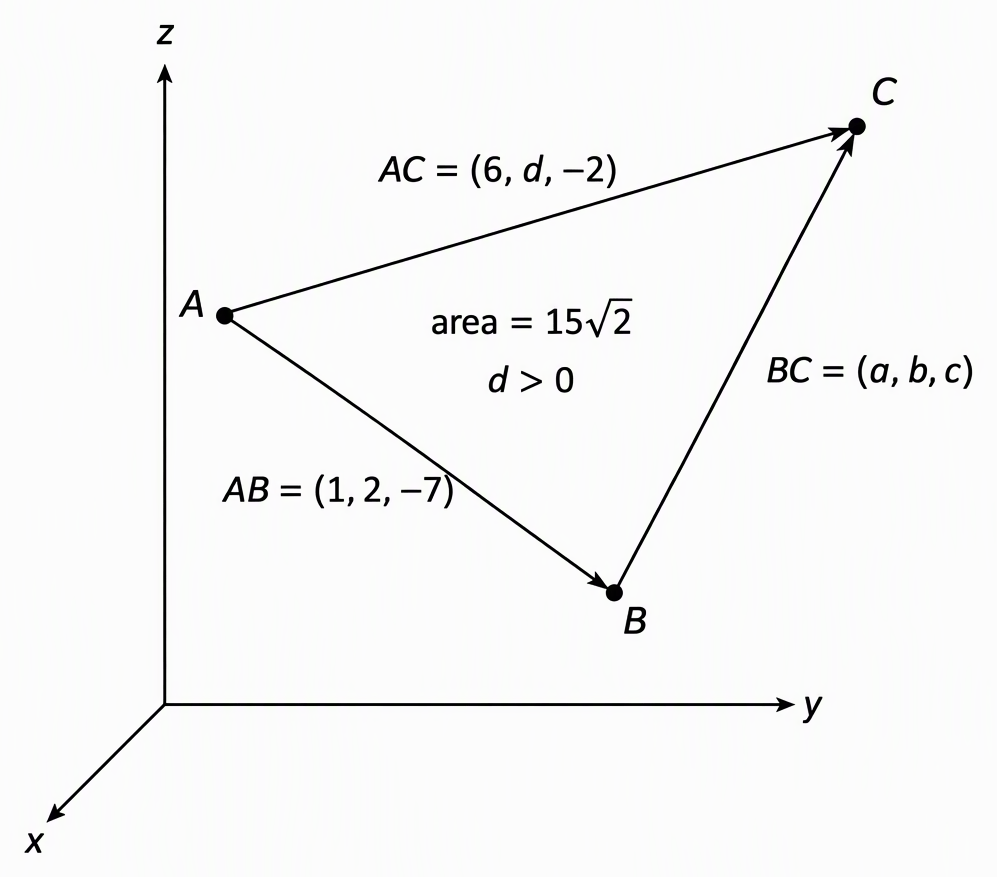
This is a numerical-answer question: there are no supplied multiple-choice options. The solution has three checks: directed-vector closure, cross-product area and squared-length comparison.
How do the triangle’s vector directions determine BC?
Travelling from A to B, then from B to C, gives the same displacement as travelling directly from A to C. The official solution uses this relation to compare components. Keep the unknown component symbolic until the area condition determines it.
Equating the three components separately gives:
Replacing AC with CA would reverse that vector, so it cannot stay on the right-hand side unchanged. Write the directed relation before doing component arithmetic.
How does the cross product give an equation for d?
The cross-product magnitude gives the area of the parallelogram formed by AB and AC. The triangle occupies half that area, so double the given triangle area before squaring.
Expand the determinant below. Keep the minus sign attached to the middle cofactor.
Its squared magnitude is the sum of the three squared components. Equate that sum to the squared magnitude obtained from the area:
Expand both brackets before collecting terms. Then move the right-hand side to the left and divide by the common factor:
The one-half belongs in the area formula, not in the cross product itself. The negative middle component becomes positive when squared, but its sign must remain negative in the vector.
Which root is valid, and why is the longest side’s square 54?
The positive root is valid because the question restricts the unknown component to be positive. After substituting it, compare squared lengths directly: taking square roots adds work without changing the order of the sides.
Substitute this value into the directed vectors. The scalar product then gives each side’s squared length:
- Side AB:
- Side BC:
- Side AC:
Squaring positive lengths preserves their order, so AB is the longest side. The question asks for its squared length, making the required entry 54, not the side length:
Why would adding the components first give the wrong entry 100?
100 is an illustrative wrong numerical entry, not a supplied answer option. It results from squaring the sum of a vector’s components instead of adding their squares. This gives the wrong comparison even when the direction and area calculations are correct.
- AB, incorrect calculation:
- BC, incorrect calculation:
- AC, incorrect calculation:
The erroneous maximum is 100. Expanding the incorrect expression exposes the unwanted mixed terms:
Those mixed terms vanish in a vector’s self-dot product because Cartesian unit vectors are mutually perpendicular. Their self-dot products are one, leaving only the squared components.
Which two follow-up questions check this method?
These are original follow-ups using the solved triangle, not independently verified PYQs. The first checks the dot product and angle; the second checks whether a different vector pair gives the same area.
What is the cosine of angle BAC, and is the angle acute?
The positive dot product establishes that the angle is acute. For this exercise, use the following vectors to calculate the cosine:
Both vectors start at A, so their angle is the required angle. Divide their dot product by the product of their magnitudes:
Does using AB and BC give the same triangle area?
Yes, the cross product gives the same area. Recalculate it using:
The agreement follows from vector closure. Expanding the cross product removes the self-cross-product term because it is zero:
Cover the working and reproduce the three cross-product components. Then check the area, including the factor of one-half.
Next step: photograph a doubt on JEEnius and photograph any question you are stuck on and get a step-by-step solution, with a free-body diagram when the question needs one (20 free).
Related on JEEnius: Thermodynamics JEE 2018: Copper Oxidation Solved.
Frequently asked questions
What is the answer to the scalar and vector products JEE 2024 triangle question?
The required numerical entry is 54. The squared side lengths are AB² = 54, BC² = 50 and AC² = 44, so AB is longest. Enter 54, not √54, because the question asks for the squared length.
How do I use the cross product to find the triangle's area?
The triangle's area is half the magnitude of AB × AC. For the given area of 15√2, the cross-product magnitude is 30√2 and its square is 1800. Using AB = (1, 2, −7) and AC = (6, d, −2) gives (7d − 4)² + 1600 + (d − 12)² = 1800.
Why is d = 2 the valid root in this triangle question?
The area equation simplifies to 5d² − 8d − 4 = 0, whose roots are 2 and −2/5. The question specifies d > 0, so only d = 2 is valid.
Why is 100 the wrong answer to this vector question?
The entry 100 comes from incorrectly calculating a squared vector length as (x + y + z)². The correct formula is x² + y² + z², which gives squared side lengths of 54, 50 and 44. The maximum is therefore 54; 100 is an illustrative error, not a supplied answer option.
Which JEE 2024 date and shift is this triangle question from?
The question bank labels it 2024, but its date field reads 2023-01-24, or 24 January 2023. These conflicting records do not establish an exact paper date or shift.