
What is the triangle question in trigonometrical identities JEE 2024?
The correct answer is negative 31, not 45. This trigonometrical identities JEE 2024 solution turns on three checks: opposite-side labels, admissible roots and the numerator’s sign. The bank labels the item JEE Main 2024 but supplies the conflicting date 2023-01-24, so no verified paper date or shift is claimed here.
Triangle ABC has BC of length 7, AC of length 8 and AB of length alpha, a natural number. The cosine of angle A is four-sevenths.
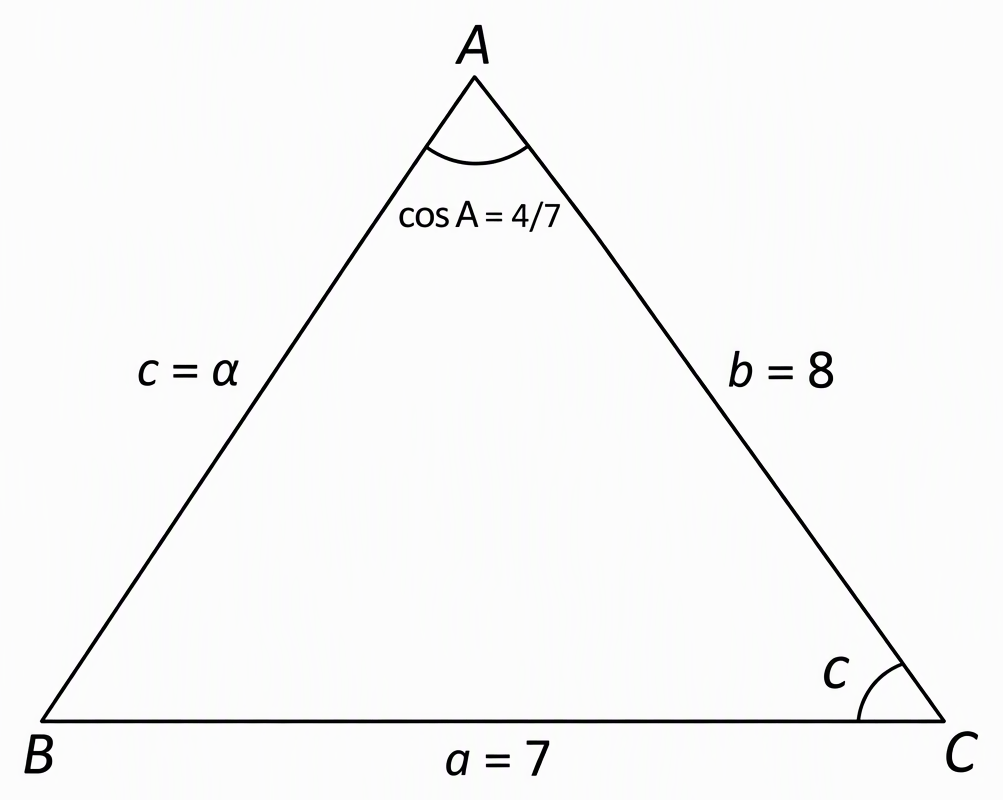
Express the following in lowest terms, with a positive denominator, and find the numerator-plus-denominator sum:
This is a numerical-answer question, with no multiple-choice options supplied. The bank tags it Hard and gives an expected solving time of 240 seconds, or four minutes, not measured student performance.
How does the cosine rule determine the natural-number side?
The natural-number condition selects 7. The cosine rule gives two positive roots, but only one is a natural number. Do not discard the other root as negative or geometrically impossible: neither explanation is correct.
First fix the opposite-side labels. Each lowercase side is opposite its matching uppercase angle:
The sides meeting at angle A belong in the denominator. The opposite side supplies the squared term being subtracted:
Cross-multiply to obtain the official quadratic, then compute its discriminant:
The two roots are:
The fractional root satisfies the strict triangle inequality. It fails only the natural-number requirement:
Write that reason beside the discarded root. Selecting the admissible root establishes the equal sides; starting with the triple-angle identity would not establish that geometry.
Why can we use the given cosine for angle C?
Equal sides BC and AB make angles A and C equal, not angles A and B. BC lies opposite A, while AB lies opposite C. The accepted root therefore lets us transfer the given cosine to angle C:
The shared endpoint of two equal sides does not identify the equal angles. Their opposite vertices do, so check those labels before substituting.
Use the triple-angle identity and keep the denominator conversion visible:
Preserve the negative sign through the remaining calculation. Use this official cosine-rule-to-triple-angle route: it gives an exact fraction without inverse trigonometry or calculator angle estimates.
How does the reduced fraction give negative 31?
The reduced numerator is negative 38 and the denominator is positive 7. Coprimality does not require a positive numerator. Substitute the signed triple-angle value before identifying either integer:
Cancel the factor of 49, then combine the terms:
Check lowest terms using the remainder:
Since 7 is prime and does not divide 38, the numerator and denominator share no factor greater than 1. The denominator is already positive, so retain the numerator’s sign:
Why is 45 wrong even though the fraction is reduced?
45 comes from changing the fraction’s sign, not from reducing it. It is an incorrect result, not an answer option. Replacing the negative fraction by its positive counterpart produces this invalid calculation:
Reduction divides both numerator and denominator by a common factor. It never takes the numerator’s absolute value. The gcd ignores sign, but the numerator retains it:
An optional exact angle check confirms the negative triple-angle cosine. Since A is a triangle angle and cosine decreases between zero and 180 degrees,
A negative cosine alone does not prove that the full expression is negative. Include the added constant to settle that sign:
Which two related questions test the same sign checks?
Use the double-angle drill for denominator handling and the triple-angle drill for the added constant. Both are original related practice, not verified JEE PYQs. Cover each worked check and attempt the question first.
What is the double-angle cosine when the given cosine is four-sevenths?
Question 1, original related practice: The answer is negative seventeen forty-ninths. Given the following cosine, find the double-angle cosine:
Apply the identity and express both terms over the same denominator:
This tests denominator handling without the triangle setup. Preserve the negative result; there is no instruction to take its magnitude.
What is the numerator-plus-denominator sum when the given cosine is three-fifths?
Question 2, original related practice: The required sum is 8. Given the following cosine, express the full expression in lowest terms with a positive denominator and find the requested sum:
Calculate the triple-angle cosine first, then include the constant:
The triple-angle cosine is negative in both problems, but this drill’s added constant makes the full expression positive. On your next attempt, write the signed reduced fraction on a separate line before naming its numerator and denominator.
Next step: the past-paper archive on JEEnius and search every JEE Main paper from 2002 and every Advanced paper from 2007, by year, subject or chapter, each with a worked solution (free).
Related on JEEnius: Redox Reactions and Electrochemistry JEE 2018: Cell EMF.
Frequently asked questions
What is the answer to the trigonometrical identities JEE 2024 triangle question?
The answer is -31. The cosine rule gives the admissible side length alpha = 7, so cos C = 4/7. The triple-angle identity then gives 49 cos(3C) + 42 = -38/7, making the numerator-plus-denominator sum -38 + 7 = -31.
Why is alpha = 15/7 rejected in this triangle problem?
The question requires alpha to be a natural number, and 15/7 is not one. This root is positive and satisfies the strict triangle inequality, so neither negativity nor invalid geometry is a valid reason to reject it.
Why are angles A and C equal in this problem?
The accepted root gives BC = AB = 7. BC is opposite angle A, while AB is opposite angle C, so these two angles are equal. Therefore, cos C = cos A = 4/7.
Why is the answer -31 instead of 45?
The reduced fraction is -38/7, with a positive denominator and a negative numerator. Taking 38 + 7 changes the numerator's sign and produces the incorrect result 45. Reduction preserves the fraction's value, so the required sum is -38 + 7 = -31.