
What is the answer to the JEE Advanced 2018 Paper 2 cell-emf question?
The JEE Advanced 2018 electrochemistry numerical gives a nonzero standard entropy change despite zero cell emf. The answer checkpoint, per mole of B produced, is:
This Chemistry numerical-answer question is from JEE Advanced 2018 Paper 2. It is tagged medium on the question bank’s scale, with a suggested solving time of 180 seconds.
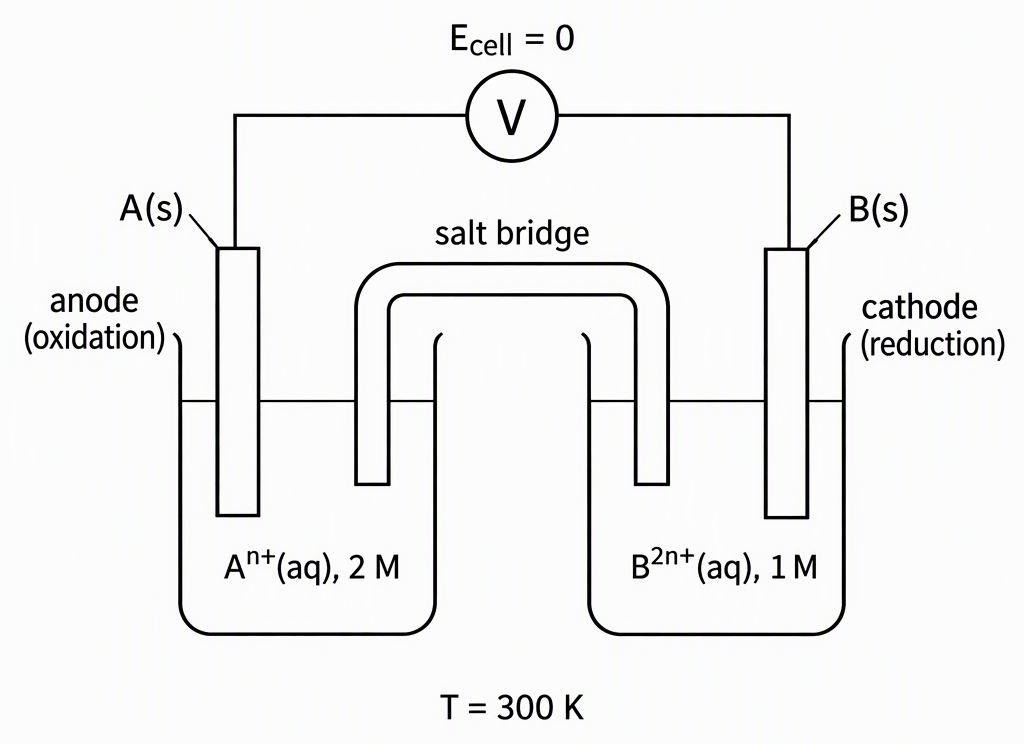
An A metal electrode sits in a 2 M solution of its ions, whose charge is n positive. It is coupled to a B metal electrode in a 1 M solution of its ions, whose charge is twice n positive. The cell emf is zero at 300 K.
At this temperature, the supplied thermodynamic relation is:
Find the standard entropy change per mole of B produced, using:
How do I balance the reaction and calculate the reaction quotient?
Balance for one mole of B first. This fixes both the electron count and the concentration exponent; neither should be taken from an isolated ionic charge without checking the balanced reaction.
The oxidation half-reaction is:
Multiply it by two to supply the electrons needed for reduction:
The reduction half-reaction is:
Adding them gives:
This reaction produces one mole of B, with electron transfer number:
Pure solids have unit activity, so neither metal appears in the quotient. Following the supplied solution’s concentration treatment:
The exponent two comes from the stoichiometric coefficient of the A ion, not its charge. The B-ion concentration has exponent one because its coefficient is one. Keep this balanced equation beside the working: changing its scale changes the thermodynamic quantities being calculated.
How can zero cell emf give a nonzero standard Gibbs energy?
The measured emf is zero at the supplied concentrations, not at standard conditions. Since the reaction quotient is four rather than one, the Nernst correction is nonzero, and the standard emf must balance it.
For the balanced reaction:
Substitute the stated emf and quotient:
Therefore:
Now follow the official Nernst-to-Gibbs route:
The entire electron-count and Faraday-constant factor cancels. No numerical value of either is needed. The actual Gibbs energy change is instead:
Zero actual emf establishes zero actual Gibbs energy change at the stated composition, not zero standard Gibbs energy change. Standard-state activities would give a quotient of one. The Nernst correction accounts for that composition difference; dropping it would erase the distinction the question tests.
How does the entropy change become negative 11.62?
Start with the thermodynamic identity:
The supplied enthalpy relation makes the standard entropy change equal to the standard Gibbs energy change divided by temperature. Since the latter is negative here, the entropy change must also be negative.
Substitute the given relation:
Rearrange line by line:
Insert the result from the Nernst calculation:
Evaluate using the supplied logarithm:
This is per mole of B formed, because the reaction has not been rescaled. Check the sign independently of the arithmetic:
Together with the entropy relation:
The cancellation of temperature is specific to the supplied relations at 300 K. It does not establish temperature independence under other conditions, where the emf or thermodynamic relation may differ.
Why is zero an incorrect numerical answer?
Zero results from substituting the measured emf into the standard-emf position. This is a numerical-answer question with no supplied options, so this diagnoses an incorrect numerical result, not an official distractor.
The erroneous chain is:
The exact invalid step deletes the Nernst correction even though:
The later algebra cannot repair that first substitution. The zero belongs to the actual cell at the stated concentrations, not to a standard-state cell.
Practical correction: label every emf and Gibbs-energy symbol as “actual” or “standard” before substituting zero. Keep those labels until the Nernst equation has connected the two conditions.
Which three follow-up questions check the method?
Use these original follow-up practice questions to check actual versus standard conditions, reaction scale, and the sign of the quotient’s logarithm. They are not further questions from the 2018 paper.
At zero emf, is the actual Gibbs energy change, the standard change, or both zero?
Only the actual Gibbs energy change is zero:
The actual composition has a quotient of four, while standard-state activities give a quotient of one.
What changes if the reaction produces half a mole of B?
The standard entropy change halves because the entire reaction is halved:
This is per mole of reaction as written. Converting back to one mole of B restores:
What if the A-ion concentration is 1 M and the B-ion concentration is 4 M?
In this hypothetical variant, retaining zero emf and the given enthalpy relation at 300 K makes the entropy change positive:
This remains per mole of B. Before calculating, check whether the quotient is above or below one, then predict the sign.
Next step: photograph a doubt on JEEnius and photograph any question you are stuck on and get a step-by-step solution, with a free-body diagram when the question needs one (20 free).
Keep going with Ray Optics JEE 2019: Optical-Bench Error Calculation.
Frequently asked questions
What is the answer to the JEE Advanced 2018 Paper 2 cell-emf question?
The standard entropy change is -11.62 J K⁻¹ mol⁻¹ per mole of B produced. Using the balanced reaction gives Q = 4, and the supplied thermodynamic relation leads to ΔS° = -R ln 4.
Why does zero cell emf not mean zero standard Gibbs energy?
Zero measured cell emf gives zero actual Gibbs energy change at the stated composition. Here Q = 4, so the Nernst correction is nonzero and ΔG° = -RT ln 4 rather than zero.
How do I calculate the reaction quotient in the 2018 cell-emf problem?
Balance the reaction for one mole of B: 2A(s) + B²ⁿ⁺ → 2Aⁿ⁺ + B(s). Omitting pure solids and using the supplied concentrations gives Q = [Aⁿ⁺]²/[B²ⁿ⁺] = 2²/1 = 4. The exponent two comes from the stoichiometric coefficient, not the ionic charge.
Do I need the value of n to solve the JEE 2018 electrochemistry numerical?
No numerical value of n is needed. The balanced reaction transfers 2n electrons, but the factor 2nF cancels when E° = (RT/2nF) ln 4 is substituted into ΔG° = -2nFE°.