
What is the JEE Advanced 2019 four-string matching question?
The JEE Advanced 2019 oscillations and waves question reports answer A, but the supplied tension list contradicts its own calculation. From Paper 2, Physics, this is a match-list question on standing waves in stretched strings. The question bank classifies it as medium.
Four strings have different lengths and harmonics but share one frequency. The supplied solution treats all four as fixed at both ends, assumes a common linear mass density and takes string I’s tension as the reference. Equal density appears in the supplied solution, not in the supplied question text.
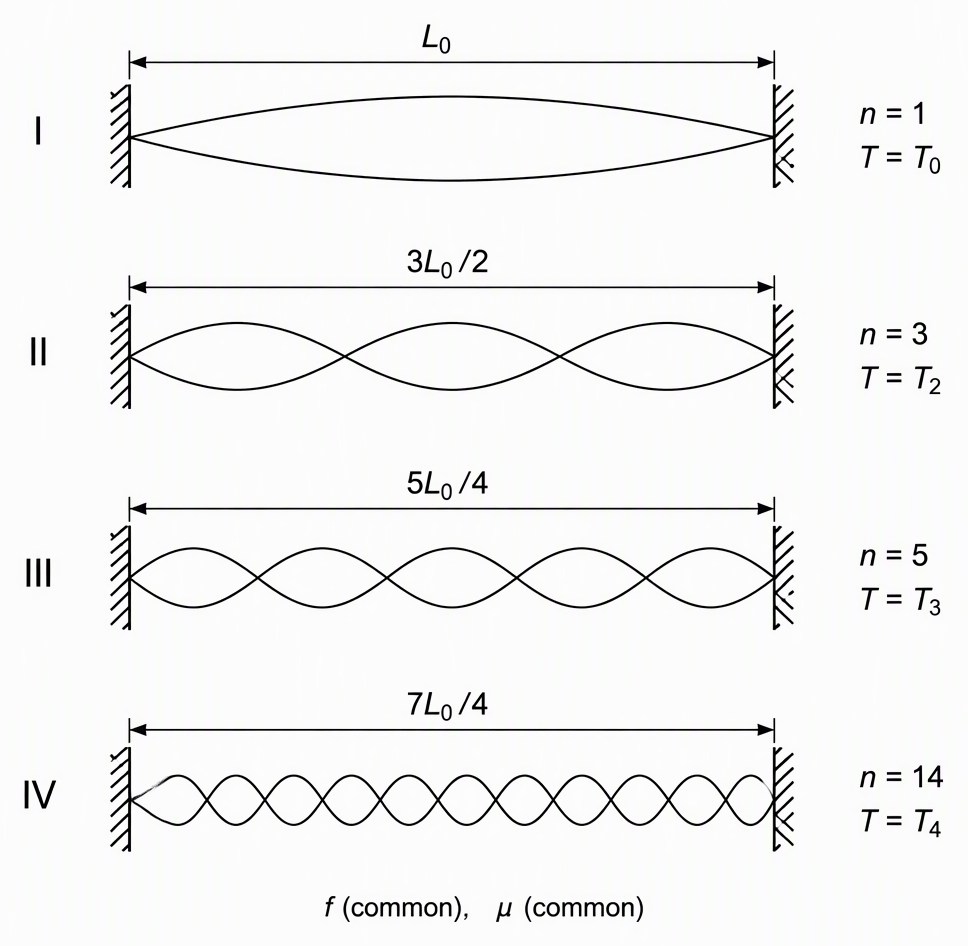
The length–harmonic pairs are:
- I:
- II:
- III:
- IV:
The supplied choices are:
The extract omits the numerical matching list for labels P through U. Its option letters therefore cannot be independently reconstructed, even after calculating the tensions.
How do you compare every string with string I?
Use the fixed-end harmonic formula, then divide each string’s frequency equation by the reference equation. The common density cancels because the supplied solution assumes equal linear densities.
The symbols below denote harmonic number, string length, tension and mass per unit length, respectively:
For string I:
Equating any string’s frequency to the reference gives:
Cancel the factor of two, then the common square-root density factor:
Divide by the square root of the reference tension and rearrange:
Square both sides:
Equal frequency does not mean equal wave speed. The harmonic-number-to-length factor also changes:
What tension ratios do the four substitutions give?
Under the supplied solution’s equal-density assumption, the ratios are one, one-quarter, one-sixteenth and one-sixty-fourth. Calculate each relative to string I, not from the source’s later numerical list.
- String I is the reference:
- String II: Simplify its frequency coefficient first.
- String III:
- String IV:
Thus, under equal density:
Check by multiplying each harmonic-length factor by its square-root tension ratio. Every product must equal 1:
Why does the supplied answer say A despite different tensions?
The supplied final answer is A: I–P, II–Q, III–T, IV–U. This is the source-reported answer, not an independently verified match.
The supplied solution separately lists these tensions in reference-tension units:
These are not consequences of the preceding algebra. For string II, the solution first calculates:
It subsequently lists:
Its reference to an “effective denominator” supplies no mathematical step that resolves this discrepancy. The missing numerical matching list and inconsistent tensions prevent independent verification of A from this extract.
Do not invent unequal densities, altered lengths or a revised harmonic number to force agreement. No different correct option can be established from the supplied material.
How can changing the reference produce option D’s first match?
Using string III’s reported tension label for string I produces the I–T entry in option D. This is a loss of the reference, not a harmonic calculation: the reference definition already fixes the first ratio.
In the source-reported correspondence, P belongs to string I, while T belongs to string III. Assigning string III’s label to the reference string produces D’s incorrect first match relative to that correspondence.
This diagnoses only D’s first-entry error, not all four entries numerically. Write the following at the top of your working and keep every later ratio relative to string I:
Which three standing-wave drills should you solve next?
Use these original follow-up drills, not additional verified PYQs, to check reference choice, squaring and density cancellation. Attempt each before reading its worked answer.
- Drill 1: Two fixed-end strings have equal linear density and frequency. The reference is in its first harmonic; the other has twice its length and is in its fourth harmonic. Find the tension ratio.
- Drill 2: A fixed-length string with unchanged linear density changes from its second to its sixth harmonic while retaining the same frequency. Find the new tension divided by the original.
- Drill 3: Two fixed-end strings have equal length, harmonic number and frequency. The second has twice the linear mass density. Find the tension ratio.
Equal frequency now requires equal tension-to-density ratios:
Cancel density only when the densities are equal. Before your next substitution, write the reference tension and check that assumption.
Next step: photograph a doubt on JEEnius and photograph any question you are stuck on and get a step-by-step solution, with a free-body diagram when the question needs one (20 free).
For a worked example of the same idea, see How to Study Ellipse JEE: Axes, Tangents and Chords.
Frequently asked questions
How do I calculate tension ratios for strings with the same frequency?
For a string fixed at both ends, use f = n/(2L) × √(T/μ). With equal linear densities and a reference string in its first harmonic, dividing the frequency equations gives T_i/T_0 = [L_i/(n_i L_0)]².
What are the tension ratios in the JEE Advanced 2019 four-string question?
Under the supplied solution's equal-density assumption, the tensions relative to string I are 1, 1/4, 1/16 and 1/64. These follow by squaring each string's length ratio divided by its harmonic number.
Is option A verified for the JEE Advanced 2019 four-string question?
The supplied source reports A, but the extract does not allow independent verification. It omits the numerical matching list for P through U, and its listed tensions contradict its algebra. No alternative correct option can be established from the supplied material.
Can I cancel linear mass density when comparing string frequencies?
You can cancel linear mass density only when the strings have equal linear densities. In this extract, equal density is assumed by the supplied solution but is not stated in the supplied question text.