
How should I start an ellipse question for JEE?
- Repair only the prerequisites you need. To study ellipse for JEE, learn to choose an equation from the given condition, not memorise a longer formula list. Check completing the square, straight-line equations, quadratic discriminants and basic trigonometric parametrisation.
Repair a weak skill when it blocks a question. Completing the square reveals the centre; line equations describe chords; the discriminant counts intersections; parametrisation keeps a moving point on the ellipse.
- Translate and normalise before naming the axes. Complete the squares and divide until the right side is one. Use coordinates measured from the centre:
The larger denominator determines the major-axis direction. The capital letters track coordinate directions; define the semimajor and semiminor axis lengths, respectively, by:
For the noncircular ellipses considered, calculate the focal distance and eccentricity using:
Place the foci along the major axis, not automatically along the horizontal axis.
- Identify the condition before calculating. Dimensions, eccentricity and foci call for standard form. A moving point often calls for parametrisation:
An unknown line calls for substitution into the ellipse and a quadratic condition. Two distinct real intersections mean a secant; a repeated intersection means a tangent; no real intersections mean the line misses the ellipse.
- Use a compact condition-to-equation map. The following results apply to this horizontal, centred ellipse. Choose by the given condition:
- Tangent at a known point on the ellipse:
- Unknown nonvertical tangent:
- Chord with a known noncentral midpoint:
The tangent-at-a-point formula requires an on-ellipse point. A nondegenerate chord midpoint must lie strictly inside; at the centre, the midpoint does not determine a unique chord because every diameter qualifies.
Slope form omits vertical lines, so check them separately. For shifted ellipses, apply these formulas in translated coordinates.
- Audit before accepting the answer. Check axis orientation, point membership and the required line condition. A tangent must have one repeated intersection; a proposed midpoint chord must pass through its midpoint and have symmetric endpoints.
Study in this order: standard form and focal geometry, parametric points, line intersections and tangents, midpoint chords, then mixed problems. Leave advanced identities until these foundations are secure. At every stage, explain why the chosen representation fits the information given.
How do I find the geometry of a shifted vertical ellipse?
The larger denominator after normalisation fixes the major axis, regardless of which coordinate appears first. Constructed teaching example 1, not a previous-year JEE question: find the centre, major-axis direction, eccentricity, foci and directrices of:
Divide by 36:
Read off the centre and semiaxis lengths:
The vertical denominator is larger, so the major axis is vertical. The foci lie above and below the centre, while the directrices are horizontal.
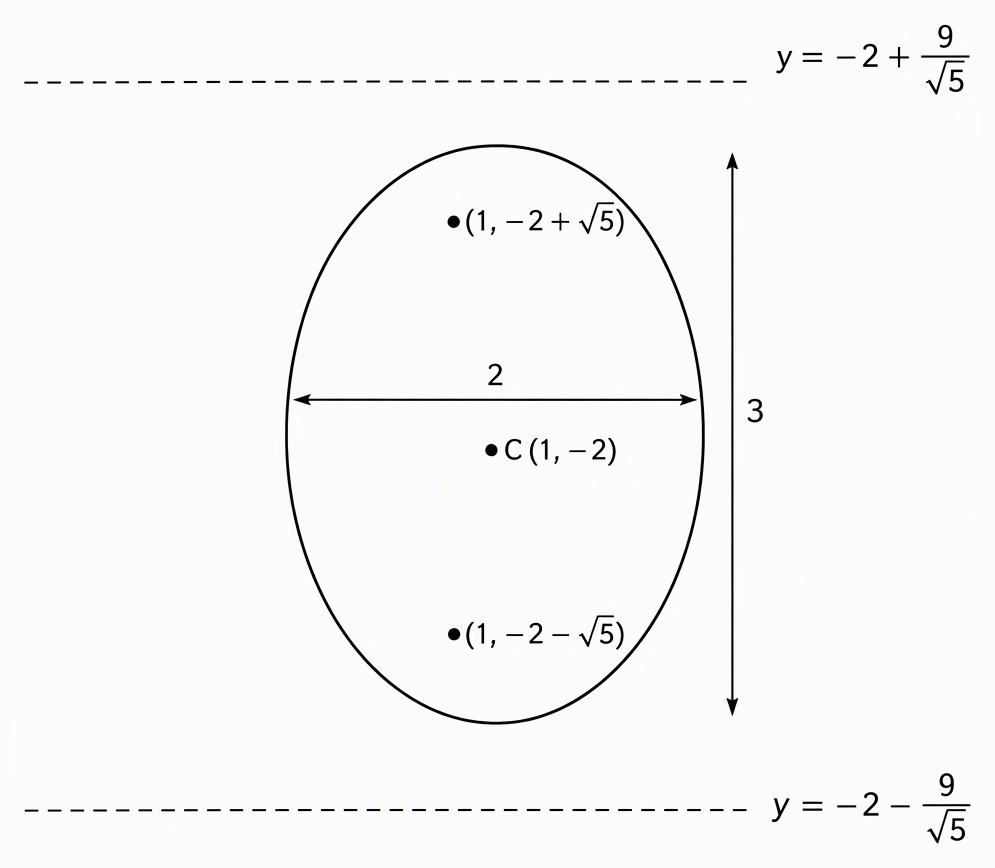
Calculate the focal distance and eccentricity:
Hence the foci are:
Each directrix is perpendicular to the major axis. Its distance from the centre along that axis is:
Therefore:
Audit: the eccentricity is between zero and one. The focal distance is smaller than the semimajor axis, while the directrix distance is larger:
Both foci lie inside the ellipse on its vertical major axis; both directrices lie outside. Assigning the semimajor-axis square to the horizontal denominator by habit puts both the foci and directrices in the wrong direction.
How do I find both tangents through an external point?
Use an unknown line through the external point and demand a repeated intersection. The external point is not a point of contact. Constructed teaching example 2, not a previous-year JEE question: find both tangents and their contact points for:
Classify the point first:
It is external, so substituting it into the tangent-at-a-point formula is invalid. Write a nonvertical line through it:
Substitute into the ellipse and collect terms:
Tangency means a repeated root. Set the discriminant to zero:
Thus the two tangents are:
The slope-form shortcut expresses this same zero-discriminant condition:
Use the repeated-root formula to find the contact coordinates:
The respective contact points are:
Both satisfy the ellipse:
They also satisfy their respective tangents:
Finally, the omitted vertical line through the external point has two distinct intersections, so it is a secant:
Practise this distinction: a point the tangent passes through need not be its contact point. One fresh ten-question JEEnius daily practice set on ellipse can diagnose such confusion; free sets are available daily, but ten questions do not complete the chapter.
How do I find a chord when its midpoint is given?
Use endpoint symmetry, not the tangent-at-a-point formula. Constructed teaching example 3, not a previous-year JEE question: find the chord of the following ellipse whose midpoint is given below:
First check feasibility:
The midpoint lies inside, so a nondegenerate chord is possible. Represent its endpoints symmetrically about the midpoint:
Both endpoints satisfy the ellipse. Subtract their equations:
This gives the chord’s direction. Since the line passes through the midpoint:
Only now introduce the textbook notation:
The midpoint-chord condition is:
Incorrectly using the tangent-at-a-point condition gives:
That line does not even pass through the stated midpoint:
For an endpoint check, parametrise the actual chord:
Substitution into the ellipse gives:
The opposite parameter values confirm symmetric endpoints. Reusable audit: the proposed chord must pass through its midpoint, and its endpoints must be symmetric about that point.
What should I practise after basic ellipse questions for JEE?
Start with shifted and vertical ellipses, then progress through points, lines and chords before mixed problems. Move on when you can state why your equation applies and verify the answer without consulting notes, not after a fixed number of days.
- Shifted and vertical ellipses: extract the centre, axes, foci and directrices.
- Parametric points: substitute coordinates and simplify using trigonometric identities.
- Line-intersection counts: distinguish secants, tangents and lines that miss.
- Tangents: separate contact-point questions from external-point questions.
- Midpoint chords: derive the direction and check symmetry.
- Mixed focal and normal problems: combine these foundations after you can justify the earlier choices.
After elementary drills, practise both JEE Main and JEE Advanced previous-year ellipse problems. Keep a short error log with four labels: wrong axis, wrong condition, algebra error, missing validity check. Redo the failed question, then attempt an unseen question of the same type.
For that unseen follow-up, JEEnius practice mode offers topic sets that skip questions already seen, with free sets included. Use it to check whether you corrected the reasoning, not merely remembered an answer.
Closed-book checkpoint: explain why the external point in example 2 cannot be treated as a contact point, and why the midpoint in example 3 cannot be put into a tangent equation. Write the failed applicability condition in each case before solving another question.
Next step: daily practice problems on JEEnius and get a fresh ten-question set on a topic every day (free sets daily).
If that step was the hard part, work through Gravitation Practice Questions JEE: 6 Solved Drills.
Frequently asked questions
In what order should I study ellipse for JEE?
Start with standard form and focal geometry, then study parametric points, line intersections, tangents and midpoint chords. Attempt mixed problems and JEE Main and Advanced previous-year questions after these foundations are secure. Move on when you can justify your equation and check the answer without notes.
How do I identify the major axis of a shifted ellipse?
Complete the squares and normalise the equation so its right side is one. The larger denominator identifies the major-axis direction: under the squared x-coordinate term it is horizontal, and under the squared y-coordinate term it is vertical. Place the foci along that axis through the centre.
How do I find tangents to an ellipse from an external point?
Write an unknown nonvertical line through the external point and substitute it into the ellipse equation. Set the resulting quadratic's discriminant to zero to impose tangency, and check the vertical line separately. Do not put the external point into the tangent-at-a-point formula: that formula requires a point on the ellipse.
What is the formula for an ellipse chord with a given midpoint?
For x²/a² + y²/b² = 1 and a noncentral midpoint (x₁, y₁), the chord is xx₁/a² + yy₁/b² = x₁²/a² + y₁²/b². A nondegenerate chord requires its midpoint to lie strictly inside the ellipse. If the midpoint is the centre, every diameter qualifies, so the chord is not unique.