
How should I study Dual Nature for JEE in six steps?
To study Dual Nature for JEE, identify the object before choosing the equation: photons and electrons do not use the same momentum formula. Sort questions into photoelectric energy balance, experimental graphs and matter-wave comparisons. Use the routine classify, check, calculate, audit, checking threshold, units and physical assumptions before calculating.
- Check the prerequisites before starting numericals.
You need kinetic energy in terms of momentum, electrical energy gain, frequency–wavelength conversion and electronvolt conversion:
The potential difference must accelerate the charge. Also practise reading a straight line: slope is vertical change divided by horizontal change; find intercepts by setting one coordinate to zero. Class 11 students should bridge these gaps first.
- Read NCERT for observations, not just equations.
Explain the observations before copying formulas: one photon must supply the work function, and extra photon energy becomes electron kinetic energy. At fixed frequency above threshold, greater intensity supplies more photons and raises saturation current under unchanged ideal conditions.
Read matter waves and the Davisson–Germer experiment: electron diffraction demonstrates the wave nature of electrons and supports de Broglie’s relation. NCERT supplies this conceptual foundation, but reading alone does not establish numerical or graph-solving competence.
- Build a three-entry question map.
- Photoelectric emission: balance one photon’s energy against the work function and maximum electron kinetic energy.
- Experimental graphs: identify both axes, their units and the controlled variables before finding a slope or intercept.
- Matter waves: begin with momentum, not mass alone.
- Make one compact formula sheet.
Here, the stopping-potential symbol denotes its magnitude, and the charge symbol denotes the positive elementary charge. Threshold frequency and threshold wavelength correspond to the same work function.
- Check the object, threshold and units before substituting.
Check whether photon energy meets the work function before calculating photoelectron energy. Photon momentum is energy divided by light speed; for a non-relativistic massive particle, use:
Never apply that massive-particle expression to a photon. For a particle starting from rest, electrical acceleration gives:
Use this with the non-relativistic momentum expression only when losses are neglected and the resulting motion remains non-relativistic. Keep energies consistently in joules or electronvolts.
- Audit the result physically.
A negative calculated maximum kinetic energy means no emission, not a negative physical kinetic energy. Above threshold, increasing photon frequency raises maximum photoelectron energy for the same metal; increasing particle momentum lowers its wavelength.
How do I check the threshold before finding stopping potential?
Compare photon energy with the work function first. Below threshold, there are no photoelectrons whose stopping potential you can calculate. Original teaching problem, not a previous-year JEE question: a metal has work function 2.00 eV and receives 400 nm light. Find maximum photoelectron kinetic energy and stopping-potential magnitude.
Classify: This is a single-photon photoelectric energy-balance problem. Use the standard approximation:
Check: Find the threshold wavelength:
Emission is energetically allowed in the ideal model when:
The incident wavelength passes this check.
Calculate: Find photon energy, then subtract the work function:
Audit: Change the light to 700 nm:
There is no emission. A negative result from subtraction is not a physical kinetic energy.
At fixed frequency above threshold, greater intensity increases saturation current under otherwise unchanged ideal conditions. It does not change maximum kinetic energy or stopping potential. Below threshold, intensity cannot produce emission in the standard single-photon model.
How do I extract threshold frequency and work function from a graph?
The horizontal intercept gives threshold frequency; the extrapolated vertical intercept gives the work function after multiplication by the negative elementary charge. Original teaching problem, not a previous-year JEE question: find both quantities for a stopping-potential graph passing through these points, with positive frequency and voltage scale constants:
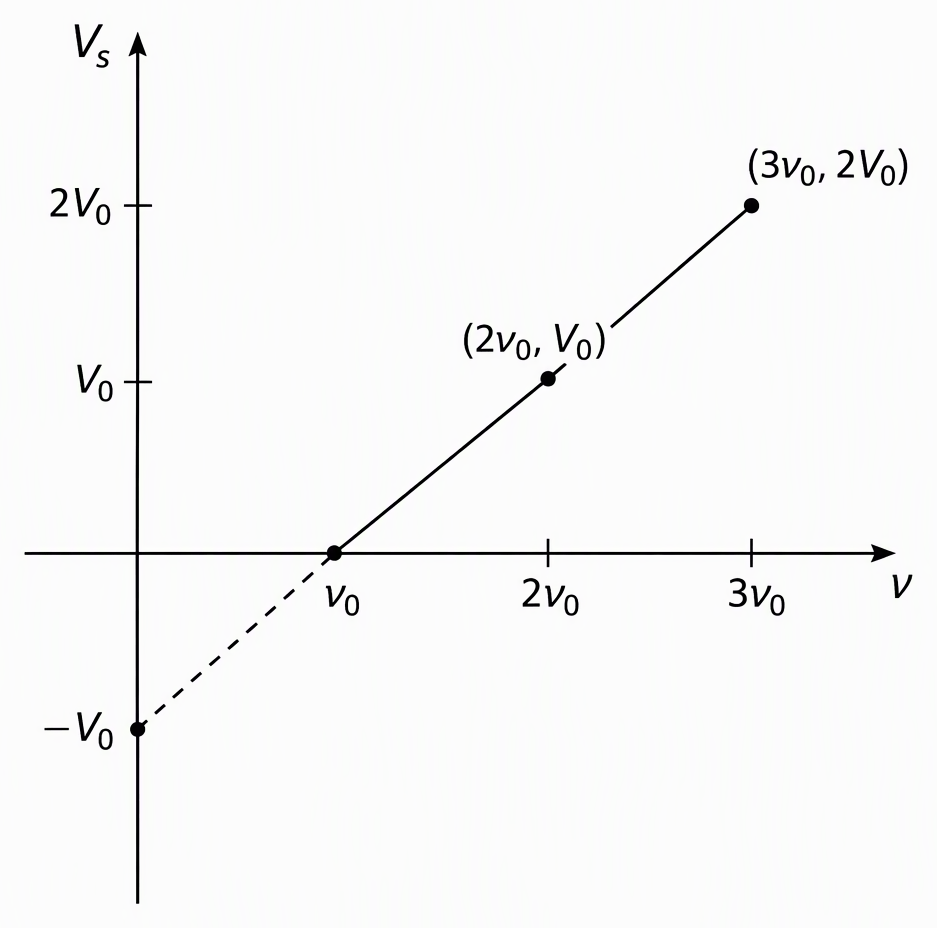
Classify: This is a slope-and-intercept problem, not a photocurrent problem. The metal is unchanged.
Check: The vertical axis is stopping-potential magnitude, not electron energy. Below threshold, the extrapolated line does not represent measured stopping potentials.
Calculate: Use the two points:
Compare this with the photoelectric equation:
The threshold frequency, work function and inferred Planck constant are:
Audit: The negative vertical intercept belongs only to the extrapolation. It is not a negative stopping-potential magnitude below threshold.
- Stopping potential against frequency: slope is Planck’s constant divided by elementary charge.
- Maximum kinetic energy in joules against frequency: slope is Planck’s constant.
- Maximum kinetic energy in eV against frequency: the numerical slope changes with the energy unit; interpret it in eV seconds.
- Current against collector voltage: at fixed frequency and metal, increasing intensity raises saturation current but leaves the stopping-potential intercept unchanged.
Do not claim a universal current change when frequency varies at fixed intensity. Photon flux and emission response must both be considered.
For repeated graph practice, JEEnius daily practice problems provide a fresh ten-question topic set every day, with free sets daily. The set need not match a particular question-type mix.
How do I compare electron and proton wavelengths without long calculations?
Use a ratio before inserting constants. At equal non-relativistic kinetic energy, the heavier particle has the shorter wavelength; at equal momentum, their wavelengths are equal. Original teaching problem, not a previous-year JEE question: an electron and a proton start from rest and are accelerated through the same potential-difference magnitude. Compare their wavelengths, assuming both remain non-relativistic.
Classify: This is a matter-wave comparison after electrical acceleration. Start from de Broglie’s relation.
Check: The charge magnitudes are equal, so both gain the same kinetic energy:
Calculate: Write each wavelength and divide:
The electron has the larger wavelength.
Audit: Distinguish the conditions:
- Equal non-relativistic kinetic energy: the same mass-ratio result holds.
- Equal momentum: wavelengths are equal regardless of mass.
- Equal accelerating potential, unequal charge magnitudes: for non-relativistic particles starting from rest, compare the product of mass and charge magnitude, not mass alone.
For the same particle, quadrupling accelerating potential halves wavelength, provided the motion remains non-relativistic:
If the non-relativistic momentum expression becomes inappropriate, de Broglie’s starting relation still holds:
What should I practise after learning these three methods?
Practise isolated skills first, then remove the question-type labels and solve mixed questions. A formula-sheet reread is not an adequate revision session: reconstruct the main relations, then solve unfamiliar questions.
- Energy conversions: threshold, work function, wavelength and stopping potential.
- Experimental reasoning: intensity changes, frequency changes and graph interpretation.
- Matter waves: ratios, equal-condition comparisons and accelerating-potential problems.
Use this recommended ten-question drill, not an exam distribution:
- Three photoelectric numericals.
- Three conceptual or graph questions.
- Three matter-wave questions.
- One mixed question requiring you to identify the correct model.
After topic-wise drills, attempt actual JEE Main previous-year questions. For Advanced preparation, add problems combining graphs, particle comparisons and multiple conceptual conditions. This is a practice choice, not a claim about a fixed Advanced pattern.
Maintain an error log with four labels:
- Wrong model
- Missed threshold
- Unit error
- Wrong controlled-variable assumption
Write the failed decision beside each label, then redo missed questions without looking at the solution. Copying corrected algebra does not test whether you can choose the method.
Use an exit check instead of a completion-time promise: explain an intensity change, recover a threshold from a graph and solve a matter-wave comparison unaided. If one fails, practise that skill before another full theory reread.
For unfamiliar follow-up questions, JEEnius practice mode offers topic sets that skip questions already seen, with free sets included. Choose the topic behind your latest error and solve the next set with your formula sheet closed.
Next step: practice mode on JEEnius and practise a topic in sets that skip questions you have already seen (free sets included).
If that step was the hard part, work through Three Dimensional Geometry JEE 2024: Closest Points and Dot Product.
Frequently asked questions
How should I study Dual Nature for JEE?
Start with energy, momentum, electronvolt conversions and straight-line graphs, then read NCERT for the experimental observations. Organise practice into photoelectric energy balance, experimental graphs and matter-wave comparisons. For each question, classify the model, check assumptions and units, calculate, then audit the result physically.
Is NCERT enough for Dual Nature in JEE?
NCERT provides the conceptual foundation, including photoelectric observations, matter waves and the Davisson–Germer experiment. Reading it alone does not establish numerical or graph-solving competence. Follow it with topic-wise drills and actual JEE Main previous-year questions; for Advanced preparation, add problems combining graphs, particle comparisons and multiple conditions.
How do I check whether photoelectric emission will occur?
Compare the incident photon energy with the metal's work function before calculating maximum kinetic energy or stopping potential. Emission is energetically allowed in the ideal model when photon energy meets or exceeds the work function. Below threshold, increasing intensity cannot produce emission in the standard single-photon model.
How do I find work function from a stopping-potential graph?
For stopping-potential magnitude plotted against frequency, the horizontal intercept gives the threshold frequency. The extrapolated vertical intercept is −φ/e, so multiply that intercept by −e to obtain the work function. The extrapolation below threshold does not represent measured stopping potentials.
Which has a larger de Broglie wavelength, an electron or a proton?
At equal non-relativistic kinetic energy, the electron has the larger wavelength, with λe/λp = √(mp/me). This also applies when both start from rest and accelerate through the same potential-difference magnitude, neglecting losses and remaining non-relativistic. At equal momentum, their wavelengths are equal.