
What should I do before expanding a determinant?
Create zeros before expanding when that reduces the work. To study determinants for JEE, learn to recognise structure and choose a legal move before calculating. Direct expansion is sensible when a row is already sparse. Use this five-step routine to justify your first operation.
- Identify the task. Evaluation needs a value. A variable determinant may need factorisation followed by solving:
A system of equations needs a uniqueness or consistency decision. These tasks can start with the same algebra but require different final checks.
- Scan for structure. An existing sparse row suggests cofactor expansion. Similar rows suggest subtraction; equal or proportional rows make the determinant zero. A parameter signals that exceptional values need checking. Inspect columns too: a useful pattern may be easier to see vertically.
- Choose a legal transformation. Keep these operation rules separate:
- Swapping two rows reverses the determinant’s sign.
- Multiplying one row by a constant multiplies the determinant by that constant.
- Adding a multiple of another row to a row leaves the determinant unchanged.
The corresponding column rules also hold. Taking a common factor out of one row produces one factor outside the determinant. Scaling the entire square matrix scales every row:
Here, the exponent is the matrix order. Scaling the whole matrix does not generally produce just one factor of the scaling constant.
- Expand or factor. Your prerequisite checklist is short: second-order evaluation, minors, cofactor signs and expansion along any row or column.
A minor is the determinant left after deleting the entry’s row and column. Choose an expansion line with zeros; factor visible common expressions before multiplying out.
- Check the result and any excluded values. Track swaps and extracted factors. Test a simple substitution when variables are present. Dividing by the following expression silently excludes its zero:
Factor it out instead and retain the corresponding case separately. In a system, return to the original equations at every singular parameter value.
How do I create zeros in a numerical determinant?
Use a convenient pivot to clear other entries in its column. In this teaching example, the first entry is one, so the other first-column entries can be removed without fractions. Two row replacements reduce the calculation to a single second-order minor.
The recognition cue is the first column: its second and third entries are twice and three times the pivot. Keep the first row unchanged and apply:
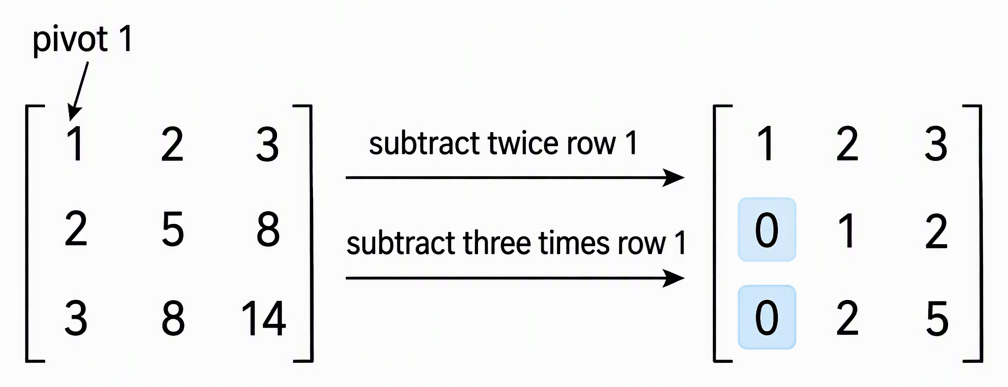
Expanding along the first column gives:
No multiplier or sign correction is needed, because both operations are row replacements. No row was scaled or swapped.
An initial first-row expansion requires three second-order minors. The transformed first-column expansion requires only one, after a few subtractions. Exploit a convenient pivot to clear a row or column before doing arithmetic.
How do I factor a variable determinant without memorising the answer?
Subtract rows with matching entries, then extract the differences that appear. For the determinant below, the first column is identical in all three rows. Subtraction creates zeros and exposes factors. The task is to find its factorised form, not a long polynomial.
Apply:
Use differences of squares:
Extract one factor from each changed row:
The remaining first-column expansion gives:
Hence:
Keep this factor order to avoid an accidental sign reversal. Factoring is not division: the identity remains valid when two variables are equal, and both sides then vanish.
Check the sign using:
Equal-variable substitutions reveal candidate factors because they produce equal rows. Guessing those factors alone does not establish the overall multiplier or sign.
Practise recognising the subtraction, not recalling the final product. JEEnius practice mode offers topic sets that skip questions already seen, with free sets included.
What should I do when a parameter makes the determinant zero?
Substitute each singular value into the original equations and check consistency. A nonzero coefficient determinant guarantees a unique solution. A zero determinant does not distinguish no solution from infinitely many solutions. Find the parameter values giving each outcome for this system:
Its coefficient determinant is:
Subtract the first row from each remaining row:
Extract the common factor from each changed row:
There are three cases. Keep the determinant calculation separate from the consistency check: the determinant identifies the values to inspect, but the right-hand sides decide what happens there.
- Unique solution: Away from both roots, the determinant is nonzero.
Subtracting pairs of original equations gives:
Since the common coefficient is nonzero in this case, all three unknowns are equal. Substitution gives:
- Infinitely many solutions: At the first singular value, all three original equations become the same equation.
Two unknowns can be chosen freely. The third is fixed by their sum.
- No solution: At the other singular value, adding all three original equations produces a contradiction.
Applying Cramer’s rule at a zero determinant would require division by zero. Cancelling the common parameter factor without checking its zero separately would lose the infinite-solution case. Check singular values in the original equations before using a formula that divides by a parameter expression.
What should I practise after these three examples?
Build technique in separate sets, then mix question types so the first move is no longer announced. Before every solution, write one recognition cue, such as “subtract similar rows” or “check singular values in the original equations”. This tests your decision-making, not just your arithmetic.
Follow this order:
- Basic evaluation and cofactor signs. Practise expansion along different rows and columns.
- Row and column operations. Track swaps, scaling and replacements separately.
- Variable factorisation and determinant equations. Factor before solving:
- Area and collinearity. Triangle area is half the absolute value of the coordinate determinant; collinearity means zero area.
- Adjugate and inverse applications. Know the identity and the condition for inversion:
- Parameter-dependent linear systems. Find singular values, then test each in the original equations.
After technique drills, attempt topic-wise JEE Main previous-year questions. Follow with mixed parameter and proof-style problems, then JEE Advanced previous-year questions. These techniques belong to both exams.
Keep four error-log categories:
- Cofactor sign: incorrect alternating sign.
- Illegal operation: an untracked change to the determinant.
- Missed factor: an overlooked common expression.
- Lost parameter case: division before checking its zero.
Retry each missed question without viewing its solution. Readiness means you can justify the first operation, track signs and factors, and check excluded values without prompting.
For the next practice round, daily practice problems provide a fresh ten-question set on a topic every day, with free sets daily. Write your recognition cue before solving each one.
Next step: daily practice problems on JEEnius and get a fresh ten-question set on a topic every day (free sets daily).
For a worked example of the same idea, see Dual Nature Practice Questions JEE: 6 Worked Solutions.
Frequently asked questions
How should I start studying determinants for JEE?
Start with second-order evaluation, minors, cofactor signs and expansion along any row or column. Then learn row and column operations, keeping swaps, scaling and replacements separate. Before calculating, scan for zeros, similar rows, common factors and parameter values that need checking.
Which row operations change the value of a determinant?
Swapping two rows reverses the determinant's sign, while multiplying one row by a constant multiplies the determinant by that constant. Adding a multiple of another row to a row leaves the determinant unchanged. The same rules apply to columns.
Does a zero determinant mean no solution?
A zero coefficient determinant can mean either no solution or infinitely many solutions. Substitute each singular parameter value into the original equations and check whether they are consistent. A nonzero coefficient determinant guarantees a unique solution.
What should I practise in determinants for JEE?
Practise basic evaluation and cofactor signs, then row and column operations, variable factorisation, area and collinearity, adjugate and inverse applications, and parameter-dependent systems. Follow technique drills with topic-wise JEE Main previous-year questions, mixed parameter and proof-style problems, and JEE Advanced previous-year questions. Track cofactor signs, illegal operations, missed factors and lost parameter cases in an error log.