
How should I study and solve Current Electricity for JEE?
- Check prerequisites before solving circuits. Current Electricity for JEE depends on potential difference, conventional current, conservation of charge and elementary simultaneous equations. Distinguish emf, the energy supplied per unit charge by a cell, from terminal voltage, the potential difference across its terminals.
- Study in dependency order. Begin with microscopic current and the relation between current density and electric field:
Next study resistance and temperature dependence:
The temperature relation is an approximation over a range where the temperature coefficient is nearly constant. Continue with resistor networks, cells and internal resistance, Kirchhoff’s laws, then bridge and measurement applications required by your current official syllabus.
- Build a conditions sheet, not just a formula sheet. The resistance formula above assumes a uniform conductor. Treat resistivity as approximately constant when temperature and material conditions remain fixed. For power comparisons, identify what the source holds constant:
Both expressions hold for an ohmic resistor. The source constraint decides which makes the comparison useful.
- Label nodes before calculating. Points joined by ideal wire share a potential. Mark source polarity and identify what remains constant. Series elements share an unbranched current path; parallel elements connect across the same two nodes. Position on the page proves neither connection.
- Choose the shortest valid method. Try series–parallel reduction first, then justified equal-potential or balanced-bridge arguments. Use Kirchhoff equations when those methods do not resolve the network. Do not write five equations when one proven zero-current branch removes the difficulty.
- Choose current directions freely, then keep your signs consistent. Across a resistor, travelling along its assumed current gives a potential drop. Crossing an ideal cell from negative to positive gives a rise:
Reversing the traversal reverses the sign. A negative current means the actual direction opposes your assumption.
- Check, reproduce and diagnose. Check units, current balance at nodes and a relevant limiting case, such as an open branch when its resistance becomes very large. Then reproduce the solution without looking. Label the first error as concept, topology, sign or algebra, rather than calling everything a calculation mistake.
The following examples are constructed teaching problems, not attributed PYQs. All numerical values are problem givens, not exam statistics.
How do I find resistance and power when a wire is stretched?
Doubling the length at constant volume and resistivity makes resistance four times larger; power falls to one-quarter at fixed voltage. Doubling length alone does not determine the new resistance, because the cross-sectional area also matters.
Problem: A uniform wire initially has resistance of 2 ohms and is connected across an ideal 6-volt source. It is stretched uniformly to twice its length, with volume and resistivity unchanged. Find the new resistance and power.
Apply the method: Constant volume forces the cross-sectional area to halve:
With unchanged resistivity:
The ideal source fixes voltage, not current. Therefore:
The tempting wrong answer is:
That incorrectly keeps the cross-sectional area unchanged. It violates the stated volume constraint.
Transferable rule: Under constant volume and resistivity, stretching length by a factor multiplies resistance by its square. Do not apply this rule when the wire’s area is independently held fixed.
When can I ignore the middle resistor in a bridge circuit?
Ignore the bridge branch only after proving its endpoints have equal potential. Matching ratios of corresponding arms establish balance here. Visual symmetry is not proof: unequal resistor values can produce equal midpoint potentials.
Problem: Two paths connect A to B. The first passes through a 2-ohm resistor, C and a 4-ohm resistor; the second passes through a 3-ohm resistor, D and a 6-ohm resistor. A 5-ohm resistor connects C to D. An ideal source holds A at 12 volts and B at zero.
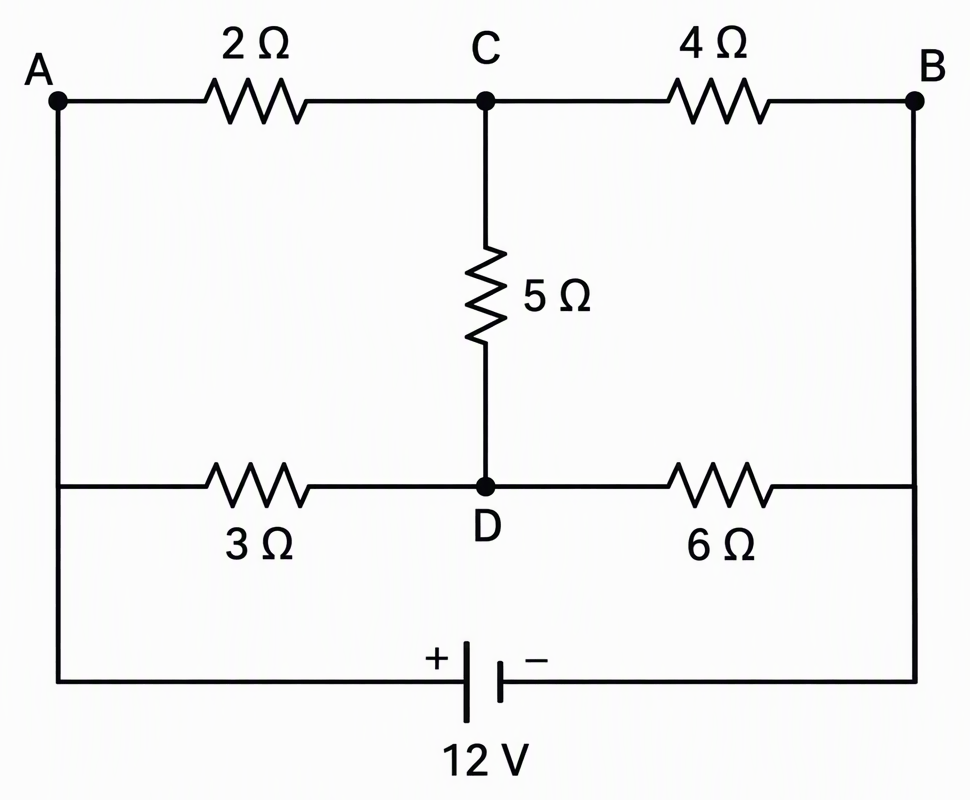
Test corresponding arms:
Verify the equal potentials by provisionally opening the central branch. The outer-path currents and midpoint potentials are:
Reconnecting the central resistor therefore produces zero current through it. For this excitation, omit it when calculating source current:
Diagnostic variation: Replace the 6-ohm arm with 5 ohms. The ratios no longer match, so the central branch cannot simply be ignored.
JEEnius daily practice problems provide a fresh ten-question topic set every day, with free sets daily, for practising such decisions.
What does a negative current mean when two cells are connected in parallel?
A negative current means the actual current runs opposite to your assumed direction, not that the solution is wrong. Here, the higher-emf cell supplies the load and drives current into the lower-emf cell. Use node-potential reasoning: resistor-only reduction cannot represent the two sources.
Problem: A 6-volt cell with 1-ohm internal resistance, a 3-volt cell with 1-ohm internal resistance and a 3-ohm load form three parallel branches between A and B. Both cells have their positive terminals toward A.
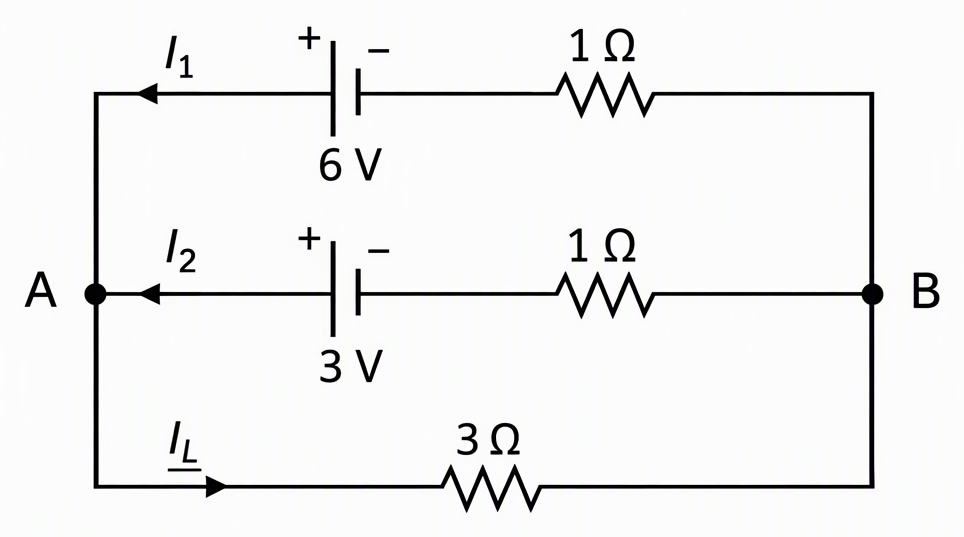
Set the reference potential and assume both cells deliver current toward A. Take the load current from A to B:
These branch equations follow from Kirchhoff’s voltage law. Apply current conservation at A:
Substitute back:
Current actually enters the positive terminal of the lower-emf cell. In this idealised model, that branch absorbs electrical energy rather than supplying it.
Check current conservation and terminal-voltage consistency:
Do not force both cell currents to be positive. The familiar terminal-voltage expression uses a current defined as leaving the positive terminal:
Keep that current signed, or change the expression consistently when using an entering-current magnitude. This is circuit analysis, not advice for connecting real batteries.
What should I practise next for JEE Main and Advanced?
Move from isolated decisions to mixed circuits, advancing when you can justify your method without looking at a solution. Use the checks below, not a fixed chapter-completion deadline, to decide when to move on.
- Microscopic current and material relations: distinguish drift speed, current density, conductivity and resistivity.
- Wire geometry and temperature-dependent resistance: explain what stays constant before choosing a formula.
- Series–parallel topology and power: redraw the network with labelled nodes and identify the source constraint.
- Cells and internal resistance: distinguish emf from terminal voltage and interpret a negative branch current without changing conventions midway.
- Balanced and unbalanced bridges: justify every zero-current branch, then change one arm and reconsider the method.
- Mixed Kirchhoff problems: combine node-current equations with consistent voltage equations, then check every branch.
- Measurement applications: finish with those explicitly included in the current official syllabus for your target exam. Check jeemain.nta.nic.in for JEE Main and the official JEE Advanced syllabus for Advanced; do not treat an older coaching module as the prescribed list.
For every question, record the chosen method before calculating. After an error, locate the first incorrect decision, re-solve from a blank page, then attempt a fresh variation.
Use recent JEE Main PYQs for clean execution in single-correct and numerical-answer formats. Use JEE Advanced PYQs for coupled constraints and checking multiple statements, reading each paper’s actual marking instructions rather than assuming a fixed pattern.
For droppers and revision students: attempt the three examples above without viewing their solutions. Restart at the earliest decision you cannot justify, not automatically at the chapter’s first page.
Fresh-question practice is not revision. Separately revisit saved mistakes so that unfamiliar questions do not replace necessary repetition. For the next fresh variation, JEEnius practice mode offers topic sets that skip questions already seen, with free sets included.
Next step: daily practice problems on JEEnius and get a fresh ten-question set on a topic every day (free sets daily).
For a worked example of the same idea, see Determinants Practice Questions JEE: 5 Solved Drills.
Frequently asked questions
In what order should I study Current Electricity for JEE?
First check potential difference, conventional current, charge conservation and elementary simultaneous equations. Study microscopic current, resistance and temperature dependence, then resistor networks, cells and internal resistance, Kirchhoff’s laws and bridges. Finish with measurement applications included in the current official syllabus for your target exam.
When should I use Kirchhoff’s laws in circuit problems?
Try series–parallel reduction first, followed by justified equal-potential or balanced-bridge arguments. Use Kirchhoff equations when those methods do not resolve the circuit. Label nodes and choose current directions before writing equations, then keep your sign conventions consistent.
When can I ignore the middle resistor in a bridge circuit?
You can omit the bridge branch when you have proved that its endpoints have equal potential, so it carries zero current. Matching ratios of corresponding arms establish balance in the bridge discussed here. Visual symmetry alone is not proof.
What does a negative current mean in a circuit answer?
A negative current means the actual current flows opposite to your assumed direction. It does not by itself indicate an incorrect solution. Keep the current signed when checking node balance and terminal-voltage equations.
How should I revise Current Electricity for JEE?
Attempt the article’s three worked examples without viewing their solutions, then restart at the earliest decision you cannot justify. Classify the first error as concept, topology, sign or algebra, and re-solve from a blank page. Practise a fresh variation, but separately revisit saved mistakes because fresh-question practice does not replace revision.