
What order should I follow to study Chemical Bonding for JEE?
To study Chemical Bonding for JEE, choose the bonding model from the property asked, not from a remembered hybridisation label. Build electron-counting skills first, then learn which model answers which question. Treat a subtopic as complete only when you can explain it and solve a question without help.
Step 1: Test the prerequisites before starting bonding lectures. On a blank page, write the electronic configurations of nitrogen, oxygen and their common ions. Count valence electrons in ammonium and carbonate, then explain why electronegativity generally increases across a period and decreases down a group.
For ion counting, add electrons for negative charge and subtract them for positive charge. Check your totals:
Repair whichever skill fails before starting bonding lectures. An incorrect electron count corrupts the Lewis structure, which corrupts lone-pair counting and then the predicted shape.
Step 2: Follow this dependency order. Find electron domains before assigning hybridisation; the label should not replace the count.
- Lewis structures, formal charge and resonance.
- VSEPR, molecular geometry and bond-dipole cancellation.
- Orbital overlap and hybridisation.
- Molecular orbital theory.
- Ionic bonding, Fajans’ rules and hydrogen bonding.
Step 3: Turn every subtopic into a closed-book task. Read the relevant NCERT explanation, close the book, reproduce one structure or argument, and solve a matching question before moving on.
Separate your revision material into two groups:
- Reconstruct: electron counts, formal charges, shapes and MO occupancy.
- Retain explicitly: MO energy-order cases, model limitations and textbook exceptions.
Do not impose a one-day completion deadline. The stopping condition is an independent explanation and solution, not hours watched.
How do I choose the right bonding model in a question?
Use the requested property to choose your model, then write its representation before checking the options. Use Lewis structures for connectivity, VSEPR for shape and MO theory for suitable diatomic bond-order and magnetism questions. Hybridisation cannot answer all these questions.
Step 4: Route the question by its target.
- Connectivity or resonance: use Lewis structures, octets and formal charges.
- Shape: use VSEPR and central-atom electron domains.
- Polarity: use molecular geometry and bond-dipole vectors.
- Bond order or magnetism of suitable diatomics: use MO occupancy.
- Ionic character: use charge density and polarisation. A small, highly charged cation polarises an anion more strongly, increasing covalent character.
- Boiling point or association: inspect intermolecular forces, including hydrogen bonding, rather than judging from intramolecular bond strength alone.
Step 5: Write before selecting. Produce a Lewis structure, spatial sketch or MO occupancy diagram so that you can check your assumptions.
Calculate formal charge using electrons, not the number of bonds:
For MO questions:
In VSEPR, a multiple bond counts as one electron domain. Electron-domain geometry includes lone pairs; molecular shape describes the arrangement of atoms.
Step 6: Run three checks.
- Do the formal charges sum to the species’ charge?
- Have all electrons been accounted for?
- Does spatial symmetry support the claimed dipole cancellation?
Minimum formal charge is useful, not a universal stand-alone rule. Octet validity and electronegativity also matter.
Hybridisation labels alone neither determine polarity nor explain oxygen’s paramagnetism. Expanded-octet hybridisation labels used in school-level questions are bookkeeping conventions, not proof of substantial d-orbital participation.
JEEnius daily practice problems provide a fresh ten-question topic set every day, with free sets daily.
How do I find nitrate’s resonance contributors and bond order?
Nitrate has three equivalent resonance contributors and three equivalent nitrogen–oxygen bonds in the actual ion. To draw the valid contributors, assign formal charges and explain bond equivalence, start with the electron count:
One contributor has one double bond and two single bonds around nitrogen, giving nitrogen an octet. Move the double bond between oxygen atoms to obtain the equivalent contributors.
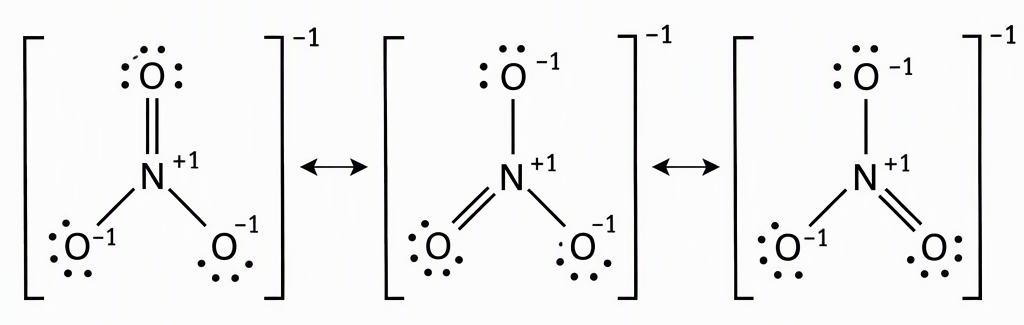
The formal charges in each contributor are:
Each bond is double in one contributor and single in the other two. The resonance-model average is:
The real ion does not alternate between drawings. Its bonding is delocalised, with equivalent bonds.
The tempting wrong answer adds extra double bonds to reduce charge separation. Reject it because second-period nitrogen cannot exceed its octet.
Why is sulfur tetrafluoride polar but xenon tetrafluoride nonpolar?
Sulfur tetrafluoride has a seesaw shape whose bond dipoles do not cancel; xenon tetrafluoride is square planar, so its equivalent bond dipoles cancel. Both have central lone pairs. To predict their shapes and permanent dipoles, count electrons, place lone pairs and inspect the spatial bond vectors.
For sulfur tetrafluoride:
Four sulfur–fluorine bonds use eight electrons. Completing the terminal fluorine octets uses another twenty-four, leaving one central lone pair.
Its electron-domain geometry is trigonal bipyramidal. The lone pair occupies an equatorial site, where it has two right-angle interactions instead of the three at an axial site.
Use spatial sketches, not a list of hybridisation labels. The arrangement of the remaining bonds decides cancellation.
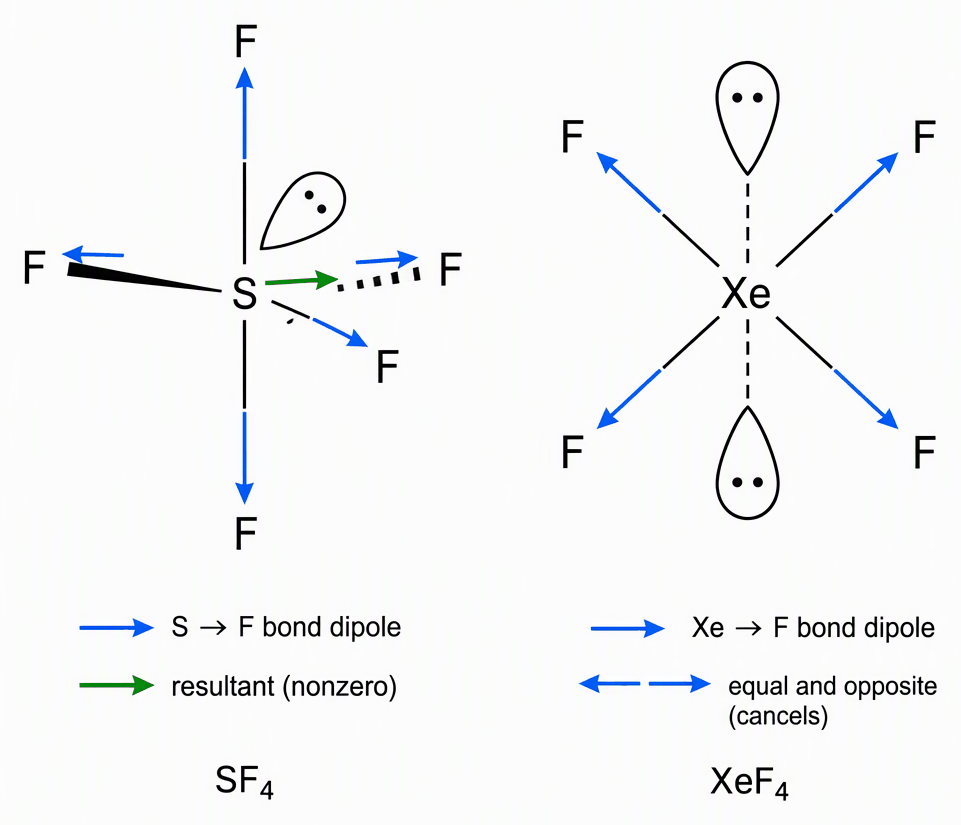
The remaining atoms form a seesaw. The equatorial bond dipoles are not opposite, leaving a nonzero resultant.
For xenon tetrafluoride:
Completing the bonds and terminal octets leaves two central lone pairs:
Its electron-domain geometry is octahedral. Two opposite lone pairs leave four fluorines in a square plane, so equivalent bond dipoles cancel pairwise: sulfur tetrafluoride is polar; xenon tetrafluoride is nonpolar despite both having central lone pairs.
How do oxygen ions change bond order and magnetism?
Removing an antibonding electron from molecular oxygen raises its bond order; adding one lowers it. The neutral molecule and both singly charged ions retain unpaired electrons. Compare their bond orders, unpaired electrons and expected bond lengths using the same oxygen-family MO ordering.
Taking the bond axis as the z-axis, the relevant valence-MO order is:
Fill molecular oxygen with twelve valence electrons:
There are eight bonding and four antibonding electrons. Hund’s rule leaves two unpaired electrons in the degenerate antibonding pi orbitals.
- Neutral oxygen: two unpaired electrons.
- Oxygen molecular cation: remove one antibonding pi electron, leaving one unpaired electron.
- Oxygen molecular anion: add one electron to the antibonding pi pair, leaving one unpaired electron.
All three are paramagnetic. Within this closely related series, higher bond order gives the expected bond-length order:
Do not extend that comparison to unrelated bonds. The boron-to-nitrogen diatomic ordering places the bonding pi orbitals below the corresponding bonding sigma orbital, unlike the oxygen-family ordering above.
The common removal error is taking an electron from a bonding orbital. Remove it from the highest occupied MO.
What should I practise next to stop forgetting Chemical Bonding?
Practise by skill first, then mix categories so that selecting the model becomes part of the question. Build your revision list from errors, not from restarting the chapter. Readiness means solving an unseen variation and explaining why a plausible wrong answer fails.
Begin with these separate sets:
- Lewis structures and resonance: transfer the nitrate method to carbonate.
- VSEPR and polarity: count electrons and sketch chlorine trifluoride and xenon difluoride.
- MO occupancy and magnetism: extend the oxygen example to peroxide.
- Ionic character and hydrogen bonding: compare sodium chloride with aluminium chloride, then ethanol with dimethyl ether.
For the salt comparison, the aluminium cation’s higher charge density gives greater polarising power and greater covalent character. Ethanol molecules form intermolecular hydrogen bonds with each other; dimethyl ether lacks an oxygen–hydrogen donor and has the lower boiling point.
Next, mix categories and name the model before solving. Follow with JEE Main and JEE Advanced previous-year questions, preserving each question’s original instructions.
Tag mistakes as electron count, wrong model, lone-pair placement, MO occupancy or recalled fact. Repair that skill, then solve an unseen parallel question rather than immediately repeating the same diagram.
For the unseen-question check, practice mode offers topic sets that skip questions already seen, with free sets included. Choose the topic matching your latest error tag.
Next step: practice mode on JEEnius and practise a topic in sets that skip questions you have already seen (free sets included).
For a worked example of the same idea, see Complex Numbers Practice Questions JEE: 6 Worked Solutions.
Frequently asked questions
In what order should I study Chemical Bonding for JEE?
First check electronic configurations, valence-electron counting and electronegativity trends. Then study Lewis structures, formal charge and resonance; VSEPR, geometry and polarity; orbital overlap and hybridisation; molecular orbital theory; and finally ionic bonding, Fajans’ rules and hydrogen bonding. Complete each subtopic by reproducing an explanation and solving a matching question without help.
Is memorising hybridisation enough for Chemical Bonding questions?
No. Use Lewis structures for connectivity and resonance, VSEPR for shape, geometry and bond-dipole vectors for polarity, and MO occupancy for suitable diatomic bond-order and magnetism questions. Count electron domains before assigning hybridisation; the label alone cannot determine polarity or explain oxygen’s paramagnetism.
How do I calculate the bond order of nitrate?
Nitrate has 24 valence electrons and three equivalent resonance contributors, each with one N–O double bond and two N–O single bonds. Each bond is double in one contributor and single in the other two, giving a resonance-model average bond order of (2 + 1 + 1)/3 = 4/3. The actual ion has delocalised bonding and three equivalent N–O bonds; it does not alternate between drawings.
How do I stop forgetting Chemical Bonding for JEE?
Practise separate skills first, then mix question categories so that choosing the model becomes part of the task. Tag errors as electron count, wrong model, lone-pair placement, MO occupancy or recalled fact, and repair the specific weakness. Test the repair with an unseen parallel question, then practise JEE Main and JEE Advanced previous-year questions.