
How should I start studying Application of Derivatives for JEE?
Write the domain before differentiating. Study Application of Derivatives for JEE through one sequence: domain, derivative signs, candidate testing and interpretation.
- Step 1: Identify the task. Write the domain and translate the question into its target: increasing or decreasing intervals, local extrema, absolute extrema, a parameter condition, a tangent slope or a rate.
- Step 2: Choose what to differentiate. For optimisation, first use the constraint to express the target quantity in one variable.
- Step 3: Find the candidates. Differentiate, then identify derivative zeros, points in the domain where the derivative does not exist, and included boundary points.
Use this study order: differentiation and domain checks → derivative signs and monotonicity → local and absolute extrema → parameter problems → constrained optimisation. Practise slope and rate questions alongside these.
Before starting, check that you can apply product, quotient and chain rules, and solve polynomial or rational inequalities. Repair whichever skill fails instead of setting aside weeks for revision.
Use this task-to-tool map:
- Monotonicity: determine the derivative’s sign.
- Extrema: test candidates, not just derivative zeros.
- Tangent at a differentiable point: use
- Related rates: differentiate the relation with respect to time, treating changing quantities as functions of time.
How do I use a sign chart to finish the solution?
Derivative signs decide increase and decrease; function values decide absolute extrema. Use the first-derivative sign test as your default because it handles both monotonicity and local extrema, including continuous corners where the derivative is undefined.
- Step 4: Split and sign the domain. Split at derivative zeros and derivative-undefined points. Determine the derivative’s sign on every resulting interval, and never join intervals across excluded domain points.
- Step 5: Test candidates. At an interior candidate where the function is continuous, positive-to-negative means a local maximum; negative-to-positive means a local minimum. The same nonzero sign on both sides means no local extremum. Test discontinuous candidates directly against nearby function values.
- Step 6: Return the requested object. An interval, an input coordinate, an extremum value and a parameter range are different answers.
For a continuous function on a closed bounded interval, compare function values at all interior candidates and both endpoints. On open or unbounded domains, also examine limiting behaviour and whether a bound is attained.
A derivative zero does not guarantee an extremum:
The derivative is positive on both sides of zero, so there is no extremum. Conversely, an extremum can occur where the derivative is undefined:
Zero is a minimum: the function decreases before it and increases after it. The second-derivative test is optional, and the following result is inconclusive, not proof that an extremum is absent:
A positive derivative throughout an interval is sufficient for strict increase, but positivity at every point is not necessary. Isolated derivative zeros need not break strict increase.
Record mistakes under four labels: domain, differentiation, sign chart, final interpretation.
How can a local maximum fail to be the greatest value?
A local maximum compares nearby values; an endpoint can be higher. Here, Step 5 requires endpoint comparison because the question asks for absolute extrema on a closed interval. This and the following examples are original teaching examples, not previous-year JEE questions.
Problem: Find the interior local extrema and the absolute maximum and minimum of
Steps 1–3: The domain includes both endpoints. Differentiate and identify the two interior stationary points:
Step 4: The derivative signs are
Step 5: Positive-to-negative gives the interior local maximum; negative-to-positive gives the interior local minimum:
Compare every candidate value, including endpoints:
Step 6: State values and locations separately:
The tempting wrong answer is 2 as the greatest value, because the derivative changes from positive to negative at the local maximum. That sign change establishes only a local comparison, not the greatest value on the interval.
How do I find a parameter range without losing the equality case?
Translate “on the whole real line” into a global derivative condition, then test equality separately. Demanding a strictly positive derivative everywhere can exclude a valid boundary case. This original teaching example uses the same method, with a parameter controlling the sign chart.
Problem: Find all real parameter values for which is strictly increasing on the whole real line.
Steps 1–3: The domain is all real numbers. Differentiate and locate the derivative expression’s minimum:
Steps 4–5: Check the three cases.
- Negative parameter: the derivative is positive everywhere, so the function is strictly increasing.
- Zero parameter: the cubic remains strictly increasing despite one derivative zero.
- Positive parameter: a decreasing interval rules out increase on the whole real line.
Step 6: The complete range is
not the stricter, incorrect range
For an “all inputs” derivative condition, look for the derivative expression’s minimum, then check equality cases. JEEnius daily practice problems provide a fresh ten-question set on a topic every day, with free sets daily.
How do I turn a geometry question into one-variable optimisation?
Use the constraint to express the area in one variable, and state which inputs represent possible rectangles. Here, the horizontal coordinate gives half the width, not the full width. Getting that model right comes before differentiating.
Original teaching example: A rectangle has its lower vertices on the horizontal axis and its upper vertices at
Find its greatest possible area.
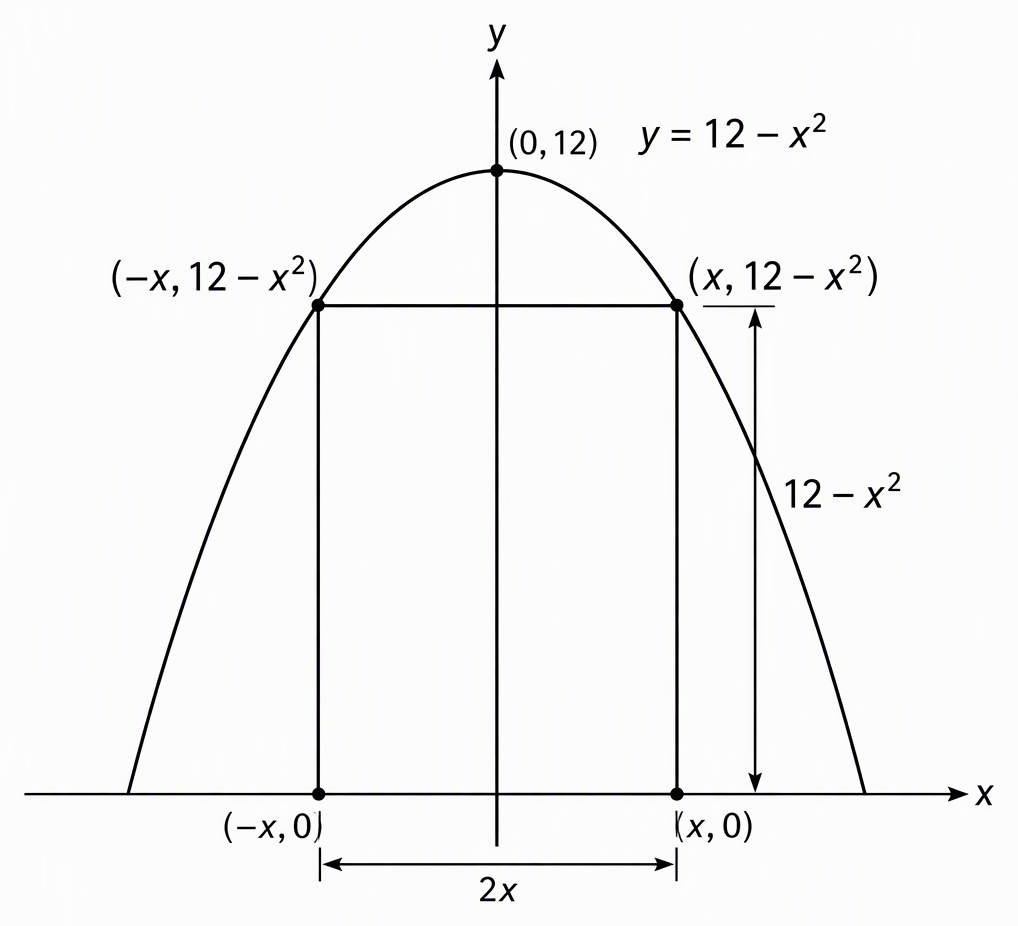
Steps 1–2: Use width times height:
Nondegenerate rectangles require
Extend to the closed interval for endpoint comparison. Both added endpoints represent zero-area degenerate cases:
Steps 3–4: Differentiate and retain only the stationary point inside this feasible domain:
Steps 5–6: Compare the candidate values:
The maximum area is 32 square units, achieved with width 4 units and height 8 units. This rectangle is nondegenerate, so it belongs to the original domain.
Writing the width as the half-width gives the wrong area. Optimising without a feasible domain can admit stationary points that represent no valid rectangle.
What should I practise next for Application of Derivatives?
Start with polynomial, rational and logarithmic monotonicity problems, then practise mixed extrema. Choose further practice by the first decision you get wrong, not by pages completed.
- Monotonicity: write the domain before every derivative. Check denominator exclusions and logarithmic restrictions explicitly.
- Mixed extrema: include a stationary point without an extremum, a nondifferentiable minimum, endpoint extrema and an unattained bound on an open interval.
- Parameters and optimisation: practise whole-domain sign conditions, equality cases and geometry-to-function modelling.
- Slopes and rates: solve tangent-slope and related-rate questions to cover the chapter beyond the three examples above.
- Mixed questions: move beyond direct single-task problems to combinations of domains, parameters and extrema. Use relevant JEE Main and JEE Advanced previous-year questions.
After checking a solution, record the first incorrect decision under domain, differentiation, sign chart or final interpretation. Redo that problem from a blank page later, rather than merely rereading the correction.
Move ahead when you can justify every sign-chart interval, explain each rejected candidate and distinguish a maximum value from its location without consulting the solution. Unseen questions test transfer; previously missed questions test whether you repaired the error.
For fresh-question practice, JEEnius practice mode offers topic sets that skip questions already seen, with free sets included. Keep a separate list of missed questions and deliberately revisit them: an unseen set does not replace revision.
Next step: practice mode on JEEnius and practise a topic in sets that skip questions you have already seen (free sets included).
For a worked example of the same idea, see Binomial Theorem Practice Questions JEE: 8 Worked Solutions.
Frequently asked questions
How should I start studying Application of Derivatives for JEE?
First check your product, quotient and chain rules, domain checks, and polynomial or rational inequalities. Study derivative signs and monotonicity before local and absolute extrema, then move to parameter problems and constrained optimisation. Practise tangent-slope and related-rate questions alongside these topics.
How do I make a sign chart for Application of Derivatives?
Write the domain, then split it at derivative zeros and points where the derivative is undefined. Determine the derivative's sign on every resulting interval, without joining intervals across excluded domain points. At a continuous interior candidate, a positive-to-negative change gives a local maximum, while a negative-to-positive change gives a local minimum.
Does a zero derivative always mean a maximum or minimum?
No: for f(x) = x³, the derivative is zero at x = 0, but the function has no extremum there because the derivative is positive on both sides. Conversely, f(x) = |x| has a minimum at zero even though its derivative is undefined there. Test candidates rather than treating derivative zeros as automatic extrema.
How do I find the absolute maximum and minimum on a closed interval?
For a continuous function on a closed bounded interval, identify all interior candidates where the derivative is zero or undefined. Compare the function values at every candidate and both endpoints. Report the greatest and least values separately from the input coordinates where they occur.
How do I solve geometry optimisation problems using derivatives?
Use the geometric constraint to express the target quantity in one variable, then state its feasible domain. Differentiate, retain only valid candidates and compare their values with included endpoints. If you add degenerate boundary cases for comparison, check that the final optimum belongs to the original feasible domain.