
How should I study Amines for JEE in five steps?
Study Amines for JEE by checking nitrogen structure, medium, carbon count and reagent conditions before choosing an answer. Use these checks to connect basicity, conversions and identification on one reaction map.
- Repair only the prerequisites that affect decisions.
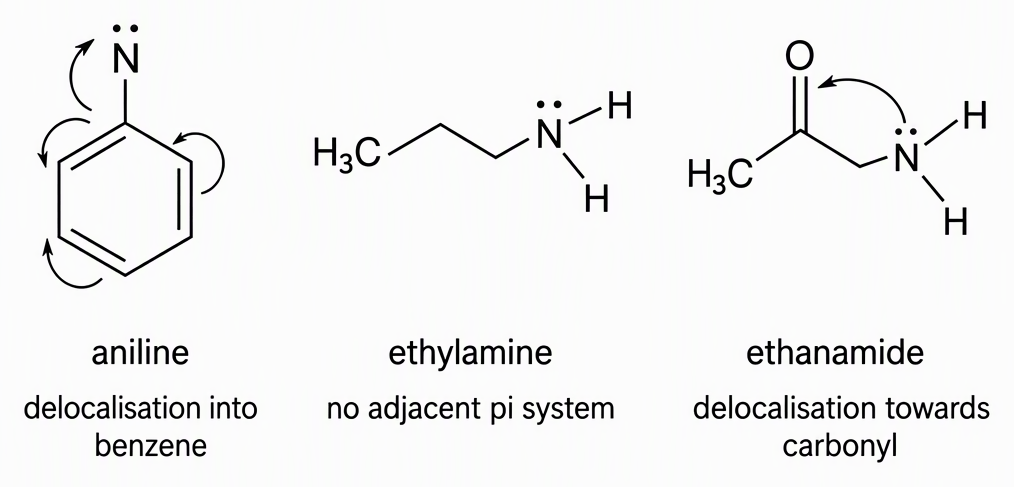
Review resonance, inductive effect, acid–base equilibria and nucleophilic substitution. Test yourself with aniline and ethylamine: locate nitrogen’s lone pair and explain its availability for accepting a proton. Aniline’s lone pair is delocalised into the benzene ring; ethylamine’s is not, and its ethyl group donates electron density inductively.
Classify amines by the number of carbon groups directly attached to nitrogen: one means primary, two secondary and three tertiary. The classification of the neighbouring carbon is irrelevant. An amide has nitrogen directly attached to a carbonyl carbon, so its lone pair interacts with the carbonyl group.
- Read NCERT with a reaction-map output task.
Build one map with branches for preparation, basicity, identification and aromatic diazonium chemistry. Every reaction arrow needs a substrate, reagent, condition and product. Use NCERT examples to check the map, rather than highlighting whole pages.
- Make the four-check decision card.
- What is attached to nitrogen?
- What medium is specified?
- Does the carbon count change?
- What do the reagent and temperature permit?
For basicity, compare lone-pair availability and conjugate-acid stability in the stated medium. Include resonance, inductive effects and solvation. A lower value of the quantity defined below means a stronger base when values are compared under the same conditions:
Track carbon changes separately:
- Nitrile reduction retains the nitrile carbon.
- Hofmann bromamide degradation removes the amide carbonyl carbon.
- Nitro-group reduction preserves the carbon skeleton.
- Learn restrictions beside the reaction arrows.
Write substrate restrictions and conditions beside each arrow. Keep these distinctions visible:
- Standard Gabriel synthesis gives primary alkyl amines, not aryl amines, because the required substitution does not work on ordinary aryl halides.
- Carbylamine identifies primary aliphatic and aromatic amines. Hinsberg behaviour depends on amine class.
- Aniline forms benzenediazonium chloride with sodium nitrite and hydrochloric acid under cold conditions:
- From that salt, warm water gives phenol, cuprous chloride with hydrochloric acid gives chlorobenzene, and potassium iodide gives iodobenzene.
- Do not transfer the cold stability of aromatic diazonium salts to aliphatic diazonium ions.
- Aniline with bromine water gives 2,4,6-tribromoaniline. Acetyl protection allows controlled, predominantly para bromination; hydrolysis then removes the protecting group.
- Close the book after each branch and solve.
Attempt a corresponding question immediately. Before looking at options, state the deciding rule: “aqueous solvation matters”, “one carbon is lost”, or “this test requires a primary amine”. If you cannot name the rule, return to that arrow, not the entire chapter.
How do I rank amines when the basicity order changes with medium?
In water, dimethylamine is the strongest and aniline the weakest among the five compounds below. The middle positions depend on both electron donation and solvation, not just the number of alkyl groups.
Question: Arrange aniline, ammonia, methylamine, dimethylamine and trimethylamine in decreasing basicity in aqueous solution.
Step 1: Separate aniline from the others. Its lone pair is delocalised into the aromatic ring. Protonation removes that lone pair from conjugation, making proton acceptance less favourable than for the other listed bases.
Step 2: Compare the methylamines in water. Methyl groups donate electron density, but water also stabilises the conjugate acids through solvation. Dimethylamine gives the strongest balance; poorer solvation of protonated trimethylamine outweighs its extra electron donation relative to methylamine.
Step 3: Reject the shortcuts. “Tertiary is always strongest” is false. “Secondary, then primary, then tertiary” is not universal either: the displayed order applies to these methylamines in water.
Without aqueous solvation, the gas-phase comparison is:
JEEnius daily practice problems provide a fresh ten-question set on a topic every day, with free sets daily. Use an Amines set to practise writing the deciding rule before answering.
Underline the medium before ranking. Never silently import an aqueous order into an unspecified or gas-phase problem.
How do I convert benzamide to phenol using carbon counting?
Hofmann bromamide degradation converts benzamide to aniline by removing its carbonyl carbon. Cold diazotisation then gives benzenediazonium chloride, and warm water converts that intermediate to phenol.
Original illustrative question: Identify the three products in this sequence.
Step 1: Count carbons before naming the amine. Benzamide contains seven carbons. Hofmann degradation removes the carbonyl carbon from the organic product, leaving six in aniline.
Step 2: Read the temperature. Cold conditions allow formation and handling of the aromatic diazonium intermediate. Warming it with water gives phenol with nitrogen evolution.
- A, aniline:
- B, benzenediazonium chloride:
- C, phenol:
Both steps after aniline retain the six-carbon aromatic ring. Changing the first reagent, however, changes the carbon count of the amine.
Check the competing reagent. Lithium aluminium hydride reduction of benzamide gives benzylamine, retaining all seven carbons:
Numerical extension: Suppose the sequence starts with 0.10 mol benzamide and every step is quantitative. Using phenol’s molar mass of 94 grams per mole, the theoretical phenol mass is:
Losing one carbon does not mean losing one product molecule. “Amide to amine” is insufficient information: the reagent determines whether the carbonyl carbon is retained or lost.
How do Hinsberg-test observations identify an amine’s class?
Check whether a sulfonamide forms, then interpret its behaviour in alkali. Primary and secondary amines both form sulfonamides, but only the primary-amine product retains an acidic nitrogen–hydrogen bond. A tertiary amine does not form that sulfonamide under Hinsberg-test conditions.
Original illustrative question: Unknowns A, B and C are ethylamine, diethylamine and triethylamine in an unknown order. With the Hinsberg reagent, benzenesulfonyl chloride, the reported observations are:
- A: Forms a sulfonamide soluble in aqueous alkali; acidification precipitates that product.
- B: Forms a sulfonamide insoluble in aqueous alkali.
- C: Forms no sulfonamide; the recovered amine dissolves in dilute acid.
A is ethylamine. Its sulfonamide retains an acidic nitrogen–hydrogen bond:
Alkali removes that proton, forming an alkali-soluble salt. Acidification restores the neutral sulfonamide, which precipitates under the stated conditions.
B is diethylamine. Its sulfonamide has no nitrogen–hydrogen bond available for that salt formation:
C is triethylamine. It does not form a sulfonamide under the test conditions, but its lone pair still accepts a proton:
Acid solubility through ammonium-salt formation is not evidence of a primary amine. Primary, secondary and tertiary amines can all accept protons.
Cross-check with carbylamine: only A gives that test among these three compounds. Aromatic primary amines also give it, so a positive result does not prove an aliphatic structure. Treat these observations as exam evidence, not instructions for conducting tests at home.
What should I practise after learning the Amines reaction map?
Start with single-rule questions, then move to mixed conversions once you can explain the deciding rule without options. I would choose this progression over a random mixed sheet because it separates gaps in individual rules from errors in linking reactions.
Practise in this order:
- Classification and lone-pair questions.
- Basicity comparisons with the medium stated.
- Reagent-to-product and carbon-count questions.
- Identification tests.
- Mixed conversions involving aniline and diazonium salts.
Use NCERT examples and exercises to check chapter coverage, then solve chapterwise JEE Main and JEE Advanced previous-year questions. The worked questions above are original illustrations, not attributed past-paper questions.
For Main preparation, emphasise reagent recognition and distinguishing close options. For Advanced, add linked transformations and simultaneous constraints. Neither exam exclusively tests one style.
Keep an error log labelled structure, medium, carbon count or conditions. Correct the missing rule rather than recopying the whole solution.
For revision, reconstruct the reaction map from memory and explain all three worked examples without options. Then move to mixed practice.
JEEnius practice mode offers topic sets that skip questions already seen, with free sets included. Use it for fresh application, but revisit logged mistakes separately: unseen-question practice does not replace correcting a rule you previously got wrong.
Next step: practice mode on JEEnius and practise a topic in sets that skip questions you have already seen (free sets included).
If that step was the hard part, work through Ellipse – Focal Distances JEE 2026: Why 13 Is Unproven.
Frequently asked questions
How should I study Amines for JEE?
Review resonance, inductive effects, acid–base equilibria and nucleophilic substitution, then build an NCERT-based reaction map. Label every arrow with the substrate, reagent, conditions and product. Before answering, check nitrogen structure, medium, carbon count and reagent conditions. Practise each branch immediately, then move to chapterwise JEE questions and mixed conversions.
What is the basicity order of methylamines in water?
In aqueous solution, the decreasing basicity order is dimethylamine > methylamine > trimethylamine > ammonia. This order reflects both electron donation and solvation of the conjugate acids. In the gas phase, the order changes to trimethylamine > dimethylamine > methylamine > ammonia, so always check the medium.
How do I convert benzamide to phenol?
Treat benzamide with bromine and sodium hydroxide for Hofmann bromamide degradation, which gives aniline and removes the carbonyl carbon. Diazotise aniline using sodium nitrite and hydrochloric acid at 273–278 K to form benzenediazonium chloride. Warm the diazonium salt with water to obtain phenol.
How does the Hinsberg test distinguish primary, secondary and tertiary amines?
A primary amine forms a sulfonamide that retains an acidic nitrogen–hydrogen bond and dissolves in aqueous alkali. A secondary amine forms a sulfonamide without that bond, so the product is insoluble in aqueous alkali. A tertiary amine does not form a sulfonamide under Hinsberg-test conditions, but the recovered amine dissolves in dilute acid through ammonium-salt formation.