
What does the ellipse focal-distances JEE Main 2026 question actually give?
The supplied key lists option C, 13, but the displayed question does not establish it. The ellipse focal-distances JEE 2026 record gives no numerical semiaxes, although its supplied solution later assumes a focal sum of 10. The question-bank record attributes this problem to January 2026, Slot 1, and labels it hard on its own scale.
The task places a first-quadrant point on an ellipse with two foci and asks for its squared distance from the centre. We use a horizontal major axis to explain the supplied method, not as an extra numerical condition.
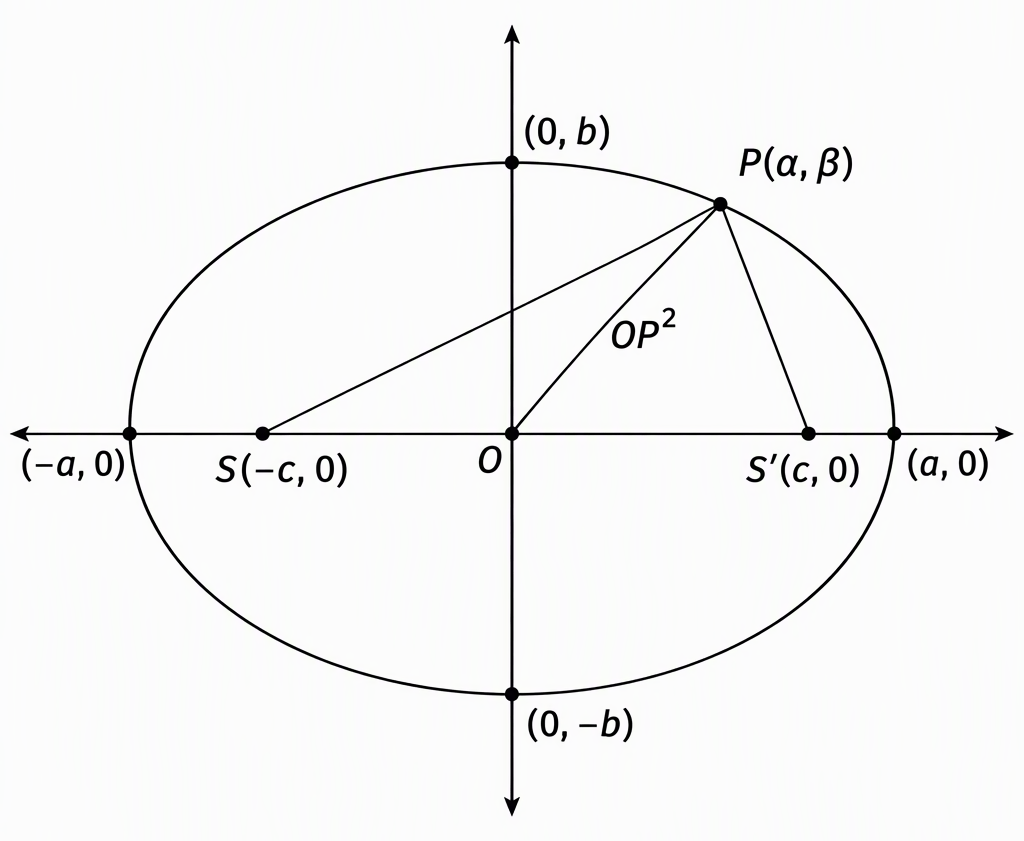
The supplied statement is:
Find:
The options are:
Which steps in the focal-sum calculation are valid?
The focal-sum method finds the product of the two distances once the major semiaxis is known. The supplied solution’s first unsupported step is assigning the focal sum a value of 10. Keep that assumption separate from the algebra.
Define the distances:
Under the horizontal-major-axis convention:
Expand the square:
Substitute into the given condition:
Only conditionally, adopt the supplied solution’s focal sum:
Then:
Nothing in the displayed question supplies that focal sum. The product of the focal distances is an intermediate result, not yet the required squared distance from the centre.
Why does the supplied solution fail to prove option C, 13?
The remaining working contains contradictory semiaxes, an incorrect product identity and an unjustified claim that the centre distance equals the semimajor axis. The first contradiction is direct:
The supplied solution asserts this product identity:
But substitution makes its right-hand side 25 under the assumed focal sum:
That cannot also equal 21. As a diagnostic correction, not a replacement official solution, the correct horizontal-ellipse identity is:
The centre distance is not generally the semimajor axis. The supplied final arithmetic also fails:
A coordinate check shows what is missing. Define the squared distance from the centre to either focus:
Using the labelled foci:
Adding cancels the cross terms:
Under the conditional focal sum and product:
A focal separation, or an equivalent missing parameter, is still required. C, 13 remains the supplied key’s answer, but publishing this as a fully verified PYQ solution requires checking the original paper or obtaining a corrected stem.
How can an unsupported assumption lead to option A, 17?
Importing a focal parameter from another problem can produce option A with correct subtraction. The error is using geometry that the question never supplied. Start from the conditional result:
Now make this hypothetical, unsupported assumption, not a fact from the paper:
It produces:
That matches option A. A remembered ellipse, an unscaled sketch or another question can suggest a number that has no basis here.
According to the supplied key, 17 is a distractor, but the incomplete statement itself does not justify rejecting it. Mark every numerical ellipse parameter as either given or derived. If it is neither, do not substitute it.
How do two fully specified ellipses give different answers?
Complete geometry makes the same focal-sum method give 13 for one ellipse and 20 for another. These are original practice questions, not authenticated PYQs. Although the source record carries a Trigonometry chapter label, both questions concern ellipse focal distances.
What is the answer for an ellipse with squared semiaxes 25 and 9?
The required squared centre distance is 13. Original practice 1: a first-quadrant point lies on the following ellipse and satisfies the stated focal-distance condition; find its squared centre distance.
The complete short chain is:
This fully specified example is consistent with 13. It is not evidence that it reconstructs the original paper.
What changes when the squared minor semiaxis is 16?
The answer becomes 20 because the foci move closer to the centre. Original practice 2: repeat the same first-quadrant task, with the same focal-distance condition, for:
Now:
Identical focal sums and products do not fix the squared centre distance when focal separation changes. In exam practice, check that the focal separation is given or derivable, then make this final conversion before looking at the options:
Next step: photograph a doubt on JEEnius and photograph any question you are stuck on and get a step-by-step solution, with a free-body diagram when the question needs one (20 free).
Read next: Chemical Kinetics JEE 2024: Why the Overall Order Is 3.
Frequently asked questions
Is 13 the correct answer to the ellipse focal-distances JEE 2026 question?
The supplied key lists option C, 13, but the displayed question does not establish it. No numerical semiaxes are given, and the supplied solution assumes a focal sum of 10 without justification. The original paper or a corrected statement is needed to verify the answer.
How do I find the product of an ellipse's focal distances?
Let u and v be the focal distances and a the semimajor axis, so u + v = 2a. For the condition u² + v² − uv = 37, expanding the focal sum gives 4a² − 3uv = 37, hence uv = (4a² − 37)/3. The product is 21 only if a = 5 is given or validly derived.
How do I find the squared distance from an ellipse's centre using focal distances?
If u and v are the focal distances and c is the distance from the centre to either focus, then OP² = (u² + v²)/2 − c². This follows by adding the two squared coordinate-distance expressions. Even if u² + v² is known, c² must still be given or derivable.
Which ellipse gives 13 for the focal-distance condition in the article?
The fully specified practice ellipse x²/25 + y²/9 = 1 gives OP² = 13 under the condition SP² + S′P² − SP·S′P = 37. Its focal sum is 10 and c² = 16, giving OP² = 29 − 16 = 13. This is an original practice example, not an authenticated reconstruction of the JEE question.