
What is the answer to the Electrostatics JEE 2020 capacitor-error question?
The Electrostatics JEE 2020 capacitor-error answer is 1.30%, obtained by propagating uncertainty through the reciprocal-capacitance relation first. This is JEE Advanced 2020, Paper 1, Physics, a numerical-answer question. The question bank classifies it as medium difficulty; that is not an official exam difficulty label.
Two capacitors are connected in series. Their capacitances are 2000 pF with an uncertainty of 10 pF, and 3000 pF with an uncertainty of 15 pF. The potential difference across the entire pair is 5.00 V with an uncertainty of 0.02 V. Find the percentage uncertainty in the total stored energy.
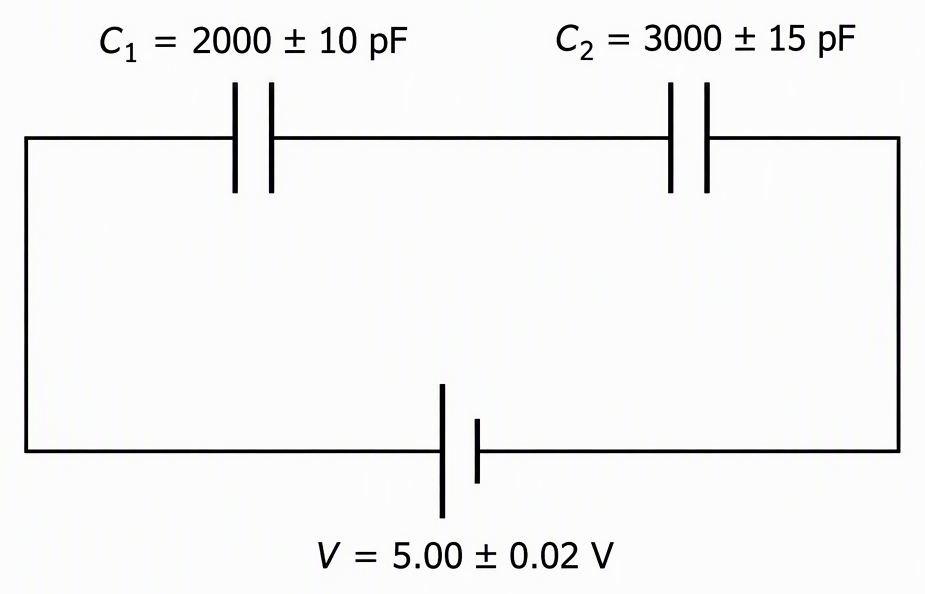
The 5.00 V spans the entire combination, not each capacitor. The working below follows the official method.
How do you find the equivalent capacitance first?
The equivalent capacitance is 1200 pF, using the central measured values. Start with the series relation, as in the official solution:
Rearranging gives:
Substitute the central values:
Keep all capacitances in pF here and in the fractional-error calculation below. Consistent units cancel correctly; convert to farads when calculating energy in joules.
How do you propagate uncertainty through the reciprocal relation?
The equivalent capacitance has 0.50% maximum relative uncertainty, not 1.50%. Differentiate the reciprocal relation before taking error magnitudes. This keeps the relationship between the repeated capacitances intact, rather than treating numerator and denominator changes separately.
Return to:
Differentiating every term gives:
The minus signs cancel, leaving positive coefficients for both capacitance changes. Capital delta denotes a positive maximum uncertainty. The official solution uses first-order maximum-error propagation, not root-sum-square statistical uncertainty, so the maximum contributions add:
Now substitute:
Evaluate the contributions separately:
As a check, each input capacitance has 0.50% relative uncertainty. The series combination also has 0.50% under this method.
How does the energy uncertainty become 1.30%?
The energy receives 0.50% from capacitance and 0.80% from the squared voltage, giving 1.30% altogether. Use the equivalent capacitance and the voltage across the complete pair. The exact constant one-half contributes no measurement uncertainty.
For first-order maximum errors:
The factor of two comes from the power of voltage, not from the presence of two capacitors. The voltage’s fractional uncertainty is:
Keep the energy calculation in fractional form:
Convert the final result to a percentage:
The contribution check is:
The fractional error is 0.013; the requested percentage value is 1.30. Enter 1.30 in the numerical-answer field, not 0.013.
Why does mechanically adding quotient errors give 2.30%?
The wrong result 2.30% comes from treating expressions containing the same measurements as independently adjustable. This is a numerical-answer question: 2.30% is a demonstrated wrong result, not a supplied exam option.
Starting from the product-over-sum expression, an invalid calculation is:
Carrying that forward gives:
The numerator and denominator share the same measured quantities. They are:
Increasing either capacitance increases both expressions. You cannot independently increase the numerator and decrease the denominator to construct the quotient’s worst case. That incompatible assumption counts linked effects as separate error sources.
Repair rule: differentiate the defining reciprocal relation first to retain the relationship between repeated variables. Only then take maximum magnitudes and add the resulting contributions.
How can you check the method with two related capacitance questions?
The same setup gives an absolute capacitance uncertainty of 6 pF and a first-order maximum energy uncertainty of 0.195 nJ. These are original follow-up exercises based on the given data, not additional verified PYQs. Both test conversion from relative to absolute uncertainty.
What is the absolute uncertainty in the equivalent capacitance?
Multiply the nominal capacitance of 1200 pF by its fractional uncertainty of 0.005. No percentage conversion is needed.
Hence:
What are the nominal stored energy and its absolute uncertainty?
Using the same equivalent capacitance and applied voltage, the nominal energy is 15 nJ, with a first-order maximum uncertainty of 0.195 nJ. First convert capacitance to farads so the energy calculation gives joules.
Multiply by the energy’s fractional uncertainty. This gives a first-order maximum uncertainty, using the same approximation as the official solution:
For your next error-propagation problem, mark every repeated measured variable before applying any product or quotient rule.
Next step: photograph a doubt on JEEnius and photograph any question you are stuck on and get a step-by-step solution, with a free-body diagram when the question needs one (20 free).
Keep going with How to Study Alternating Current JEE: A Seven-Step Plan.
Frequently asked questions
What is the answer to the JEE Advanced 2020 capacitor energy error question?
The percentage uncertainty in total stored energy is 1.30%, using first-order maximum-error propagation. Capacitance contributes 0.50%, while the squared voltage contributes 0.80%. Enter 1.30 in the numerical-answer field, not the fractional uncertainty 0.013.
What is the equivalent capacitance and its uncertainty in this question?
The 2000 pF and 3000 pF capacitors in series have an equivalent capacitance of 1200 pF. Differentiating 1/C = 1/C₁ + 1/C₂ and adding maximum uncertainty contributions gives a relative uncertainty of 0.50%. The absolute uncertainty is therefore 6 pF.
Why is 2.30% the wrong answer to the capacitor error question?
The result 2.30% comes from treating the numerator and denominator of C₁C₂/(C₁ + C₂) as independently adjustable error sources. Both contain the same measured capacitances, so this procedure double-counts linked effects. Differentiate the reciprocal-capacitance relation before taking maximum error magnitudes to obtain the correct 1.30% energy uncertainty.
Why is the voltage percentage error doubled in capacitor energy?
Stored energy is U = CV²/2, so first-order maximum-error propagation gives ΔU/U = ΔC/C + 2ΔV/V. The factor of two comes from the voltage exponent, not from having two capacitors. Here, the 0.40% voltage uncertainty contributes 0.80% to the energy uncertainty.