
What is the answer to the Gravitation JEE 2022 two-star question?
The gravitation jee 2022 two-star question gives 2.3: the shell’s density fixes B’s added volume and new radius, while its total mass determines escape speed at that radius. This numerical-answer PYQ is from JEE Advanced 2022, Paper 1, Physics. Its medium difficulty and 180-second target are question-bank metadata, not an official difficulty rating or time limit.
Initially, spherical stars A and B have equal radii, but B has twice A’s mass. A then shrinks to half its radius without changing density. All the mass A loses forms a concentric thick shell around B, with the shell having A’s density.
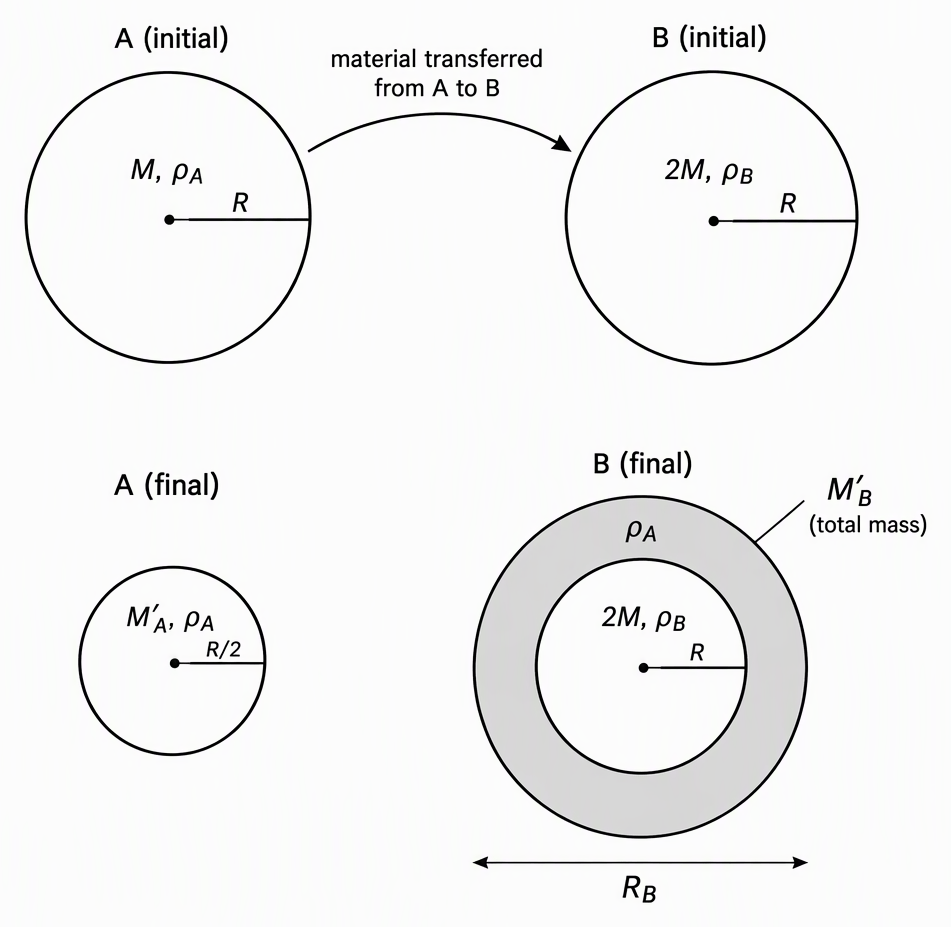
Define the final surface escape speeds of A and B, respectively, as:
The supplied relation is:
Find:
This is a numerical-answer question. There are no supplied answer options to reproduce.
How do you find A’s remaining mass and escape velocity?
A retains one-eighth of its initial mass because its density stays fixed while its radius halves. Mass follows volume, not radius alone: halving the radius does not leave one-half of the mass.
Let the initial common radius and A’s initial mass be:
Then:
A’s final mass is:
With gravitational potential taken as zero at infinity, the surface escape relation is:
Substitute A’s final mass and radius. Dividing by the halved radius supplies another factor of two:
The transferred mass is the initial mass minus the remaining mass:
How does the shell’s volume give B’s new radius?
Use the added shell’s volume, not the volume of the entire final star. B’s original core keeps its radius; the deposited material fills the space between that core and the new outer surface.
The shell mass is:
Substitute the initial mass expression on the right:
Cancel the shared factor from both sides:
This leaves:
Taking the cube root:
Equal initial radii and twice the initial mass imply:
But that is the core’s density, not the deposited shell’s density. Using it for the shell gives the wrong added volume, so do not treat B as uniformly dense.
A shell of positive thickness must increase the outer radius. The result passes this check:
How do you calculate B’s escape velocity and get 2.3?
Use B’s final total mass and its new outer radius. By the shell theorem, the exterior potential of a spherically symmetric body depends on total mass and distance from its centre, even when core and shell densities differ. Uniform density is not required.
B’s final mass is:
The exterior potential is:
Escape begins at the outer surface, not the original core surface. Thus:
Divide by A’s squared escape speed before taking square roots:
Escape speeds are positive, so:
Compare with the supplied relation:
Check mass conservation by adding the final masses. They equal the initial total:
What goes wrong if you update B’s mass but keep its old radius?
You combine the final mass with a surface that is no longer B’s outer boundary. This is a wrong numerical route, not a wrong option from the paper, since the question is numerical-answer. A finite-density thick shell increases both total mass and outer radius.
The inconsistent substitution is:
Using the correctly calculated escape speed for A gives:
This differs from the correct squared ratio:
Carrying the error through the supplied relation produces:
The new mass cannot be combined with the old surface radius. Identify the actual escape surface before substituting.
Which three practice questions check this method?
These original practice questions, based on the gravitation jee 2022 PYQ, test fixed-density radius scaling, shell volume and exterior potential. They are not additional verified past-paper questions.
- A uniform star’s radius becomes one-third of its original radius at fixed density. What happens to its mass and surface escape speed?
Mass scales with the cube of radius. Escape speed depends on the square root of mass divided by radius:
- In the main question, keep the transferred mass unchanged but double the deposited shell’s density. What is B’s new outer radius?
The shell now needs half as much volume. Its mass balance becomes:
- Two spherically symmetric bodies have equal total mass and outer radius but different radial density profiles. How do their surface escape speeds compare?
Their exterior potentials are identical. Their surface escape speeds are therefore equal:
Cover the main solution and reproduce B’s shell-volume equation first. Then use the resulting outer radius and total mass to calculate its surface escape speed.
Next step: the past-paper archive on JEEnius and search every JEE Main paper from 2002 and every Advanced paper from 2007, by year, subject or chapter, each with a worked solution (free).
Keep going with How to Study Aldehydes Ketones JEE: A Six-Step Method.
Frequently asked questions
What is the answer to the JEE Advanced 2022 two-star gravitation question?
The answer is n = 2.3. The squared escape-speed ratio is 23/15^(1/3); comparing it with the supplied expression 10n/15^(1/3) gives 10n = 23.
Why does star A retain only one-eighth of its mass?
Star A shrinks to half its initial radius while its density remains constant. Mass is proportional to volume, so its remaining mass is (1/2)^3 = 1/8 of the original mass.
How do you find star B's new radius in the two-star question?
Let R be the common initial radius. The transferred material has A's density, so its shell volume equals seven-eighths of A's initial volume, giving R_B^3 - R^3 = 7R^3/8. Hence B's new outer radius is R_B = R(15/8)^(1/3), and this radius must be used for its surface escape speed.
Can I use the escape velocity formula if the core and shell have different densities?
Yes, provided the body is spherically symmetric and escape begins at its outer surface. The shell theorem gives the exterior potential as -GM/r, so the surface escape speed is sqrt(2GM/R), using the total mass M and outer radius R. Uniform density is not required.