
How should I study Biomolecules for JEE in six steps?
Study Biomolecules for JEE on two tracks: recall names and associations, but inspect structures for reducing behaviour, hydrolysis and bond counting. For each question, classify the task, retrieve the relevant fact or relationship, then test every option. This separates gaps in memory from gaps in reasoning.
- Set the boundary before reading.
Check the official syllabus for the exam you are attempting. For JEE Main, use the NTA site, jeemain.nta.nic.in; for Advanced, consult its official syllabus separately. Do not assume the two exams have identical scope or demands.
Use the corresponding NCERT Biomolecules material as your starting reference. Keep prerequisites narrow: recognise hydroxyl, carbonyl, amino and carboxyl groups, and understand condensation and hydrolysis. You do not need to finish all organic chemistry first.
- Separate recall from reasoning.
Vitamin names and textbook deficiency associations need retrieval practice. Reducing behaviour, hydrolysis products and peptide-bond counting need structural reasoning, supported by remembered definitions.
I would choose this two-track approach over repeated full-chapter reading. Rereading everything wastes effort on familiar material; trying to derive every vitamin association wastes effort on facts that need recall.
- Build one comparison sheet, not another textbook.
Give each family an entry covering the features that decide answers. Use these comparisons:
- Carbohydrates: constituent units, linkage and reducing behaviour. Contrast glucose, an aldose, with fructose, a ketose; both reduce Tollens’ reagent under usual conditions. Contrast sucrose, which has both anomeric centres linked, with maltose, which retains one free.
- Proteins: amino acids, peptide bonds and structural levels. Separate peptide-bond cleavage from denaturation, which ordinarily preserves the primary sequence.
- Nucleic acids: sugar, base and phosphate. A nucleoside contains sugar and base; a nucleotide also contains phosphate.
- Vitamins: solubility and textbook deficiency associations. Add only the prescribed enzyme and hormone facts, not unrelated biology.
- Read, close, reconstruct, check.
Read one short NCERT subsection, close the book and answer prompts from memory. Start with “What does sucrose hydrolysis produce?” and “What does denaturation normally leave intact?”
Check your answers against the source and correct omissions. Judge a reading session by what you can reconstruct afterwards, not how many pages you have highlighted.
- Solve using classify–retrieve–test.
First identify the biomolecule family and the task: composition, reaction, connectivity or statement checking. Next retrieve the relevant fact or relationship. Finally test every option independently, rather than stopping when one familiar phrase appears.
Mark words such as only, all, not and on hydrolysis. NCERT is a study anchor, not a guarantee of complete preparation; exam-specific questions test whether you can apply what you remember.
- Record the cause of each error.
Label each mistake as a missing fact, confused pair, structural misunderstanding or misread wording. Write the repair beside it: a retrieval prompt, a comparison, an explanation or a corrected reading.
Do not copy the complete solution. Repair the exact step that failed, then test it again without the book.
Which sugars give a positive Tollens’ test, and why?
Glucose, fructose and maltose give a positive Tollens’ test under usual conditions; sucrose does not. The deciding issue is reducing behaviour, not simply whether a sugar is an aldose or ketose. Remembering constituent sugars alone is insufficient because their linkage can block the structural feature needed for reduction.
Original illustrative question, not a previous-year JEE question: “Which of glucose, fructose, maltose and sucrose give a positive Tollens’ test under the usual test conditions?”
- Classify: this asks about reducing behaviour, not just aldose versus ketose identification.
- Retrieve: look for an accessible reducing form under the stated conditions.
- Test each sugar independently:
- Glucose: its cyclic forms can access an open-chain aldehyde form, so it is reducing.
- Fructose: it undergoes tautomerisation in the alkaline test medium, producing aldose forms that reduce the reagent. Being a ketose does not exclude it.
- Maltose: it retains a free anomeric centre that permits ring opening, so it is reducing.
- Sucrose: its glycosidic linkage involves both anomeric centres, so it is non-reducing.
Now change the condition: first hydrolyse sucrose, then test the products under suitable conditions. Hydrolysis produces glucose and fructose, so the resulting mixture is reducing.
Transferable rule: inspect the available structural feature and the stated conditions, not just the sugar’s name.
How do I count peptide bonds and distinguish hydrolysis from denaturation?
A linear tripeptide contains two peptide bonds, and complete hydrolysis releases three amino-acid molecules. Denaturation concerns loss of native structure, not ordinary cleavage of the peptide backbone. Keep connectivity, hydrolysis products and folding separate even when they appear in the same question.
Original constructed question: “For the linear tripeptide Gly–Ala–Gly, how many peptide bonds are present, and what forms on complete hydrolysis?”
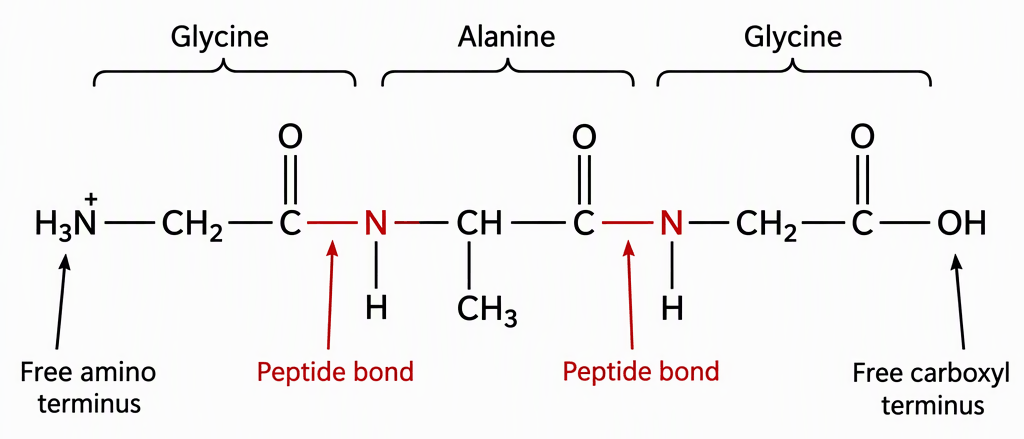
Classify: first connectivity, then hydrolysis. Retrieve: each junction between adjacent residues contributes one peptide bond. Test: count residues, not distinct residue names.
For a single linear chain only:
For this tripeptide:
Complete hydrolysis gives two glycine molecules and one alanine molecule: three amino-acid molecules, but only two distinct amino-acid types. Repeated residue names do not reduce the number of residues or peptide bonds.
Assess a separate statement: “Denaturation normally breaks the peptide bonds.” False. Denaturation disrupts native higher-order structure while ordinarily preserving the primary sequence.
Complete hydrolysis asks about covalent bond cleavage; denaturation asks about loss of native structure and function.
How can I eliminate incorrect nucleic-acid statements?
Reconstruct the components before judging the statements. A nucleoside contains sugar and base; a nucleotide also contains phosphate. DNA and RNA differ in their standard sugar and one standard base, but share cytosine. Use these comparisons rather than guessing from familiar-looking terms.
Original instructional statement set: which statements are correct?
- “A nucleoside contains phosphate.”
- “A nucleotide contains a sugar, a base and phosphate.”
- “The standard sugar in DNA is ribose.”
- “Cytosine occurs in both DNA and RNA.”
Rebuild the minimum reference:
- DNA: standard sugar is 2-deoxyribose; standard bases are A, G, C and T.
- RNA: standard sugar is ribose; standard bases are A, G, C and U.
Test each statement independently:
- Statement 1 is false: it confuses nucleoside with nucleotide.
- Statement 2 is true: all three components are included.
- Statement 3 is false: it confuses ribose with deoxyribose.
- Statement 4 is true: cytosine belongs to both standard base sets.
Answer: the nucleotide statement and the cytosine statement are correct. This is an instructional format, not a claim about a fixed JEE Advanced question pattern.
For further component practice, JEEnius daily practice problems provide a fresh ten-question set on a topic every day, with free sets daily.
Add this retrieval prompt to your sheet: “What changes between DNA and RNA, and what stays common?”
What should I practise next to find and repair my gaps?
Begin by reconstructing the comparison sheet with the book closed. Return only to entries you cannot explain or recall, rather than rereading the entire chapter. Use the gaps to choose what to repair, then test the repaired ideas in questions.
Use this practice order:
- Carbohydrate classification and hydrolysis.
- Peptide connectivity and denaturation.
- Nucleic-acid components.
- Prescribed vitamin, enzyme and hormone facts in mixed statement questions.
Match the repair to the error. A forgotten vitamin-deficiency association becomes a retrieval card with the vitamin on one side and its textbook association on the other. A reducing-sugar error needs an explanation of the free anomeric centre, accessible open-chain form or test condition, not another name-only flashcard.
Next, use previous-year questions for your target exam, checking that their topics remain in its current syllabus. Retest repaired ideas without looking at your earlier solutions.
You are ready to move on when you can justify correct answers, reject distractors and reproduce the key comparisons without opening the book. Recognition alone is not enough.
For fresh-question practice, JEEnius practice mode offers topic sets that skip questions already seen, with free sets included. Revisit mistakes separately: avoiding previously seen questions does not itself repair them.
Next step: practice mode on JEEnius and practise a topic in sets that skip questions you have already seen (free sets included).
For a worked example of the same idea, see Chemical Kinetics Practice Questions JEE: 6 Worked Examples.
Frequently asked questions
Is NCERT enough for Biomolecules in JEE?
NCERT is the starting reference, not a guarantee of complete preparation. Check the current official syllabus separately for JEE Main and JEE Advanced, then practise exam-specific questions. Use previous-year questions whose topics remain in your target exam's syllabus.
Can I study Biomolecules before finishing organic chemistry?
You do not need to finish all organic chemistry before starting Biomolecules. You should recognise hydroxyl, carbonyl, amino and carboxyl groups, and understand condensation and hydrolysis.
Why does fructose give a positive Tollens' test but sucrose does not?
Fructose tautomerises in the alkaline test medium to produce aldose forms that reduce Tollens' reagent. Sucrose is non-reducing because its glycosidic linkage involves both anomeric centres. After hydrolysis, sucrose produces glucose and fructose, so the resulting mixture is reducing under suitable test conditions.
How do I count peptide bonds, and does denaturation break them?
For a single linear peptide chain containing n amino-acid residues, the number of peptide bonds is n minus one. Count every residue, including repeated amino acids: Gly–Ala–Gly has three residues and two peptide bonds. Denaturation ordinarily preserves the peptide backbone and primary sequence; complete hydrolysis cleaves peptide bonds.