
How should I study Binomial Theorem for JEE in six steps?
- Choose between three moves: track an exponent, compare neighbouring terms or transform a coefficient sum. To study Binomial Theorem for JEE, first check factorials, combinations, laws of indices and solving a linear equation whose index must be an integer. Revise these before attempting mixed problems, including combination symmetry:
- Learn the general term, not a page of expansions. The finite binomial theorem is:
The index counts selections of the second part. The term number is one more than the index. The first term therefore has index zero.
- For a coefficient or constant term, track the exponent first. Combine the powers before calculating any combination:
Equate that exponent to the requested power, or to zero for a constant term. A non-integer index, or one outside the allowed range, means the power is absent. This works with negative and fractional powers too, wherever the expression is defined.
- Separate middle terms from greatest terms. There is one middle position when the outer exponent is even, and two when it is odd:
Greatest numerical terms depend on values, not positions. For positive terms, compare adjacent terms through:
For signed terms, decide whether the question asks for greatest value or greatest magnitude. Use absolute values for magnitude comparisons.
- For sums, identify what changes the coefficients. Use this question-cue checklist to choose the first move:
- Required power or constant: equate the exponent in the general term.
- Middle term: count positions.
- Greatest term: compare neighbouring values.
- Ordinary or alternating coefficient sum: substitute one or minus one into the generating expansion.
- Coefficient multiplied by its index: differentiate, then substitute.
- Coefficient divided by one more than its index: integrate or use a shifted-combination identity.
Class 11 students can use the weighted-sum example below without calculus. Learn that route first if differentiation and integration are unfamiliar.
- Check before doing large arithmetic. Confirm the integer index, its allowed range, the sign and whether the question wants a coefficient or a full term. Check endpoints in sums and equality in adjacent-term comparisons.
How do I find a coefficient when both positive and negative powers appear?
Match the exponent before calculating the coefficient. In this illustrative problem, not an attributed previous-year question, find the coefficient of the third power. The general term identifies the required contribution without expanding all ten terms:
The bracket notation means “coefficient of”. Write the general term, keeping the negative sign attached to the second part:
Now impose the requested exponent:
The index is an integer within the allowed range. The contribution comes from the sixth term, not the fifth, because term numbering starts one place ahead of the index.
The coefficient is a number. The full term still contains the power:
As an absence check, test whether the square power could occur:
That is not an integer, so there is no such term. The exponents decrease in steps of three, which gives an independent check on both results.
Determine whether the term exists before calculating its coefficient. This avoids combination arithmetic for a power that cannot occur.
How do I find the greatest term and catch two equal greatest terms?
Compare adjacent positive terms and retain the equality case. For this illustrative problem, the sixth and seventh terms are both greatest. The middle term is not the answer because position alone ignores the multiplying powers of two.
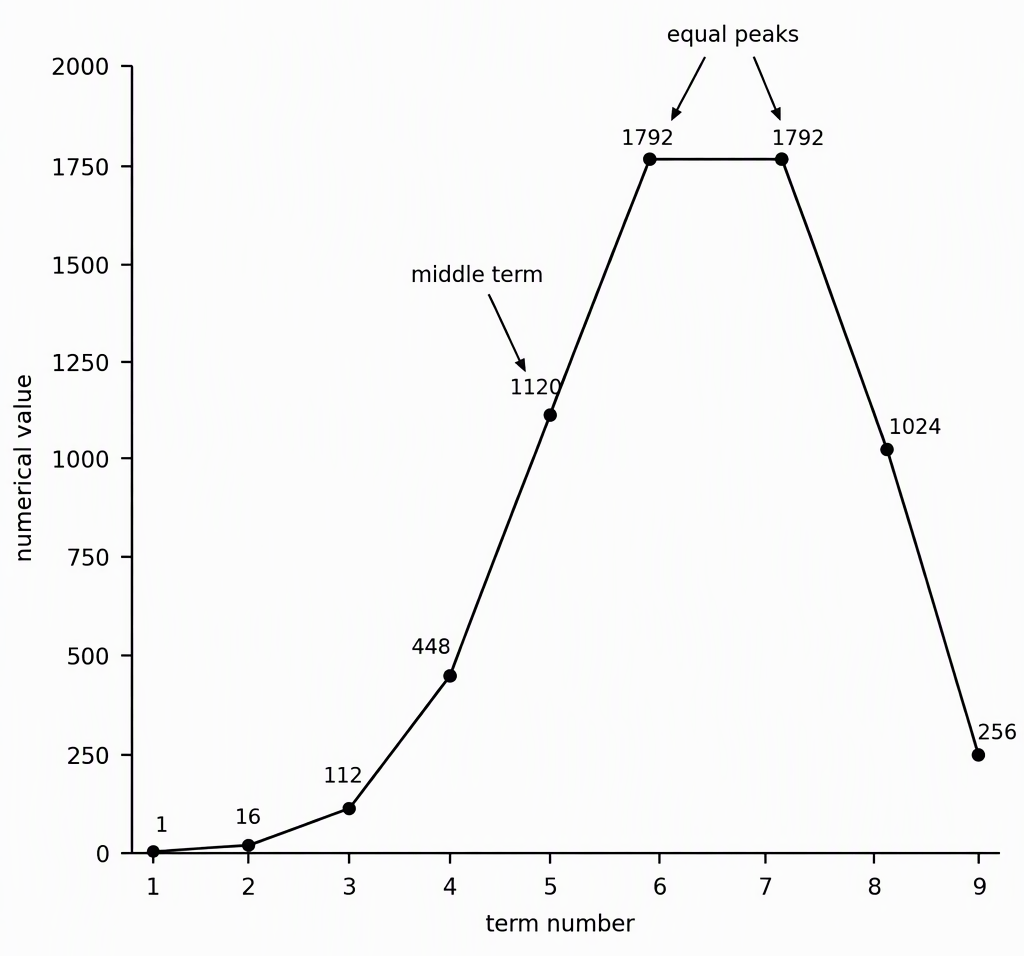
After substitution, every term is positive:
Divide the next term by the current one:
A ratio above one means an increase; below one means a decrease. This ratio decreases as the index increases, since its numerator falls while its positive denominator rises.
Find the equality point:
At this index, the ratio compares the seventh term with the sixth. Earlier ratios exceed one; later ratios are below one.
Keep these three questions separate:
- Greatest numerical terms: sixth and seventh, both valued at 1792.
- Middle term: fifth, with value after substitution:
- Greatest binomial coefficient: the central combination:
With signed terms, greatest value and greatest magnitude are not interchangeable. A large negative term may win the magnitude comparison but cannot exceed a positive term in value.
How do I evaluate a weighted coefficient sum without memorising another identity?
Convert the denominator into a shifted combination, then use the ordinary coefficient sum. This is the route I would choose first for Class 11: it follows from factorials and exposes the missing endpoint. Evaluate:
Start with factorials rather than quoting an identity:
To recognise a combination with its upper entry increased by one, multiply and divide by that new upper entry:
Shift the index and change both limits:
The full coefficient sum starts at zero. Our sum starts at one, so subtract the omitted coefficient:
Check a small case directly:
The calculus alternative integrates the finite expansion between zero and one. Integration creates the required denominator because:
For a follow-up, use Binomial Theorem JEE 2026: Weighted Sums by Integration. The main error to watch is shifting the index but keeping the old limits, or forgetting the missing endpoint.
For fresh topic work after practising this transformation, JEEnius daily practice problems provide a fresh ten-question set on a topic every day, with free sets daily.
What should I practise next for Binomial Theorem in JEE?
Separate the question types first, then mix them once you can choose the opening equation unaided. Use this first ten-question set as a suggested practice mix, not an exam distribution:
- Four coefficient or constant-term questions: include negative coefficients, an absent power, and negative or fractional powers of the variable.
- Two middle-term questions: use one even and one odd outer exponent.
- Two greatest-term questions: include one with equal greatest terms.
- Two coefficient-sum questions: include one substitution problem and one weighted sum.
Keep the outer exponent a non-negative integer in these finite expansions. Fractional or negative powers inside the brackets do not turn the expression into an infinite binomial expansion with a non-integer outer exponent.
Before solving each question, write its category and first equation. Afterwards, log mistakes under index, exponent, sign, ratio or summation limits. Record the exact failed step, not just “careless error”.
Start with standard JEE Main previous-year problems, then move to mixed and multi-step JEE Advanced problems. These methods are shared tools, not techniques reserved exclusively for either exam.
Your revision checkpoint is competence: choose the method unaided, explain why an absent term is absent and reproduce the weighted-sum derivation rather than recall its answer. If one check fails, return to that question type.
Revisit your error-log questions separately before fresh practice. Then use JEEnius practice mode for topic sets that skip questions already seen, with free sets included; select your category mix yourself rather than assuming it matches the suggested set above.
Next step: daily practice problems on JEEnius and get a fresh ten-question set on a topic every day (free sets daily).
Frequently asked questions
What should I revise before studying Binomial Theorem for JEE?
Revise factorials, combinations, combination symmetry and laws of indices. You should also be comfortable solving a linear equation and checking whether its solution is an integer within the allowed index range.
How do I find a coefficient in a binomial expansion?
Write the general term, combine the powers of the variable and equate the resulting exponent to the required power. Calculate the coefficient only if the index is an integer within the allowed range; otherwise, that power is absent. Remember that index r corresponds to term number r + 1.
Is the middle term always the greatest term?
No: the middle term depends on position, while the greatest numerical term depends on the values of the terms. For positive terms, compare each term with the next using their ratio, retaining the equality case because two adjacent terms can be equally greatest. For signed terms, distinguish greatest value from greatest magnitude.
Can I solve weighted binomial coefficient sums without calculus?
Yes: for the sum of C(n,r)/(r+1) from r = 0 to n, use C(n,r)/(r+1) = C(n+1,r+1)/(n+1). Shift the index and subtract the missing zero-index coefficient from the full coefficient sum. This gives (2^(n+1) - 1)/(n+1) for every non-negative integer n.
What questions should I practise for Binomial Theorem in JEE?
Start with four coefficient or constant-term questions, two middle-term questions, two greatest-term questions and two coefficient-sum questions. This is a suggested practice mix, not an exam distribution. Begin with standard JEE Main previous-year problems, then move to mixed and multi-step JEE Advanced problems.