
How should I study Coordination Compounds for JEE in six steps?
Start Coordination Compounds for JEE with charge and donor count, not hybridisation. Memorise ligand facts from NCERT, then derive what the formula tells you. Use worked questions to test each decision, rather than treating recognition while rereading as understanding.
- Repair the prerequisites. Revise ionic electron configurations, oxidation-state balance and orbital filling. For first-row transition-metal ions, remove electrons in this order, even though the usual Aufbau filling order is reversed:
Apply Hund’s rule within orbitals of equal energy.
- Build a compact ligand sheet from NCERT. Record each ligand’s formula, naming form, charge, donor atom and denticity. Start with these contrasts:
- Ammonia: neutral and monodentate, donating through nitrogen; its coordinated name is ammine.
- Chloride: anionic and monodentate, donating through chlorine; its coordinated name is chlorido.
- Ethane-1,2-diamine, abbreviated en: neutral and bidentate, donating through two nitrogen atoms.
- Parse the formula before choosing a theory. Identify the coordination sphere inside brackets, counterions outside, complex charge, metal oxidation state, coordination number and d-electron count. Coordination number counts attached donor atoms, not ligand molecules. Use this working line, recording coordination number separately:
Werner’s primary valency corresponds to oxidation state; secondary valency corresponds to coordination number. Then branch into naming, isomerism or bonding according to the question.
- Learn nomenclature and isomerism through drawings. Practise formula-to-name and name-to-formula questions. Alphabetise ligand names while ignoring multiplicative prefixes such as di, tri and bis. Distinguish coordinated chlorido from counterion chloride.
- Ionisation: exchange between a coordinated ion and counterion.
- Linkage: alternative donor atoms of an ambidentate ligand.
- Coordination: ligand redistribution between complex cations and anions.
- Geometrical: different relative positions.
- Optical: non-superimposable mirror images.
Preserve chelate connections when sketching. Disconnected donor labels can produce false counts.
- Combine coordination number, metal configuration and ligand-field information. Coordination number four does not uniquely determine geometry, and ligand strength alone is not a universal geometry rule. For octahedral complexes where high- and low-spin arrangements differ, compare splitting energy with pairing energy:
Fill the lower and upper orbital sets before counting unpaired electrons:
Calculate the spin-only estimate using the number of unpaired electrons:
Exact colours cannot be obtained merely by counting unpaired electrons. Transition energies, and sometimes charge-transfer processes, matter.
- Close the book and test each branch. Memorise ligand facts and NCERT’s standard field-strength ordering, but derive oxidation states, d counts and electron arrangements. Label the first incorrect decision in every missed question rather than memorising its final answer.
JEEnius daily practice problems provide a fresh ten-question set on a topic every day, with free sets daily. Use a set to test the branch you have just studied.
Why can two octahedral iron complexes have different magnetic moments?
Fluoride gives high-spin iron(III), while cyanide gives low-spin iron(III) in this original teaching comparison. Both complexes are paramagnetic despite different magnetic moments. Their oxidation states and coordination numbers match; their orbital populations do not.
Each ligand carries one negative charge. The same balance applies to both:
Fluoride case: weak-field octahedral splitting favours occupying all five orbitals before pairing. This high-spin arrangement has five unpaired electrons and is paramagnetic:
Cyanide case: strong-field splitting favours pairing in the lower set before occupying the upper set. This low-spin arrangement retains one unpaired electron and is also paramagnetic:
If hybridisation is requested, translate these results within the conventional JEE VBT model. The high-spin case uses outer d orbitals; the low-spin case makes two inner d orbitals available:
Strong field does not mean diamagnetic. Low-spin iron(III), with five d electrons, still has one unpaired electron.
Why does coordination number four not settle the geometry?
Four donor atoms can form a tetrahedral or square-planar arrangement. In this original worked comparison, the chloride complex is tetrahedral, while the cyanide complex is square planar. Coordination number restricts possible structures; the metal configuration and ligand-field effects distinguish these outcomes.
Both contain nickel(II), as the charge balance shows. Determine its configuration and donor count before discussing geometry:
The chloride complex is tetrahedral. Its weak-field environment retains two unpaired electrons; in tetrahedral splitting, the lower set holds four electrons and the upper set holds four.
The cyanide complex is square planar and diamagnetic. For this nickel(II) complex, strong-field square-planar splitting favours pairing eight electrons in four lower d orbitals, leaving the highest orbital empty.
These are conventional VBT labels. Do not apply octahedral orbital filling to the square-planar case, or turn this example into “strong ligand means square planar”.
Checkpoint: if you obtained the same geometry solely because both coordination numbers are four, your error occurred before orbital filling.
How do I name a chelate complex and count its isomers?
Use charge balance to name the metal, then donor count and connected ligand drawings to count isomers. The salt below has two geometrical isomer types, but three stereoisomers when its optical pair is counted separately. No magnetic calculation is needed.
Here en is neutral bidentate ethane-1,2-diamine. Assume the usual octahedral coordination geometry.
The outer chloride requires a complex charge of positive one. Charge balance therefore gives cobalt(III):
Each en supplies two nitrogen donors; each coordinated chloride supplies one donor. There are only four ligand molecules or ions inside the brackets, but six attached donor atoms:
The salt is dichloridobis(ethane-1,2-diamine)cobalt(III) chloride. Chlorido precedes ethane-1,2-diamine alphabetically because multiplicative prefixes are ignored. The two coordinated chlorides become dichlorido; the outer ion remains chloride.
For isomerism, compare adjacent and opposite chlorido positions while preserving both en links. The adjacent, cis arrangement has two mirror-related forms; the opposite, trans arrangement is optically inactive.
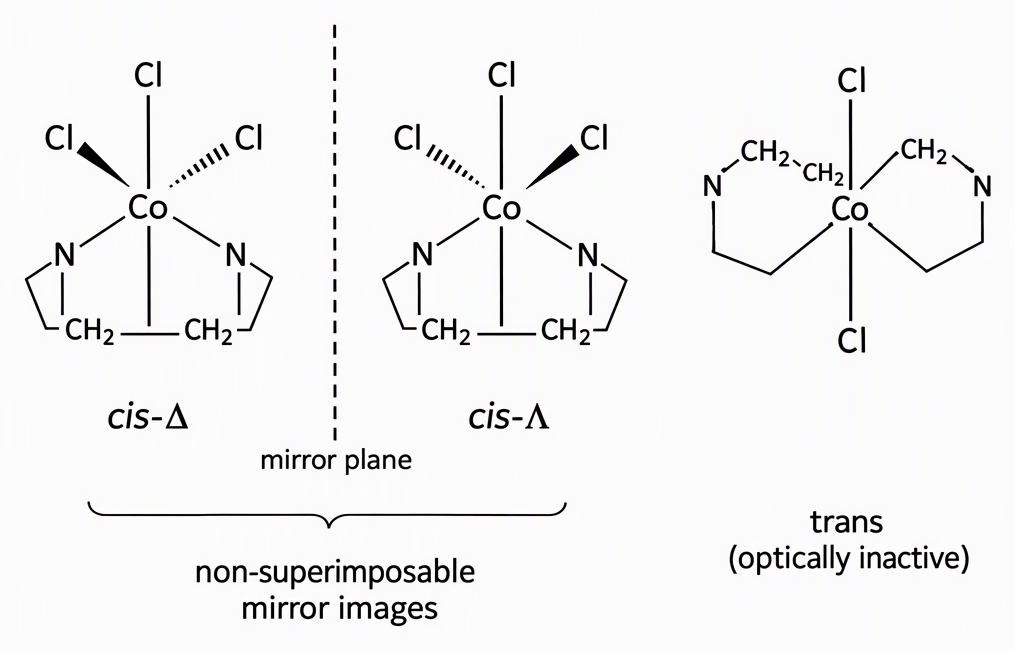
No rotation superposes the two cis mirror images while preserving the chelate connections. The ideal trans coordination structure has an inversion centre, so it does not produce a separate optical pair.
Match the count to the wording asked. Counting geometrical types groups the cis mirror images together; counting stereoisomers separates them:
- Geometrical isomer types: two, cis and trans.
- Total stereoisomers: three, the two cis enantiomers and one trans form.
What should I practise after finding my first wrong step?
Choose the next set from the first failed decision, not the chapter label. Move from isolated deductions to linked questions in this order:
- Charge, coordination-number and d-count drills.
- Formula-to-name and name-to-formula questions.
- Drawn isomer comparisons.
- Geometry and magnetism pairs.
- Mixed previous-year questions.
For each incorrect answer, record the first failed step and one corrective rule. Do not copy the entire solution.
- Wrong complex charge: revisit counterions and overall neutrality.
- Wrong coordination number: revisit denticity and count attached donors.
- Wrong magnetic moment: check d count and orbital filling before recalculating.
- Wrong isomer total: redraw complete structures and remove duplicates.
For weak ionic configurations, use D Block Practice Questions JEE: 6 Free Solved Questions. Reattempt missed questions closed-book in the next study session, then check transfer with unseen questions rather than relying on recognition.
Include short NCERT recall checks on Werner’s theory, ligand nomenclature, bonding, colour and applications. The calculation checklist is not the entire chapter.
Use JEE Main previous-year questions for direct and mixed applications, followed by JEE Advanced problems requiring several linked deductions. Readiness means you can justify charge, donor count, geometry and isomer distinctions without the answer key.
For the unseen-question check, JEEnius practice mode offers topic sets that skip questions already seen, with free sets included. Choose the topic linked to your first failed step and explain each decision before checking the answer.
Next step: practice mode on JEEnius and practise a topic in sets that skip questions you have already seen (free sets included).
Frequently asked questions
What should I study before Coordination Compounds for JEE?
Revise ionic electron configurations, oxidation-state balance and orbital filling. For first-row transition-metal ions, remove 4s electrons before 3d electrons. Apply Hund’s rule within orbitals of equal energy.
What should I memorise in Coordination Compounds for JEE?
Memorise ligand formulas, naming forms, charges, donor atoms, denticity and NCERT’s standard field-strength ordering. Derive oxidation states, d-electron counts and electron arrangements rather than memorising individual answers. Include short NCERT recall checks on Werner’s theory, bonding, colour and applications.
How do I calculate coordination number for bidentate ligands?
Count the donor atoms attached to the metal, not the number of ligand molecules or ions. Each ethane-1,2-diamine ligand, abbreviated en, contributes two donors. A complex with two en ligands and two coordinated chloride ions therefore has coordination number six.
Does a strong-field ligand always make a complex diamagnetic?
No; strong field does not mean diamagnetic. In octahedral [Fe(CN)6]3−, iron(III) has five d electrons and a low-spin arrangement that retains one unpaired electron. The complex is paramagnetic, with a spin-only magnetic moment of approximately 1.73 BM.
How should I practise Coordination Compounds questions for JEE?
Start with charge, coordination-number and d-count drills, then move to nomenclature, drawn isomer comparisons, and geometry–magnetism pairs. Follow these with mixed JEE Main previous-year questions and then JEE Advanced problems requiring linked deductions. For each mistake, record the first failed decision and one corrective rule, then reattempt the question closed-book before testing yourself on unseen questions.