
What should I check before finding an antiderivative?
- Start definite integration for JEE with basic antiderivatives and substitution, not every indefinite-integration trick. Revise standard antiderivatives, substitution with changed limits, elementary trigonometric identities, logarithm rules and basic graph/sign analysis. Learn harder indefinite integrals alongside this chapter, not as an entry requirement.
- Check that the integral exists on the stated interval. Inspect denominators, logarithm arguments and interior singularities before applying a property. A zero denominator needs investigation; a logarithm needs a positive argument wherever the real-valued integrand is evaluated.
For an improper integral, the required one-sided limits must converge separately. Splitting at a singularity identifies the pieces but does not prove convergence.
- Read the limits and test a transformation. Symmetric limits suggest parity. General finite limits suggest reflection about the midpoint. Positive reciprocal endpoints suggest reciprocal substitution, but you must transform the differential too.
Assuming the integral exists, reflection gives:
Add the two representations:
On a symmetric interval, the odd and even rules require integrability:
Oddness does not turn a divergent improper integral into zero. For example, this ordinary improper integral does not exist:
For reciprocal substitution, retain the Jacobian:
- Split where the formula or sign changes. For a modulus, find the enclosed expression’s roots inside the actual interval, then determine its sign between roots. Roots are candidate split points, not proof that the sign changes.
Piecewise definitions require separate intervals wherever their formulas change. Apply symmetry first if it reduces the number of pieces.
- Choose the shortest valid calculation. If an antiderivative is immediate, use endpoint evaluation. Otherwise, try pairing or substitution before long algebra or integration by parts.
- Check sign, rough bounds and reversed limits. A nonnegative integrand with increasing limits cannot produce a negative answer. A bound on the integrand gives a bound on the integral:
Reversing limits changes the sign. A signed integral subtracts below-axis contributions; geometric area counts them positively.
Use this study-sheet format: visible cue → candidate move → validity check → algebraic simplification. Derive each property once through substitution, then retrieve it through cues rather than an unconnected formula list.
For regular cue practice, JEEnius daily practice problems provide a fresh ten-question set on a topic every day, with free sets daily. Write your proposed first move before calculating.
How do I recognise when complementary terms should be paired?
Try reflection when it exchanges sine and cosine while leaving their sum unchanged. In this original teaching example, pairing makes the integrands add to one. Direct integration hides that simpler calculation.
The denominator is positive throughout the interval: both terms are nonnegative and never zero together. The endpoints suggest:
The limits change as follows:
Therefore,
Add this to the original representation:
Neither numerator needs separate integration. Exchanging sine and cosine helps because the complete transformed integrand, including its denominator, complements the original.
The transfer cue is a defined, integrable ratio of this form:
Check that the denominator does not vanish on the interval. Reflection then makes the paired integrands sum to one.
How do I combine symmetry with a modulus?
Use evenness to halve the interval, then inspect the sign inside the modulus on that reduced interval. Symmetry saves work, but it does not remove the need to split at a sign change.
For this original teaching example,
the integrand is continuous and even, so:
On the reduced interval, the sign changes at one. The modulus reflects the negative part of the parabola above the horizontal axis.
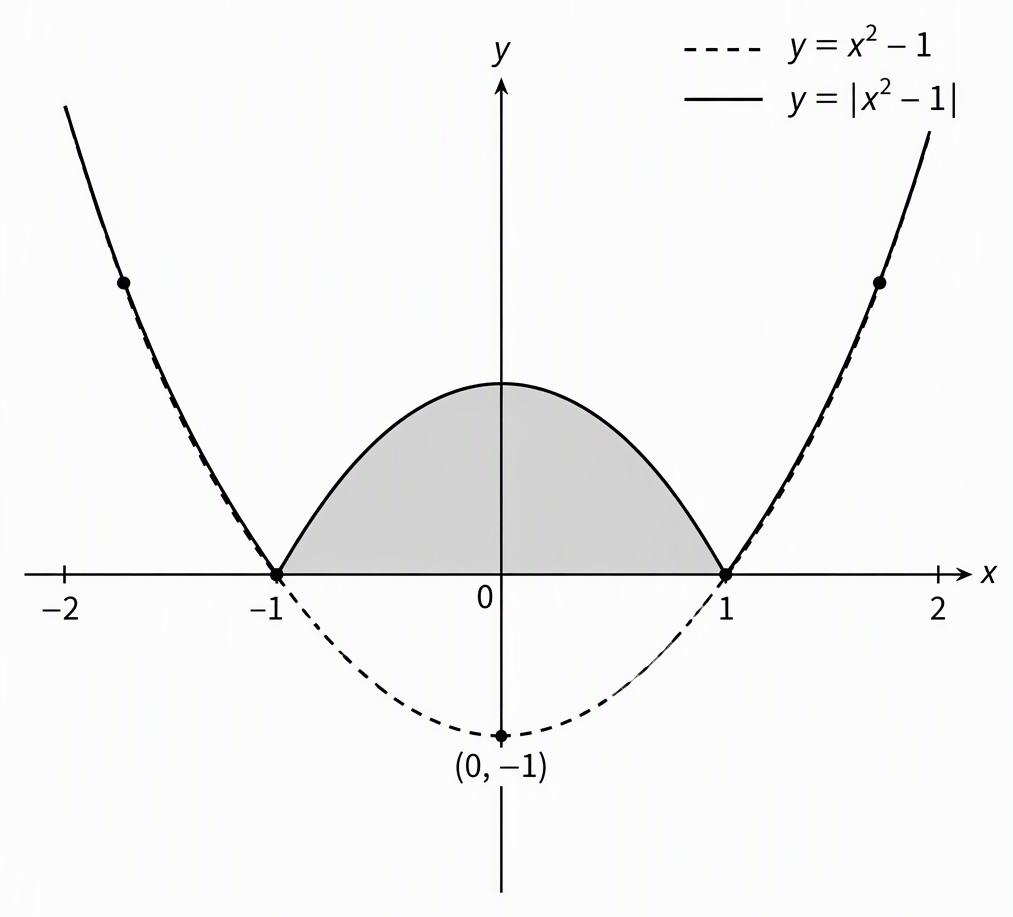
Thus,
Removing the modulus gives a different problem:
That is signed area, not the area under the absolute-value curve. The tempting wrong move is to use evenness correctly and then integrate without splitting.
Transfer rule: for an absolute-value integrand, find the enclosed function’s zeros within the actual integration interval. Determine its sign between those zeros before integrating.
When do reciprocal limits make an integral cancel?
Reciprocal endpoints help when the transformed differential and denominator cooperate, not merely because the endpoints multiply to one. Here, the logarithm changes sign while the remaining integration factor keeps its form. Check both parts before claiming cancellation.
For this original teaching example,
the integrand is continuous throughout the positive interval, so no improper-integral issue arises. The recognition cues are reciprocal endpoints and the logarithm identity:
Set:
Explicitly change both limits:
Transform the whole integrand:
The differential’s factor cancels the squared factor introduced by the denominator. Reversing the limits gives:
The logarithm is negative below one and positive above one. This makes zero plausible, but opposite signs alone do not prove equal contributions.
Treat the differential as part of every transformation: reciprocal endpoints alone do not guarantee cancellation. This result is a definite-integral cancellation and does not require finding an elementary antiderivative.
How should I practise choosing the first move for JEE?
Write and justify the first move before doing any calculation, then test it through a full solution. Compare your initial plan with the method that worked. This separates recognition errors from mistakes made while integrating.
Follow this topic order:
- Direct evaluation and substitution with changed limits.
- Reflection and parity.
- Modulus and piecewise splitting.
- Mixed transformations, including reciprocal substitution.
- A separate block requiring ordinary substitution or integration by parts.
Do not skip the last block: not every definite integral is a symmetry trick. For each unfamiliar question, write interval cue → proposed move → reason in one line before solving.
Track four error categories:
- Failed recognition: you missed a useful cue.
- Invalid property use: you ignored a condition, such as convergence.
- Changed-limit/Jacobian errors: the substitution was incomplete.
- Calculation errors: the plan was sound, but execution failed.
Make the next practice block target the category causing your mistakes. Begin with JEE Main previous-year questions to check basic execution, then attempt mixed-condition JEE Advanced questions. Neither exam is restricted to one method or difficulty level.
Revisit missed questions without opening earlier solutions. Explain why your original move failed, or why it created avoidable work.
For unseen-question practice, JEEnius practice mode provides topic sets that skip questions already seen, with free sets included. This builds fresh recognition; separately re-solve mistakes from your own error log.
Readiness check: take an unfamiliar integral and justify the property, preserve limits and differentials, and explain why a plausible alternative move is less useful. Do this without referring to the three worked answers.
Next step: practice mode on JEEnius and practise a topic in sets that skip questions you have already seen (free sets included).
For a worked example of the same idea, see Differentiation Practice Questions JEE: 6 Worked Solutions.
Frequently asked questions
Do I need to finish indefinite integration before starting definite integration for JEE?
You need standard antiderivatives and basic substitution, not every indefinite-integration trick. Revise substitution with changed limits, elementary trigonometric identities, logarithm rules and graph/sign analysis. Learn harder indefinite integrals alongside definite integration.
In what order should I study definite integration for JEE?
Start with direct evaluation and substitution with changed limits, then study reflection and parity. Follow with modulus and piecewise splitting, mixed transformations including reciprocal substitution, and a separate block on ordinary substitution or integration by parts. Begin practice with JEE Main previous-year questions before attempting mixed-condition JEE Advanced questions.
Is the definite integral of an odd function always zero?
An odd function integrates to zero over symmetric limits only when the integral exists. For an improper integral, the required one-sided limits must converge separately. The ordinary improper integral of 1/x from -1 to 1 does not exist, despite the integrand being odd.
How do I solve definite integrals with a modulus?
Apply symmetry first if it reduces the interval, then find the enclosed expression's zeros within the remaining interval. Check its sign between those zeros; a root does not necessarily mean the sign changes. Split where needed and replace the modulus with the correct expression on each piece before integrating.
How should I practise definite integration questions for JEE?
Before calculating, write the interval cue, your proposed first move and the reason for choosing it. Complete the solution, then classify mistakes as failed recognition, invalid property use, changed-limit/Jacobian errors or calculation errors. Target the next practice block at your weakest category and re-solve missed questions without looking at earlier solutions.