
How should I study differentiation for JEE, step by step?
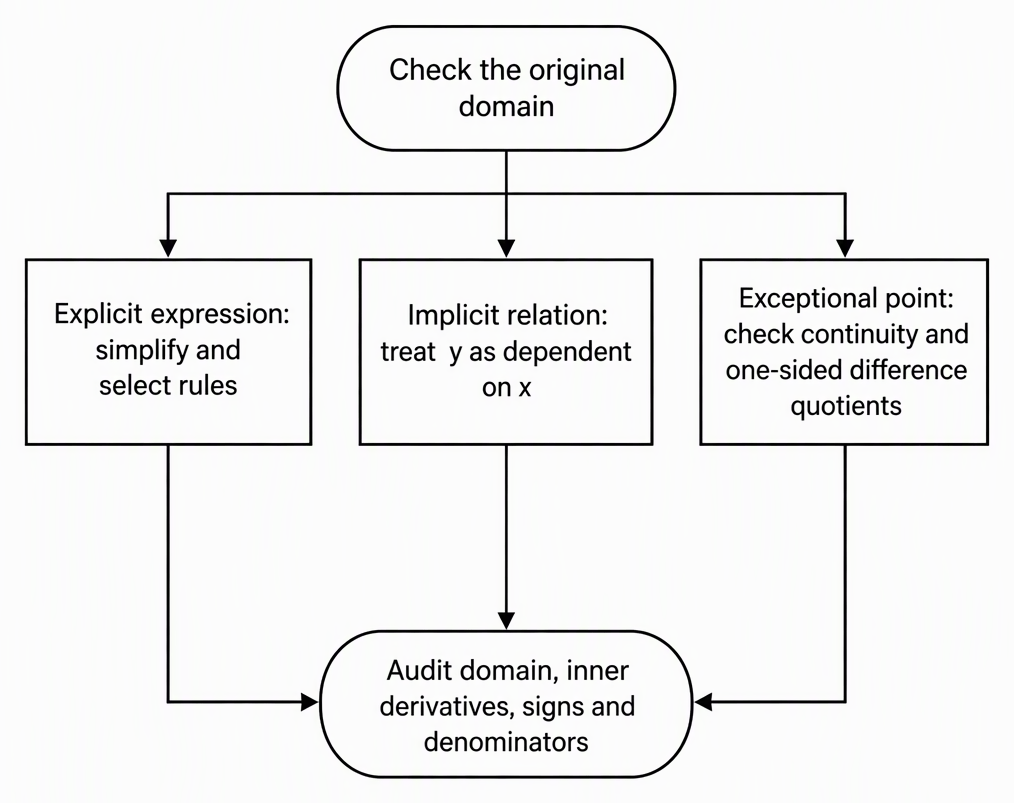
Study differentiation for JEE by classifying before calculating. Use a classify–differentiate–check routine, keeping three tasks separate: finding explicit derivatives, differentiating implicit relations, and deciding whether a derivative exists at an exceptional point.
- Repair only the prerequisites you need.
Check function domains, composition, elementary algebra, trigonometric identities and limits. Repair a skill when it blocks a question, rather than restarting entire chapters. Finding a derivative formula and proving that a derivative exists at a particular point are different jobs.
- Build a compact, usable derivative sheet.
Include powers, exponential and logarithmic functions, trigonometric and inverse-trigonometric functions, then sum, product, quotient and chain rules. Use radians for trigonometric derivatives. Attach validity conditions to formulas:
- Classify before calculating.
- Nested expression: use the chain rule.
- Product or quotient: simplify first, then choose the required rule.
- Variable base and exponent: consider logarithmic differentiation.
- Relation involving both variables: use implicit differentiation.
- Parametric curve: divide the parameter derivatives only when the denominator is nonzero.
- Write the dependency chain explicitly.
Show the intermediate variable before differentiating a composite function. In an implicit relation, differentiate every occurrence of the dependent variable as a function of the independent variable.
- Give exceptional points a separate route.
At joining points, modulus corners and separately defined values, check continuity, then use one-sided difference quotients. A continuity failure rules out differentiability, but passing continuity does not establish it.
- Audit before accepting the answer.
Check the original domain, missing inner derivatives, signs and newly introduced denominators. A numerical spot-check can expose an error, but it cannot prove differentiability.
Follow this learning order: elementary formulas and chain rule → product and quotient → logarithmic, implicit and parametric forms → piecewise differentiability → mixed questions. This sequence builds the rules needed for later tasks; it is not an exam-weightage claim.
How do I differentiate a function with a variable base and exponent?
Use logarithmic differentiation when both the base and exponent vary and the function is positive. Neither the constant-exponent power rule nor the constant-base exponential rule applies directly. Consider this original illustrative problem:
First check the domain and positivity:
Logarithmic differentiation is therefore valid throughout the real domain. Take natural logarithms, then differentiate:
There are two separate rule decisions here. After taking logarithms, use the product rule on the right side and the chain rule inside the logarithm of the quadratic.
Multiply back by the original function:
At zero, both terms inside the brackets vanish:
The two common omissions are the derivative of the exponent and multiplication back by the original function. An answer containing only the derivative of the base treats the exponent as constant. Stopping at the logarithmic derivative leaves the calculation unfinished.
How do I find an implicit derivative at a given point?
Differentiate the relation first, collect the derivative terms, and substitute the point last. Choose implicit differentiation here: solving explicitly introduces unnecessary square roots and branch choices. Find the slope in this original illustrative problem:
Verify that the point belongs to the curve:
The middle term needs the product rule. Differentiate both factors, treating the dependent variable as a function of the independent variable:
Differentiate the full relation:
Collect derivative terms before dividing:
Divide only where the coefficient is nonzero:
At the specified point, the denominator is nonzero:
Substituting the point before differentiating reduces the equation to a numerical identity. That destroys the varying relation needed to find the slope.
A zero denominator elsewhere requires separate analysis. It does not justify cancellation or mean that the curve itself is undefined.
Can a function be differentiable at zero while its derivative is discontinuous?
Yes. A derivative can exist at zero even when nearby derivative values fail to approach it. Separate three tests: continuity of the function, existence of its derivative, and continuity of that derivative. Consider this original illustrative function:
First, check continuity. Bound the absolute value by a quantity tending to zero:
Hence,
Next, test differentiability using the definition. At the separately defined point, use the difference quotient:
because
Away from zero, apply the product and chain rules:
To test the limit of this derivative, use two sequences approaching zero. Let the index run through positive integers tending to infinity:
The sequences give different limiting values, so the derivative has no limit at zero. The function is differentiable there, but its derivative is not continuous there. Continuity of the derivative is not required for the derivative at the point to exist.
The decisive trap is substituting zero into a derivative formula valid only away from zero. Return to the difference quotient instead.
What should I practise next to improve differentiation for JEE?
Start with untimed single-skill questions, then mixed questions, then relevant JEE Main and JEE Advanced previous-year questions. Advance when you can choose the method, complete the calculation and justify domain restrictions without a solution. Neither exam tests only formula-based derivatives or only conceptual differentiability.
Suggested starter set: 10 questions. These are editorial practice recommendations, not exam-distribution figures:
- 3 explicit questions: chain, product and quotient rules.
- 2 logarithmic-differentiation questions: variable bases and exponents.
- 2 implicit or parametric questions: track dependency or parameter derivatives.
- 3 differentiability-at-a-point questions: joins, modulus corners and separately defined values.
Before each calculation, write method and domain. Record each wrong answer under one of four causes, then repair that cause:
- Method selection: classify the original expression again.
- Inner derivative: write every dependency link.
- Algebra/sign: redo the line where the first mismatch occurred.
- Domain/exceptional point: restore restrictions and use difference quotients where needed.
For parametric practice, begin where the parameter derivative in the denominator is nonzero, then move to points where the ratio formula is inconclusive. For inverse-trigonometric practice, include domain and branch restrictions, not just formula substitution.
First-time Class 11 learners should follow the sequence from the start. Class 12 students and droppers should use a mixed diagnostic set to find their earliest weak skill rather than repeat every lecture.
JEEnius daily practice problems provide a fresh ten-question set on a topic every day, with free sets daily.
Before increasing difficulty, reattempt errors and justify any exceptional-point treatment without consulting a solution. Move to applications of derivatives once this routine is secure.
For fresh questions after those reattempts, JEEnius practice mode offers topic sets that skip questions already seen, with free sets included.
Next step: daily practice problems on JEEnius and get a fresh ten-question set on a topic every day (free sets daily).
For a worked example of the same idea, see Electromagnetic Induction Practice Questions JEE: 5 Drills.
Frequently asked questions
In what order should I study differentiation for JEE?
Start with elementary derivative formulas and the chain rule, then study product and quotient rules. Follow with logarithmic, implicit and parametric differentiation, then piecewise differentiability and mixed questions. Repair prerequisites such as domains, algebra and limits when they block a question.
How do I differentiate a function with a variable base and exponent?
Use logarithmic differentiation when both the base and exponent vary and the required logarithms are defined. For a positive base u(x), write y = u(x)^v(x), take natural logarithms and differentiate ln y = v(x) ln u(x) using product and chain rules. Multiply back by y to obtain the derivative.
Should I substitute the point before implicit differentiation?
No: first verify that the point lies on the curve, then differentiate the relation while treating y as a function of x. Collect the derivative terms and check that their coefficient is nonzero before dividing and substituting the point. Substituting before differentiating destroys the varying relation needed to find the slope.
Can a function be differentiable at zero but have a discontinuous derivative?
Yes: the function f(x) = x² sin(1/x) for x ≠ 0, with f(0) = 0, has f′(0) = 0. Its derivative away from zero is 2x sin(1/x) − cos(1/x), which has no limit at zero. Use the difference quotient at the separately defined point rather than substituting into a formula valid only away from it.
What questions should I practise for JEE differentiation?
Begin with untimed single-skill questions, move to mixed questions, then attempt relevant JEE Main and JEE Advanced previous-year questions. A suggested starter set contains three explicit, two logarithmic, two implicit or parametric, and three differentiability-at-a-point questions. Write the method and domain before calculating, then classify and reattempt your errors.