
What is the calorimetry and latent heat JEE 2019 question?
The calorimetry and latent heat JEE 2019 numerical gives 270.00 because the calorimeter releases equal heat in two stages, but the first stage includes both heating and vaporisation. It is from JEE Advanced 2019, Paper 1, Physics, Thermodynamics. Its medium difficulty is the question bank’s classification, not an official exam rating.
A liquid at 30°C is poured very slowly into a calorimeter initially at 110°C. The liquid boils at 80°C, and the first 5 g evaporates completely. Another 80 g is then added, giving a final equilibrium temperature of 50°C; heat exchange with the surroundings is neglected.
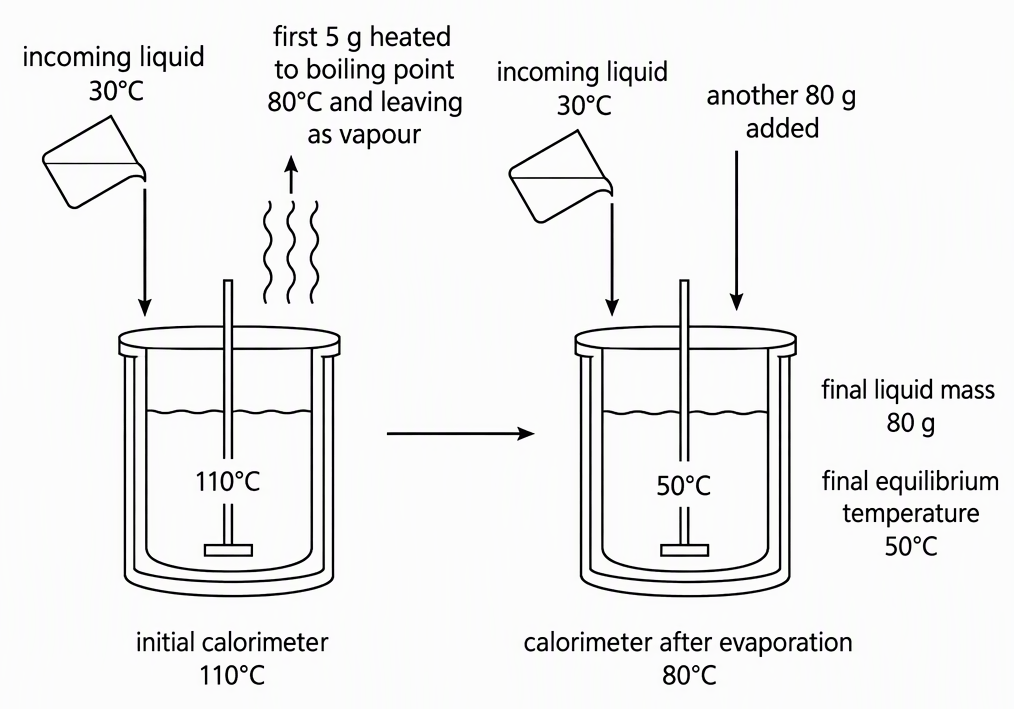
Find the liquid’s latent heat of vaporisation divided by its specific heat, expressed in °C. This is a numerical-answer question with no supplied options.
Why does the first 5 g need both heating and vaporisation?
The first 5 g enters below its boiling point, so it must absorb sensible heat before absorbing latent heat. The official solution places the stage boundary at 80°C: after those 5 g have evaporated, the calorimeter has cooled to the liquid’s boiling point.
Define the quantities as follows:
Keep every mass in grams. With energy in joules, specific heat and latent heat must be expressed per gram:
\begin{aligned} [C]&=\mathrm{J}/{}^\circ\mathrm{C},\\ [s]&=\mathrm{J}/(\mathrm{g}\cdot{}^\circ\mathrm{C}),\\ [L]&=\mathrm{J}/\mathrm{g}. \end{aligned}The liquid’s temperature increase and sensible heat are:
Vaporisation then requires:
The calorimeter supplies both contributions by cooling from 110°C to 80°C:
Equating heat gained and heat lost gives the complete first balance:
The latent-heat term alone is not enough. Heating the incoming liquid from 30°C to 80°C uses part of the calorimeter’s energy before vaporisation.
Why does only 80 g appear in the second heat balance?
Only the newly added 80 g remains as liquid in the second stage. The first 5 g has already evaporated and must not be counted as liquid warming to the final equilibrium temperature. Using 85 g would count the escaped vapour as remaining liquid.
The next 80 g enters at 30°C and reaches 50°C, below the 80°C boiling point. Its heat gain is therefore sensible heat:
The calorimeter starts this stage at 80°C and ends at 50°C:
The second balance is:
The liquid rises by 20°C, while the calorimeter falls by 30°C. A shared final temperature does not mean equal temperature changes.
How do you eliminate the calorimeter’s heat capacity and get 270.00?
The calorimeter falls by 30°C in each stage, so it releases equal amounts of heat in those stages. Equate the two heat gains to eliminate its unknown heat capacity; there is no need to calculate that heat capacity separately.
Substitute the second balance into the first:
The required numerical entry is:
The unit check confirms that the ratio represents a temperature interval:
This interval is also numerically 270 K. It is not an absolute temperature, so no 273.15 conversion applies.
Substitution checks the energy balance:
Both contributions are positive and together match the heat released. The bank’s 120-second expected solve time is its practice benchmark, not measured student performance; use it after you can reproduce both balances without notes.
Why does leaving out sensible heat give 320 instead?
The result 320 comes from assigning all the first-stage heat to vaporisation. It is an illustrative wrong numerical result, not an official option: this question has no supplied answer choices. The missing term is the heat needed to bring the incoming liquid to its boiling point.
The faulty first balance is:
Combining it with the correct second balance gives:
The incoming liquid must first warm from 30°C to 80°C. Omitting that heating assigns its energy to latent heat and overstates the requested ratio by:
List temperature-change segments and phase-change segments separately before writing the heat balance. The first liquid portion has both; the second has only a temperature-change segment.
Can you solve two original practice variations using the same method?
Separate stage balances solve both variations below, even when the calorimeter’s temperature drops are unequal. These are original practice variations, not additional verified PYQs.
Question 1. Under the same slow-pouring and no-heat-loss assumptions, liquid enters at 30°C, boils at 80°C, and enters a calorimeter initially at 110°C. The first 4 g evaporates completely; another 60 g gives equilibrium at 50°C. Find the latent-heat-to-specific-heat ratio.
The two balances are:
Equating the heat gains:
Question 2. Keep the original incoming temperature of 30°C, boiling point of 80°C, initial calorimeter temperature of 110°C, first evaporated mass of 5 g and subsequent mass of 80 g. Change only the final equilibrium temperature to 40°C, retaining the same assumptions. Find the ratio.
The balances are:
Therefore:
Equal calorimeter temperature drops simplify the original question, but separate balances still work when those drops differ. Before eliminating heat capacity, write the calorimeter’s starting and ending temperatures for each stage.
Next step: photograph a doubt on JEEnius and photograph any question you are stuck on and get a step-by-step solution, with a free-body diagram when the question needs one (20 free).
For a worked example of the same idea, see How to Study General Organic Chemistry JEE: Order and Practice.
Frequently asked questions
How do you get 270.00 in the JEE Advanced 2019 calorimetry question?
Let C be the calorimeter's heat capacity, s the liquid's specific heat and L its latent heat of vaporisation. The two heat balances are 250s + 5L = 30C and 1600s = 30C. Eliminating C gives 5L = 1350s, so L/s = 270°C and the numerical entry is 270.00.
Why does the first 5 g need sensible heat as well as latent heat?
The liquid enters at 30°C but boils at 80°C, so it must first absorb heat to rise by 50°C. For 5 g, this sensible heat is 250s, followed by latent heat of 5L. The calorimeter supplies both contributions as it cools from 110°C to 80°C.
Why is 80 g used instead of 85 g in the second heat balance?
The first 5 g has evaporated and escaped, so it is not part of the liquid warming in the second stage. Only the newly added 80 g warms from 30°C to 50°C. Its heat gain is therefore 80s × 20 = 1600s.
Why am I getting 320 instead of 270 in the calorimetry question?
The result 320 comes from omitting the heat needed to warm the first 5 g from 30°C to 80°C. Writing 5L = 30C incorrectly assigns all the first-stage energy to vaporisation. Including the missing 250s term gives L/s = 270°C instead of 320°C.