
What order should I study GOC in, and how should I solve its questions?
- Draw the deciding species before ranking anything. To study General Organic Chemistry for JEE, start with bonding: draw lone pairs, assign formal charges, and identify sigma bonds, pi bonds and hybridisation in simple structures. Repair these gaps before studying electronic effects.
Worked numerical check: nitrogen in ammonia has five valence electrons, two nonbonding electrons and six bonding electrons. Formal charge assigns half the bonding electrons to nitrogen:
After protonation, nitrogen has four bonds and no lone pair. Its formal charge becomes:
- Study effects in prerequisite order. Learn bond polarity and inductive effect first, valid resonance structures and conjugation next, then hyperconjugation. After each concept, close the notes and explain one comparison without looking. If you cannot identify the electrons or orbitals involved, revisit the structure rather than memorising the answer.
- Apply the effects to different targets. Study carbocations, carbanions and radicals, followed by acidity, basicity, electrophiles and nucleophiles. Do not transfer a carbocation stability order blindly to carbanions: electron donation can help an electron-deficient centre but need not help a negatively charged one.
- Identify what the question compares. Use this target map before choosing an effect:
- Acidity: draw the conjugate base and compare its stability.
- Basicity: compare proton-accepting tendency by locating the accepting lone pair and considering the conjugate acid and specified medium.
- Carbocation stability: inspect electron deficiency and stabilisation of the positive centre.
- Draw first, then inspect in a fixed sequence. Check the atom and its charge, orbital availability, conjugation, inductive effects and hyperconjugation where applicable. For radicals, inspect the unpaired-electron centre. Resonance contributors must preserve atom connectivity and total charge; only electron placement changes.
- State the decisive difference in one sentence. Then check whether solvent, geometry or a change of comparison class limits that conclusion. “This species has resonance” is incomplete unless you establish that conjugation exists and explain why it matters here.
Reject the universal shortcut “resonance beats hyperconjugation beats inductive effect”. Check whether each effect operates before deciding which controls the comparison.
Keep one revision sheet with three entries per comparison: structure, deciding effect and condition. Do not collect unexplained rankings.
How do I rank ethanoic acid, phenol and ethanol by acidity?
Compare their conjugate bases, not the apparent complexity of the parent molecules. For this illustrative comparison under ordinary aqueous conditions, remove the acidic oxygen-bound proton from each acid first. Keep the atom framework unchanged and mark the negative charge:
Acetate has two equivalent principal resonance contributors. The oxygen labels track the same atoms across both:
Neither contributor is preferred over the other. The actual ion shares negative charge between the two oxygen atoms.
Phenoxide also has resonance delocalisation. However, its contributors with negative charge at ortho or para ring carbons are not equivalent to the contributor with charge on oxygen. Negative charge on carbon is less favourable than on the more electronegative oxygen.
Ethoxide has no comparable resonance delocalisation. Its negative charge remains largely localised on one oxygen atom. The resulting acidity order is:
“Both acetate and phenoxide have resonance” does not make their stabilisation equal. Contributor quality and the atoms bearing charge matter, not just the number of drawings.
Drawing the conjugate bases therefore gives a better test than counting resonance structures in the parent acids. The stronger acid forms the more stabilised conjugate base in this comparison.
How do I rank ethylamine, ammonia and aniline by basicity?
In aqueous solution, ethylamine is more basic than ammonia, which is more basic than aniline. Compare how readily the nitrogen lone pair accepts a proton, considering the resulting conjugate acid and its solvation. Mark that lone pair before using any memorised amine order:
In aniline, the nitrogen lone pair participates in conjugation with the benzene ring. Protonation uses this pair to form a nitrogen-hydrogen bond, removing it from that conjugation.
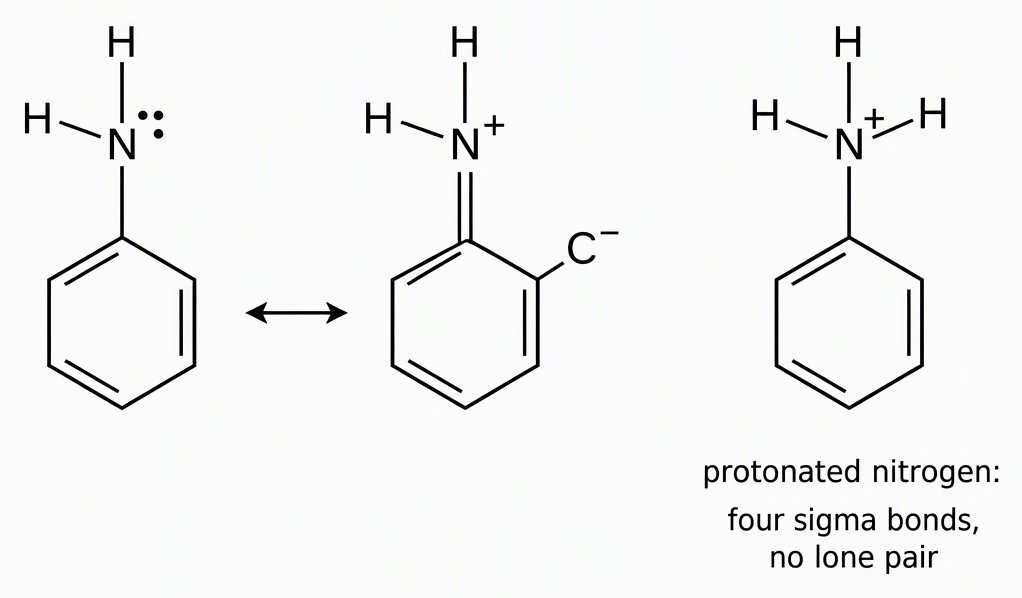
The ethyl group donates electron density through the inductive effect. This helps account for ethylamine accepting a proton more readily than ammonia in this comparison:
The trap is: “Resonance stabilises aniline, so aniline must be more basic.” That confuses the stability of the starting species with its tendency to accept a proton.
Aqueous basicity also depends on solvation. This example does not establish a universal primary, secondary and tertiary amine order.
For repeated comparisons, JEEnius daily practice problems provide a fresh ten-question set on a topic every day, with free sets daily.
The reusable check is: identify which lone pair accepts the proton and whether it is already participating in conjugation.
Why is an allylic carbocation more stable than a simple primary carbocation?
The allylic carbocation gains conjugated charge delocalisation that the simple primary propyl carbocation lacks. Compare the following carbocations as drawn, excluding rearrangement. Both positively charged carbons are attached to one carbon, so calling both “primary” cannot decide their relative stability:
In the allylic ion, the adjacent pi system overlaps with the empty p orbital at the positively charged carbon. This allows the electron deficiency to spread over the terminal carbons.
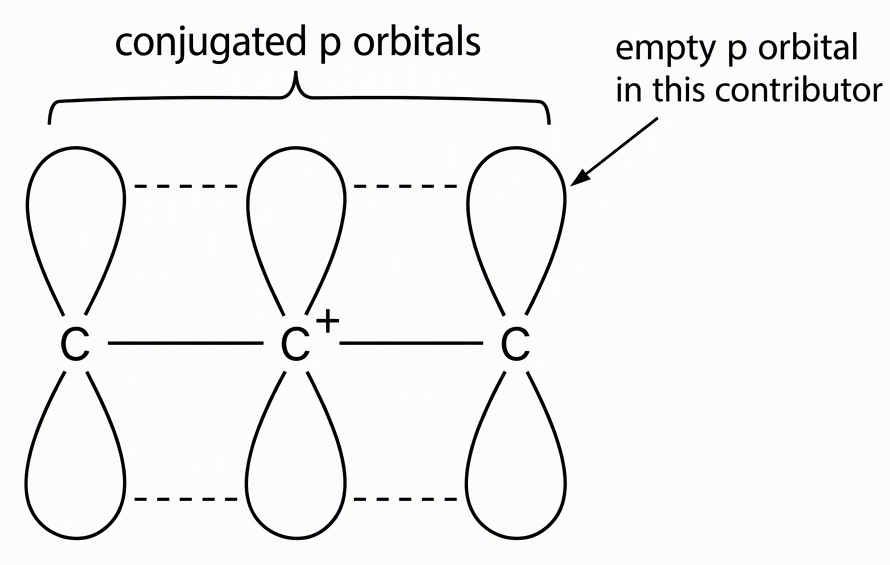
The simple primary propyl carbocation has no adjacent pi bond to provide this conjugated delocalisation. The allylic carbocation is more stable in this comparison.
Do not confuse allylic with vinylic. A vinylic carbocation has its positive centre on a double-bond carbon:
A positive centre next to a double bond and one on a double-bond carbon are different structural situations. The allylic argument cannot simply be copied across.
Resonance moves electrons, not atoms. Contributors are not separate species switching back and forth, and this local comparison is not an unconditional ranking of every allylic, benzylic and alkyl carbocation.
What should I practise next to make GOC reasoning reliable?
Begin with structure drills, then single-effect comparisons, then mixed questions. Use this loop to find the first reasoning step you cannot justify:
- Check structures: assign formal charges, reject invalid resonance contributors, distinguish conjugated from non-conjugated systems, and identify allylic versus vinylic positions.
- Isolate effects: solve comparisons controlled mainly by inductive effect, resonance or hyperconjugation. Explain why the effect operates.
- Mix targets: attempt acidity, basicity and intermediate-stability questions. Include carbanions and radicals so carbocation rules do not become universal rules.
- Commit before checking: write the deciding species, relevant structural feature and one-line justification for every comparison.
Classify each mistake as structure/charge, missed conjugation, wrong deciding species, ignored medium or unjustified memorised order. Correct that cause instead of copying the solution.
Then run a transfer check: change one substituent or its position, explain whether you expect the conclusion to change, and verify your prediction. Base that expectation on the changed structure: moving a group can interrupt conjugation even when the molecular formula stays unchanged.
Use NCERT Chemistry as your theory source, one coaching module as your practice source, and relevant JEE previous-year questions after the basic drills. Do not split attention across several books covering the same comparison types.
Class 11 students should build from bonding. Class 12 students and droppers can use the three worked examples diagnostically, repairing the first step they cannot justify.
Move on when you can explain an unseen comparison and reject its tempting wrong argument without notes. Then use Haloalkanes Practice Questions JEE: 5 Solved Drills to carry that reasoning into haloalkane questions.
For fresh attempts, JEEnius practice mode offers topic sets that skip questions already seen, with free sets included. Write your deciding species before checking each answer.
Frequently asked questions
In what order should I study GOC for JEE?
Start with bonding, lone pairs, formal charges and hybridisation. Study bond polarity and inductive effect next, followed by resonance, conjugation and hyperconjugation. Then apply these ideas to carbocations, carbanions and radicals before studying acidity, basicity, electrophiles and nucleophiles.
Why is ethanoic acid more acidic than phenol and ethanol?
Under ordinary aqueous conditions, the acidity order is ethanoic acid > phenol > ethanol. Acetate shares negative charge between two oxygen atoms through equivalent principal resonance contributors, whereas phenoxide's carbon-charged contributors are less favourable. Ethoxide has no comparable resonance delocalisation, so counting resonance drawings alone cannot explain the order.
What is the basicity order of ethylamine, ammonia and aniline?
In aqueous solution, the basicity order is ethylamine > ammonia > aniline. The ethyl group's inductive donation helps explain ethylamine's greater basicity, while aniline's nitrogen lone pair participates in conjugation with the benzene ring. Solvation also matters, so this comparison does not establish a universal order for primary, secondary and tertiary amines.
How should I practise GOC questions for JEE?
Begin with structure and formal-charge drills, move to single-effect comparisons, then mix acidity, basicity and intermediate-stability questions. Before checking an answer, write the deciding species, relevant structural feature and one-line justification. Classify each mistake by its reasoning cause, and use relevant JEE previous-year questions after the basic drills.