
Which free JEE Chemistry mock test should you choose?
Choose a free JEE Chemistry mock test by the problem it needs to expose: a chapter test for a recently studied topic, mixed Chemistry practice for recall across chapters, and a full PCM mock for exam-wide time pressure. JEEnius includes free full-length mocks with 75 questions, 300 marks, 180 minutes and a scored per-subject breakdown.
That verified JEEnius option is a full Physics–Chemistry–Mathematics paper, not a confirmed standalone free Chemistry test. Choose it when you need to measure Chemistry alongside the demands of the other two subjects.
This comparison focuses on JEE Main. Advanced requires a separate check of question types and marking, not just harder questions inside a Main template.
Use the narrowest test that answers your present doubt. Choose a full mock to investigate time allocation across subjects, not to judge mastery of completed chapters through a full-syllabus total.
How do chapter tests, Chemistry-only tests and full mocks compare?
Chapter tests diagnose topic-level gaps, mixed Chemistry tests diagnose recall and method selection, and full mocks test performance across subjects. Choose by what you need to measure. Here is how chapter/topic tests, mixed Chemistry-only tests and full PCM mocks with a Chemistry score compare.
- Question coverage
- Chapter: One topic or chapter.
- Chemistry-only: Several Chemistry chapters.
- Full PCM: Physics, Chemistry and Mathematics.
- Problem it diagnoses
- Chapter: Whether a recently learned idea can be applied.
- Chemistry-only: Whether you can retrieve facts and select methods without chapter labels.
- Full PCM: Whether Chemistry holds up while you allocate time across subjects.
- Use with an incomplete syllabus
- Chapter: Strong fit for completed topics.
- Chemistry-only: Useful when restricted to studied chapters.
- Full PCM: Unstudied content complicates interpretation.
- Exam-wide time-pressure realism
- Chapter: Does not measure it.
- Chemistry-only: Measures isolated Chemistry pacing.
- Full PCM: Tests allocation across the full 180 minutes.
- Result worth tracking
- Chapter: Repeated errors in the target concept.
- Chemistry-only: Recall gaps and mixed-topic accuracy.
- Full PCM: Chemistry marks alongside time use and other subjects.
- Important limitation
- Chapter: Knowing the chapter gives a method clue; mixed-topic selection remains untested.
- Chemistry-only: A strong isolated result does not establish performance alongside Physics and Mathematics.
- Full PCM: Chemistry marks alone cannot explain errors; unstudied chapters can hide mastery of completed topics.
- Verified availability
- Chapter: Standalone availability on JEEnius is not established.
- Chemistry-only: Standalone availability on JEEnius is not established.
- Full PCM: JEEnius includes free full-paper tests with a scored per-subject breakdown.
A previous-year paper is a question source, not a fourth format. Use its Chemistry questions for subject practice or attempt the complete paper as a full mock.
Which test fits your preparation stage in Class 11, Class 12 or a drop year?
Your preparation state matters more than your class label. A dropper with conceptual gaps still needs chapter work, while a Class 12 student with unfinished chapters should not be judged only by full-paper totals. Match the test to the gap you can name, then check the repair with wider coverage.
- Class 11, just finished Chemical Bonding: Start with a chapter test. Then mix bonding questions with other completed chapters so the chapter name stops acting as a clue. Do not treat a full-syllabus total as a verdict on ability when it includes topics you have not studied.
- Class 12, current Organic Chemistry feels familiar but older Physical Chemistry slips: Choose mixed Chemistry practice spanning both years. Use it to find retrieval gaps that repeated tests on the current chapter leave untested.
- Broad PCM coverage, repeatedly running out of time: Choose a full mock. A Chemistry-only session cannot show whether a long Physics attempt or delayed Mathematics work is squeezing Chemistry.
- Dropper, recognising many previous-year questions: Prefer unseen questions when measuring readiness. Keep repeat-paper results separate from fresh attempts because remembered methods can shorten solving time.
- Solid overall mocks, one chapter repeatedly weak: Return to targeted practice. After correcting the gap, use a mixed test to check that you can recognise and apply the method without a chapter label.
For parents, a diagnostic test identifies the next teaching task; it is not a rank prediction. “Needs help choosing an equilibrium model” tells you what support is needed; a disappointing total alone does not.
What should you check before starting a free test?
Check the question structure, marking, timer and access to results before starting. Confirm that “free” covers the parts you need, not just opening the test. The checks below are selection criteria, not verified JEEnius features.
- Check the Main section structure. A current-pattern Chemistry section has 25 questions: 20 single-correct MCQs and 5 numerical-answer questions, worth 100 marks. All 25 belong to the paper; there is no optional question subset. Leaving one unanswered still earns 0.
- Read the marking rules. A correct answer earns 4 marks, a wrong answer loses 1, and an unattempted answer earns 0. This applies to numerical-answer questions too.
- Check what the timer means. The official 180 minutes covers the full PCM paper. A Chemistry-only timer is set by the provider or student, not an official separate Chemistry duration.
- Check access before starting. Are taking the test, seeing the score and reading explanations all free? Is registration required? Check each condition rather than relying on the “free test” label.
- Check review material and relevance. Look for a usable answer key, clear numerical-answer instructions and questions within the relevant syllabus. Check official requirements at jeemain.nta.nic.in.
A chapter quiz need not copy the full Chemistry section; judge it against its stated purpose. Older papers with different structures remain useful question practice, but are not automatically current-pattern simulations.
Advanced has two compulsory three-hour papers, with question types and marking that vary. Do not present the Main template as its pattern.
How should you turn your Chemistry score into a revision task?
Review the cause of each lost or uncertain answer before taking another test. The total tells you what happened, not what to revise. For Main-pattern scoring, check the marks using the rule below, and record unattempted questions separately so that omissions do not disappear behind one number.
Make a manual review log with four fields: question/topic, outcome, cause and next action. Include uncertain correct answers as well as wrong and unattempted ones; guessing correctly does not establish understanding.
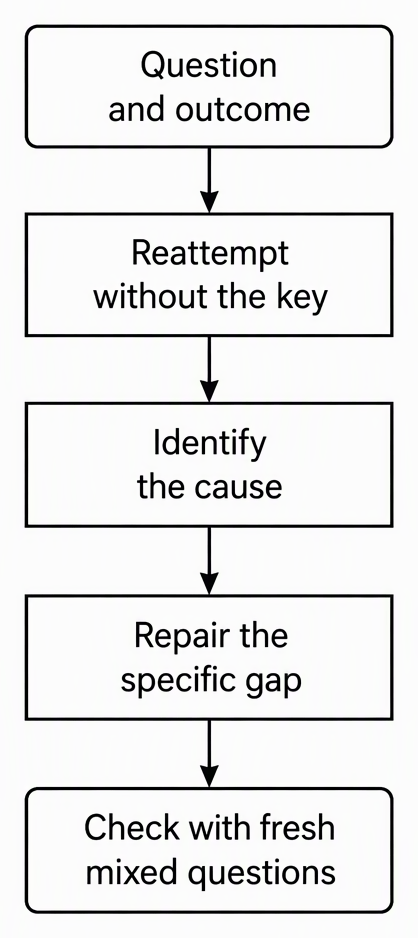
Use distinct cause labels:
- Unstudied content: Learn the topic before using that question to judge mastery.
- Failed recall: Retrieve the missing fact or relation from memory, then check it.
- Conceptual error: Rebuild the reasoning that selects the method.
- Calculation or unit error: Locate the first faulty substitution, conversion or arithmetic step.
- Misreading: Identify the condition or word you missed.
- Time-driven omission: Reattempt untimed to separate knowledge from allocation.
Match the repair to the error:
- Physical Chemistry: Choosing the wrong equation needs a different repair from substituting or calculating incorrectly. Identify which happened before assigning more questions.
- Organic Chemistry: Forgetting a reagent calls for recall practice; faulty mechanism reasoning calls for rebuilding the reaction steps. For that repair, use How to Study Haloalkanes JEE: Mechanisms and Practice.
- Inorganic Chemistry: Separate a missed factual item from misunderstanding a trend or exception. One forgotten fact should not trigger rereading an entire unit.
Reattempt missed and uncertain questions without the key, repair the gap, then try fresh mixed questions to check whether the repair transfers. Do not convert a standalone Chemistry score into a JEE percentile: official total percentile is shift-relative, based on total raw marks, and is not an average of subject percentiles.
When should you use JEEnius instead of a narrower Chemistry test?
Use JEEnius when you want a free full-length JEE Main mock: 75 questions, 300 marks and 180 minutes, with a scored per-subject breakdown. Attempt the whole paper, then inspect Chemistry alongside Physics and Mathematics to understand its contribution to the overall result.
If your immediate task is Chemical Bonding repair or a standalone Chemistry recall session, choose a narrower test instead. The verified full-paper option is not a substitute for a confirmed Chemistry-only test.
Is the JEEnius option a standalone free Chemistry test?
No. The confirmed option is a full PCM mock that includes a Chemistry score. Standalone chapter tests and Chemistry-only sessions are not established by the supplied product facts, so choose it for full-paper practice rather than expecting a separate Chemistry product.
Does a free test mean no registration and free explanations?
No. Free test access does not establish login requirements or access to explanations. Before starting, check what you can view after submission, especially the answer key and any explanation access limits.
Does Chemistry have an official separate time limit in JEE Main?
No. The official 180 minutes covers the full PCM paper, not a separately timed Chemistry section. Treat a subject-only timer as a practice setting chosen by the provider or student.
Can a Chemistry mock score predict my JEE percentile?
No. A standalone Chemistry result does not establish the shift-relative total percentile. Identify one repeated error cause, repair it, and check that repair with fresh mixed questions before taking another full test.
Next step: full-length mock tests on JEEnius and sit a full 75-question, 300-mark, 180-minute paper and get a scored per-subject breakdown (free tests included).
Frequently asked questions
Should I take a Chemistry chapter test or a full JEE mock?
Use a chapter test to check a recently studied topic and mixed Chemistry practice to test recall across completed chapters. Choose a full PCM mock when you need to measure time allocation across subjects. If your syllabus is incomplete, unstudied questions can make the full-paper total a poor measure of mastery of completed topics.
Does JEEnius offer a free Chemistry-only mock test?
The confirmed free JEEnius option is a full JEE Main PCM mock with 75 questions, 300 marks, 180 minutes and a scored per-subject breakdown. Standalone Chemistry-only and chapter-test availability is not established, so choose this option for full-paper practice.
Are explanations and registration-free access included in a free mock test?
A free test label does not establish whether registration is required or explanations are included. Before starting, check whether taking the test, viewing the score and accessing the answer key and explanations are all free.
Is there a separate time limit for Chemistry in JEE Main?
No, the official 180 minutes covers the full Physics, Chemistry and Mathematics paper. A Chemistry-only timer is a practice setting chosen by the provider or student, not an official subject time limit.
Can my Chemistry mock score predict my JEE percentile?
No, a standalone Chemistry mock score cannot establish your JEE Main total percentile. The official total percentile is shift-relative, based on total raw marks, and is not an average of subject percentiles. Use the mock to identify repeated error causes, repair them and check the repair with fresh mixed questions.