
How should I study haloalkanes for JEE in six steps?
- Repair the prerequisites. Study haloalkanes for JEE by checking the substrate, reagent and conditions together, not reagent names alone. First, identify nucleophiles and bases, compare carbocation stability, recognise resonance, read wedge–dash structures and locate beta hydrogens. If these checks fail, return to the relevant GOC and stereochemistry concepts before learning more reactions.
- Classify the carbon bonded to the halogen. Mark it as methyl, primary, secondary or tertiary by counting its carbon neighbours. Separately flag allylic and benzylic positions, where resonance can affect reactivity. Distinguish these from vinylic and aryl halides, whose halogen is attached directly to a double-bond carbon or aromatic ring.
- Annotate the whole reaction. Write five entries before predicting anything: substrate, leaving group, reagent role, solvent and temperature. Decide whether the reagent acts mainly as a nucleophile, a base or both. Neither “primary” nor “tertiary” is enough to select a mechanism.
- Choose the plausible pathway. Check access for backside attack, carbocation stability and base strength.
- SN2: Concerted backside attack needs an accessible carbon. It gives inversion and does not rearrange.
- SN1: Favourable ionisation produces a stabilised carbocation, which can rearrange.
- E2: A strong base removes a beta hydrogen as the leaving group departs. Suitable anti-periplanar geometry is required; rearrangement does not occur.
- E1: Ionisation gives a carbocation before proton loss. Rearrangement is possible, and E1 can compete with SN1.
Secondary substrates need particular attention to conditions. Polar aprotic solvents often favour anionic SN2 nucleophiles; polar protic solvents can support ionisation; heating often increases elimination competition. None gives a standalone verdict.
Quick numerical check: In an illustrative SN2 reaction, double the haloalkane concentration and triple the nucleophile concentration at unchanged temperature. The rate law predicts six times the original rate:
For ideal SN1 kinetics, its rate law predicts only a twofold increase for the same changes.
- Audit the product. Check carbon connectivity, any justified rearrangement, substitution versus elimination, alkene position and stereochemistry. SN2 inversion does not automatically change an R label to S: assign priorities again. SN1 need not produce exact 50:50 racemisation because ion-pair and solvent-cage effects can make the two faces unequally accessible.
- Build an NCERT reaction map. For each transformation, record starting material, conditions, product and the condition that changes the answer. Cover preparation from alcohols, halogen exchange, substitution, elimination and reactions with metals. Keep condition-sensitive pairs together, such as aqueous and alcoholic KOH, and explain why their outcomes differ.
What happens when (R)-2-bromobutane reacts with NaI in dry acetone?
The expected product is (S)-2-iodobutane, formed by SN2 substitution with inversion under standard Finkelstein conditions. This original illustrative problem, not a previous-year JEE question, asks for both the product and configuration of (R)-2-bromobutane reacting with NaI in dry acetone.
Apply the sheet: the substrate is secondary, bromide is the leaving group, iodide is a good nucleophile but weak base, and acetone is polar aprotic. These conditions support backside substitution, not the shortcut that every secondary halide undergoes SN1.
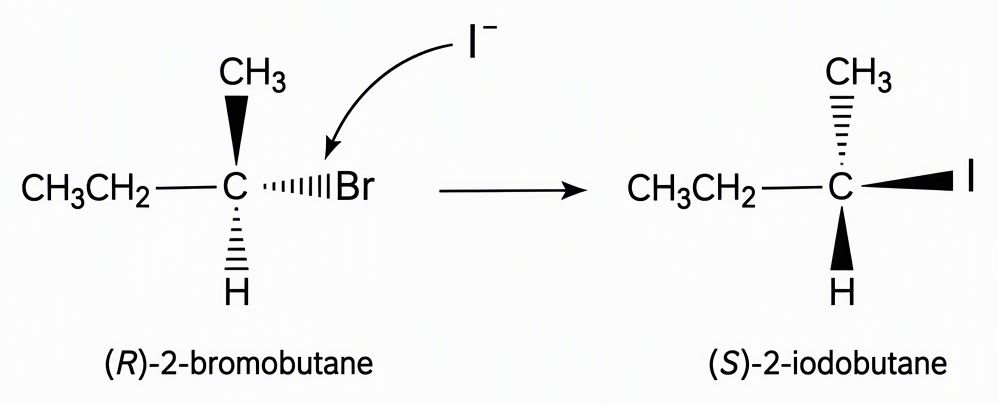
NaBr precipitates from acetone, helping drive the exchange. The carbon chain remains unchanged, and no carbocation forms to rearrange.
Recheck priorities instead of changing the configuration label automatically. In both substrate and product, the halogen ranks above ethyl, then methyl, then hydrogen. Because that priority order remains unchanged, inversion converts the R substrate into the S product here.
Error diagnosis: The correct product formula is insufficient when the question also asks for configuration.
Why can the same haloalkane give two different major alkenes?
Base size changes which beta hydrogen is removed most readily. In this original paired problem, compare 2-bromo-2-methylbutane with heated ethanolic KOH and with potassium tert-butoxide in tert-butanol under elimination conditions. The smaller base favours the more substituted alkene; the bulky base favours removal at the less hindered position.
The substrate is tertiary, so steric hindrance blocks ordinary SN2. Strong-base conditions make E2 the appropriate pathway here, with bromide as the leaving group.
Mark two distinct beta-carbon environments: the two equivalent methyl groups attached to the brominated carbon, and the methylene group of the ethyl branch. Removing hydrogens from these positions creates different double bonds.
- Heated ethanolic KOH: With the smaller base, the more substituted 2-methylbut-2-ene is the expected major alkene under these textbook conditions.
- Potassium tert-butoxide in tert-butanol: The bulky base favours abstraction at the less hindered methyl beta position, giving 2-methylbut-1-ene as the expected major alkene.
Both structures retain all five carbons. Neither requires a carbon shift.
E2 needs the departing halogen and removed hydrogen to be anti-periplanar. This acyclic substrate can reach suitable conformations through bond rotation. Major does not mean exclusive: competing alkenes may also form.
For condition-change drills, JEEnius daily practice problems provide a fresh ten-question topic set every day, with free sets daily.
When should I check for rearrangement before predicting an alcohol?
Check after identifying a carbocation pathway, before allowing water to attack. In this original textbook-style problem, find the expected major alcohol from 2-bromo-3-methylbutane under ionising aqueous silver nitrate (AgNO3) conditions. Asking specifically for the alcohol does not imply that substitution is the only reaction.
Apply the sheet: secondary substrate, bromide leaving group, water as a weak nucleophile, and an ionising aqueous medium. Silver ions assist halide departure, initially producing a secondary carbocation at the carbon that bore bromine.
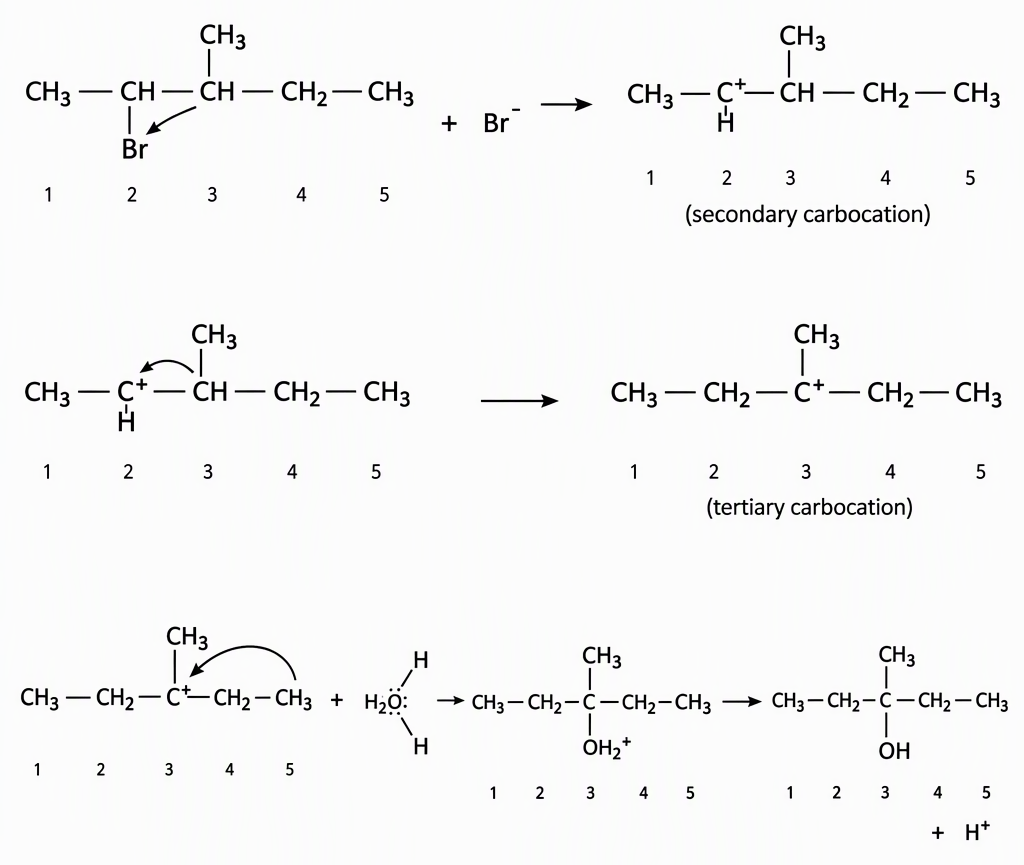
A hydride migrates from the adjacent branched carbon. The positive charge moves to that carbon, producing a more stable tertiary carbocation without changing carbon–carbon connectivity.
Water attack followed by deprotonation gives the expected major alcohol, 2-methylbutan-2-ol, through this favourable rearrangement:
Mechanically replacing bromine with hydroxyl instead gives unrearranged 3-methylbutan-2-ol. That misses the favourable hydride shift.
Carbocation formation does not guarantee rearrangement: identify both a suitable migration and a more stable resulting cation. Elimination may also compete under solvolysis conditions. The product audit must check the cation before trapping it, not merely replace the leaving group.
What should I practise after learning these mechanisms?
Practise classification and prerequisite checks first, then isolated SN2 and SN1 problems, then elimination, and finally mixed-condition questions. Keep the mechanisms separate until you can justify each pathway; then practise questions where the mechanism is not named.
Use this reaction-map checklist for chapter coverage:
- Preparation from alcohols: Record the halogenating reagent, conditions and substrate-dependent rearrangement risk.
- Finkelstein and Swarts: Distinguish iodide exchange in dry acetone from fluoride preparation.
- Aqueous versus alcoholic KOH: Contrast substitution with elimination under the stated conditions.
- KCN versus AgCN: Recall nitrile versus isocyanide formation.
- Ammonia substitution: Include amine formation and possible further alkylation.
- Wurtz reaction: Record sodium in dry ether and the mixture problem with unlike halides.
- Grignard formation: Record magnesium in dry ether and destruction by moisture.
These facts still need deliberate recall. Mechanism reasoning reduces memorisation; it does not replace reagent-specific knowledge.
For physical properties, compare like with like. Explain trends using intermolecular forces, molecular size or branching, rather than quoting a universal order across unrelated compounds.
Use NCERT examples and exercises for coverage, then verified JEE Main previous-year questions. Follow with JEE Advanced problems combining stereochemistry, rearrangement and multistep transformations.
Label each error substrate misclassified, reagent role missed, condition ignored, or product or stereochemistry unchecked. Redo the question by naming the cue that changes the answer.
Test readiness by explaining the mechanism, drawing the product and predicting how one condition change affects the outcome, with a reason. Recognising an option is not enough.
For fresh mixed practice, JEEnius practice mode offers topic sets that skip questions already seen, with free sets included. Write your substrate–reagent–conditions sheet before checking each answer.
Next step: daily practice problems on JEEnius and get a fresh ten-question set on a topic every day (free sets daily).
If that step was the hard part, work through Indefinite Integration Practice Questions JEE: 6 Worked Examples.
Frequently asked questions
What should I study before haloalkanes for JEE?
Revise nucleophiles and bases, carbocation stability, resonance, wedge–dash structures and beta-hydrogen identification. If you cannot apply these concepts, repair the relevant GOC and stereochemistry topics before learning more reactions.
How do I choose between SN1, SN2, E1 and E2?
Write down the substrate, leaving group, reagent role, solvent and temperature before choosing a mechanism. Check access for backside attack, carbocation stability, base strength and suitable beta hydrogens. Substrate classification alone is insufficient, especially for secondary haloalkanes.
Does SN2 always change R configuration to S?
SN2 gives inversion at the reacting carbon, but inversion does not automatically change an R label to S. Reassign the product's CIP priorities before naming its configuration. For (R)-2-bromobutane with NaI in dry acetone, the priority order remains unchanged, so the expected product is (S)-2-iodobutane.
What is the best order to practise haloalkanes questions for JEE?
Start with substrate classification and prerequisite checks, then practise isolated SN2 and SN1 problems, followed by elimination and mixed-condition questions. Use NCERT examples and exercises for coverage, then verified JEE Main previous-year questions and JEE Advanced problems. For each error, identify whether you misclassified the substrate, missed the reagent role, ignored a condition or failed to check the product.