
Should I start Kinetic Theory practice with drills, PYQs or mocks?
For Kinetic Theory practice questions for JEE, choose worked drills for weak concepts, authentic previous-year questions (PYQs) for exam calibration and full-length mocks for whole-paper execution. Use them in that order. No format replaces the other two: a full mock is inefficient for repairing one chapter.
This comparison covers formats, not a ranking of platforms. Six free original questions below include answers and error-specific next steps.
How do free Kinetic Theory drills, PYQs and full-length mocks compare?
Choose the format that exposes your current mistake. Drills isolate misconceptions, PYQs test your reasoning against authentic exam wording, and mocks test timing and question selection across subjects.
- Format: This article’s original diagnostic questions.
Best use: Finding specific conceptual gaps.
Feedback available: Worked reasoning and a repair task for each error.
Limitation: These questions are not evidence of actual exam difficulty or chapter weightage.
When to choose it: You recognise formulas but cannot explain which one applies.
- Format: Authentic previous-year papers with official answer keys.
Best use: Exam calibration using genuine question wording.
Feedback available: Official answer verification, preferably from the final key.
Limitation: An answer key is not necessarily a worked solution. Full papers require you to locate the relevant chapter questions.
When to choose it: You can explain the basic concepts and need unseen exam questions.
- Format: Full-length mocks.
Best use: Timing, question selection and switching between subjects.
Feedback available: JEEnius includes free full-length tests with 75 questions, 300 marks, 180 minutes and a scored per-subject breakdown.
Limitation: A subject score does not isolate one chapter’s weaknesses.
When to choose it: Isolated questions go well, but mixed-paper performance does not.
Which option should Class 11, Class 12 students and droppers choose?
Choose by the mistake you make, not your class. Before progressing, check whether you can choose an equation, state its assumptions and explain what stays fixed. Recognising the answer does not establish any of these.
- Class 11, just finished the chapter: If molecular mass and molar mass still get mixed up, start with worked concept drills. Identify whether each formula uses quantities per molecule or per mole before substituting.
- Class 12, formulas remembered but changed conditions cause trouble: Attempt the diagnostic below, especially if changes in temperature, gas species or constraints confuse you. Repair the specific misconception, then solve unseen PYQs without opening their solutions.
- Dropper, comfortable with isolated questions but losing marks in mixed papers: Prioritise full-length practice. Review reading errors, calculation slips and time spent on questions that should have been left for later.
- Advanced aspirant with basic fluency: Move to authentic Advanced PYQs, especially questions combining assumptions and concepts. Ordinary substitutions are not “Advanced-level” practice.
A Class 11 student with sound reasoning can progress to PYQs. A dropper with mass-convention errors should still use drills: repeated full papers do not target that gap efficiently.
Can you solve these six free Kinetic Theory questions?
Attempt all six before reading the solutions, recording your equation and its conditions. Every question here is original practice, not a PYQ. There are three single-correct MCQs and three numerical-answer questions; this small set is diagnostic, not a replica of the JEE Main section distribution.
MCQ 1, original practice: Temperature and rms speed
The same ideal gas is heated from 27°C to 927°C. Find the rms speed at the higher temperature divided by that at the lower temperature. Choose one answer.
MCQ 2, original practice: Gas species and rms speed
Hydrogen and helium are ideal gases at the same temperature. Their molar masses are 2 grams per mole and 4 grams per mole, respectively. Find hydrogen’s rms speed divided by helium’s rms speed.
MCQ 3, original practice: Translational kinetic energy
Two ideal gases with different molecular masses are at the same temperature. Select the statement about their average translational kinetic energies per molecule that must be true.
- A: The heavier molecules have greater average translational kinetic energy.
- B: Both gases have equal average translational kinetic energy per molecule.
- C: The lighter molecules have greater average translational kinetic energy.
- D: Their relative energies cannot be determined without the pressures.
Numerical 1, original practice: Pressure
An ideal gas remains in a fixed volume, with unchanged molecular mass. Its number of molecules is halved while its rms speed doubles. Enter the final pressure divided by the initial pressure.
Numerical 2, original practice: Mixture heat capacity
Mix two moles of a monatomic ideal gas with one mole of a rigid diatomic ideal gas. Rotational modes are active and vibrations are neglected. Define molar constant-volume heat capacity per mole of the entire mixture, and enter:
Numerical 3, original practice: Mean free path
Identical hard-sphere gas molecules remain at fixed temperature and fixed collision diameter. The pressure doubles. Enter the final mean free path divided by the initial mean free path.
What are the answers, and what does each mistake reveal?
Answer key: MCQ 1 A; MCQ 2 C; MCQ 3 B. Numerical answers: 2, 11 and 0.5. Use the reasoning below to identify your repair task. Keep guessed answers on your repair list: these results diagnose concepts, not JEE marks or rank.
MCQ 1: Convert first, then take the square root. The temperatures become 1200 kelvin and 300 kelvin.
Ratios of Celsius readings are invalid because kinetic-theory temperature is absolute. B suggests a missed square root; C or D suggests a temperature-scale error. Repair: Practise kelvin conversion and square-root scaling separately.
MCQ 2: Match the mass convention to the constant. The two valid forms are:
Repair: Pair the gas constant with molar mass and the Boltzmann constant with molecular mass. For absolute speeds in SI units, convert molar mass to kilograms per mole.
MCQ 3: Energy is not speed. Average translational kinetic energy depends only on absolute temperature:
Equal energies do not imply equal rms speeds or equal total internal energies for gases with different active degrees of freedom. Repair: Separate translational energy, speed and total internal energy in your notes.
Numerical 1: Pressure contains speed squared. With volume and molecular mass fixed, doubling rms speed multiplies the speed-squared contribution by four:
Repair: Mark every squared quantity before applying a multiplier. Halving molecule count does not cancel doubling rms speed.
Numerical 2: Add total heat capacities before dividing by total moles. The monatomic and rigid diatomic contributions are:
Repair: Use mole-weighted heat capacities, not an unweighted average of gas types. The required denominator is the total number of moles.
Numerical 3: Follow the fixed conditions. At fixed temperature, doubling pressure doubles number density. With collision diameter unchanged, mean free path halves.
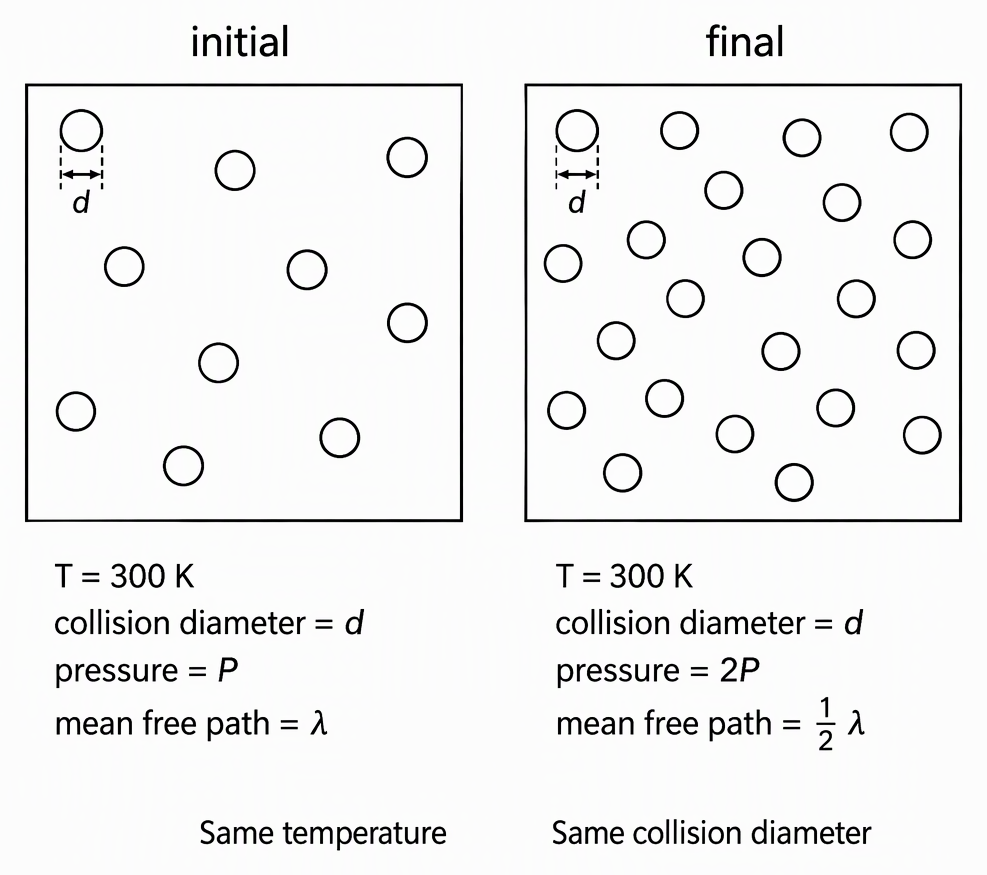
Repair: Write what stays fixed before deciding which quantities are proportional. Pressure alone is not enough without those conditions.
When should you move to JEE Main and Advanced PYQs?
Move to PYQs when you can solve the diagnostic concepts and justify the assumptions without reading the explanations. Attempt unseen questions before opening solutions. Record the assumption or constraint that determined your method, not just the formula used.
For Main, start at the official NTA site, jeemain.nta.nic.in, and look for question-paper and answer-key releases where available. For Advanced, use the official JEE Advanced past-paper archive. In third-party chapter-wise compilations, check the claimed year, paper or shift against the original paper when available.
Use the final official answer key to verify answers. Finding a sound worked explanation is a separate task: an answer letter cannot explain why a constraint changes the method.
Advanced has two compulsory three-hour papers, while question types and marking vary. Never apply Main’s marking scheme to it. Do not plan around a fixed Kinetic Theory question count, guaranteed marks or a universal Main-to-Advanced difficulty boundary.
When should you use a free full-length mock?
Use mixed-paper practice once you can solve and explain the diagnostic concepts and relevant PYQs. Test whether that reasoning holds under time pressure; do not use scattered mock errors as your first tool for relearning the chapter.
For Main, a correct answer earns 4 marks, an incorrect answer loses 1 mark, and an unattempted question earns 0. Having no optional question selection does not force you to submit an answer to every question.
A Physics score alone cannot establish Kinetic Theory mastery. A full-length mock is not guaranteed to sample every chapter.
The same drill-to-PYQ-to-mock sequence applies to another Physics chapter in Kinematics Practice Questions JEE: Drills, PYQs and Mocks.
JEEnius includes free full-length mocks with 75 questions, 300 marks, 180 minutes and scored per-subject breakdowns. After your next mock, classify every missed question as a concept, algebra, reading or execution error. Use focused questions for conceptual gaps and targeted reattempts for algebra or reading errors; choose more full-paper practice when the knowledge is sound but execution breaks.
Frequently asked questions
Should I start Kinetic Theory practice with drills, PYQs or mocks?
Start with worked drills if you cannot explain which equation applies or what stays fixed. Move to authentic PYQs once you can justify your method and assumptions without solutions. Use full-length mocks to test timing, question selection and execution across subjects.
Are these Kinetic Theory questions actual JEE PYQs?
No, all six questions are original diagnostic practice, not previous-year questions. The set contains three single-correct MCQs and three numerical-answer questions, each with worked reasoning and an error-specific repair task. It does not establish actual exam difficulty or chapter weightage.
What is the difference between molecular mass and molar mass in the rms speed formula?
Use v_rms = sqrt(3RT/M) when M is molar mass, and v_rms = sqrt(3k_B T/m) when m is the mass of one molecule. Pair the gas constant R with molar mass and the Boltzmann constant k_B with molecular mass. For absolute speeds in SI units, use kelvin and molar mass in kilograms per mole.
How does mean free path change when pressure doubles?
For identical hard-sphere molecules at fixed temperature and collision diameter, doubling pressure halves the mean free path. Number density doubles, and mean free path is inversely proportional to number density. Pressure alone is insufficient to determine the change unless the fixed conditions are specified.