
Which kinematics practice should you choose for JEE?
For free kinematics practice questions for JEE, use drills to repair concepts, PYQs to calibrate against the exam and mocks to test execution. Start with original concept drills if choosing an axis, reading a graph or identifying the motion model is unreliable.
Choose JEE Main previous-year questions, or PYQs, once your setup works. Choose Advanced PYQs when you can connect ideas rather than merely substitute into formulas.
Full-length mocks come later, for selection and execution across subjects, not chapter repair. Attempt the original diagnostic with worked solutions below; these are not authenticated PYQs.
Which free kinematics practice format fixes which problem?
Concept drills target setup errors; PYQs show actual exam demands; full mocks test whole-paper decisions. For a weak chapter, I would choose targeted drills before a mock: a whole-paper score cannot tell you why your displacement calculation failed.
- Original concept drills on this page
- Best use: Repairing setup errors.
- Prerequisite: Basic definitions of position, velocity and acceleration.
- Chapter targeting: Four kinematics skills.
- Solutions and access: Free, self-contained questions and worked explanations below.
- Exam authenticity: Original authored problems, not exam questions.
- Main limitation: A diagnostic, not complete chapter coverage.
- JEE Main kinematics PYQs
- Best use: Learning how familiar physics appears in exam wording.
- Prerequisite: Reliable axes, signs and motion equations.
- Chapter targeting: Select kinematics questions from identifiable papers.
- Solutions and access: Released papers and answer keys where available; check worked explanations separately.
- Exam authenticity: Establishes what was actually asked.
- Main limitation: One paper is not a complete chapter-coverage checklist.
- JEE Advanced kinematics PYQs
- Best use: Connecting constraints, motion models and other physics ideas.
- Prerequisite: Reliable standard setups.
- Chapter targeting: Mixed-concept questions may not be pure kinematics drills.
- Solutions and access: Released papers and keys where available; seek reasoning, not just answers.
- Exam authenticity: Authentic when traceable to the source paper.
- Main limitation: Question types and marking instructions vary.
- Full-length mocks
- Best use: Question selection and execution across subjects.
- Prerequisite: Enough preparation to attempt a mixed paper meaningfully.
- Chapter targeting: Not kinematics-only.
- Solutions and access: Check explanation access separately. For whole-paper practice, JEEnius includes free full-length tests with 75 questions, 300 marks, 180 minutes and a scored per-subject breakdown.
- Exam authenticity: Practice papers, not actual PYQs.
- Main limitation: A per-subject breakdown is not verified chapter-level error analysis.
What should Class 11, Class 12 and dropper students pick?
Choose by your setup errors, not your class or the worksheet’s difficulty label. Use these starting points, then check your choice against the diagnostic below.
- Class 11, formulas remembered but signs wrong: Start with concept drills on axes, displacement, distance and graphs. State the positive direction before writing an equation. A negative velocity is not automatically a mistake.
- Class 12, textbook exercises comfortable but unfamiliar wording difficult: Choose Main PYQs. First write what moves, from where, with which initial velocity and acceleration. Substitute only after that.
- Advanced aspirant, standard projectile and relative-velocity setups reliable: Choose Advanced PYQs. Inspect each source paper’s instructions and marking before attempting its questions.
- Dropper, old answers recognised immediately: Do not count recall as mastery. Change an assumption, explain why an alternative method fails or solve an unfamiliar original problem.
- Isolated questions correct, complete-paper choices poor: Use a full-length mock. Afterwards, manually separate kinematics mistakes from time-management and question-selection errors.
Parents should look at the student’s reasoning, not the download folder. A large PDF or an Advanced-labelled worksheet is not evidence that practice is at the right level. Ask the student to explain why an equation applies, rather than checking copied answers.
Can you solve these original kinematics questions without checking the answers?
These four questions test turning points, graph areas, horizontal projection and relative motion. Attempt all four before reading the worked solutions. They are concept diagnostics, not an exhaustive chapter test, an Advanced readiness certificate or authenticated exam questions.
The symbolic quantities are authored mathematical givens, not exam frequency or difficulty data. Write your setup as well as your answer.
Question 1: Turning point
A particle moves along a straight line with position
Find its displacement and total distance travelled over the stated interval.
Question 2: Velocity graph
A particle’s velocity varies linearly between these endpoints:
Find its displacement and total distance travelled during this interval.
Question 3: Horizontal projection
A particle leaves a point above level ground with purely horizontal speed. Its initial height, horizontal speed and constant downward acceleration are defined below:
Neglect air resistance. Find the flight time and horizontal range up to first contact with the ground.
Question 4: Relative motion
Two particles start simultaneously and maintain constant velocities in the same plane:
Do they collide? If so, find the time and position.
How do you solve the four diagnostic questions?
Locate reversal, distinguish signed from absolute area, separate motion components and check whether both particles reach the same point simultaneously. Compare your first equation with each setup below. Fix setup errors before checking the final expression.
Solution 1: Split the journey at the turning point.
Differentiate position to find velocity. Reversal occurs when velocity becomes zero:
The starting, turning and ending positions are
Subtract the endpoint positions for displacement; add both segment lengths for distance:
Likely wrong approach: Taking the absolute displacement as distance. That fails because the particle reverses direction.
Solution 2: Keep the signs for displacement, remove them for distance.
Linear variation puts the zero crossing halfway through the interval. The two triangular areas have equal magnitudes and opposite signs.
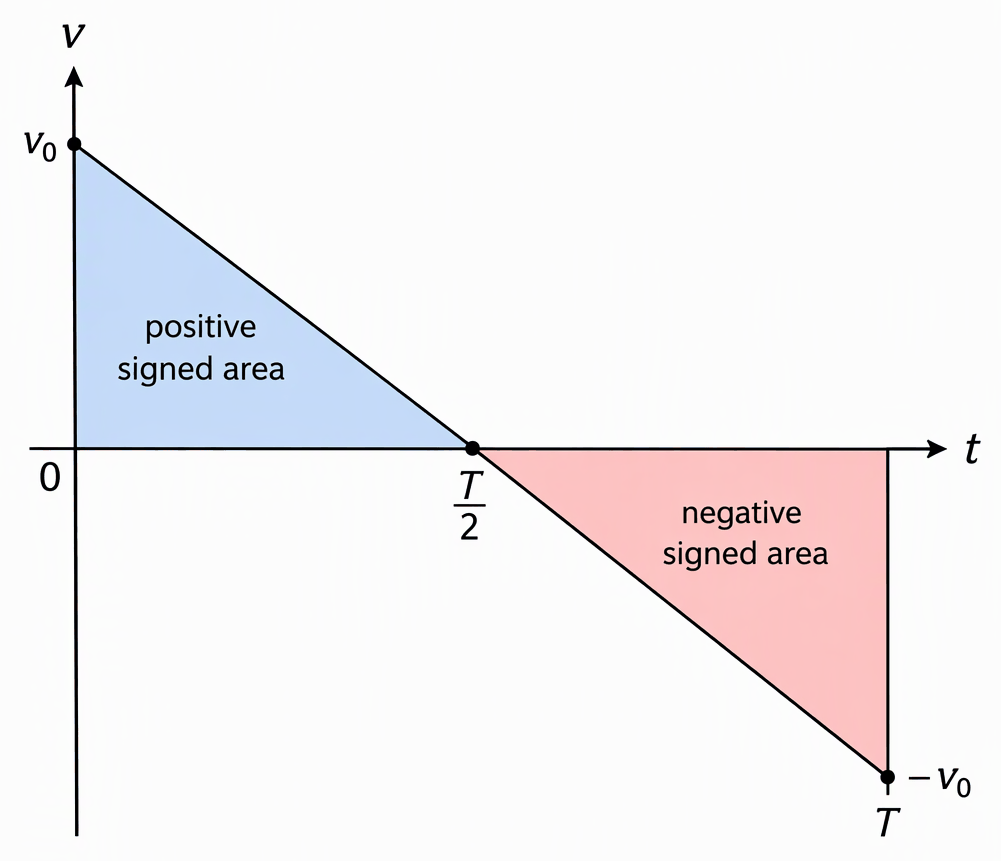
Likely wrong approach: Cancelling the areas when calculating distance. Only displacement uses signed area.
Solution 3: Use vertical motion to find the flight time.
Choose downward as positive vertically. “Purely horizontal” means the initial velocity has no vertical component:
Taking the positive time and using constant horizontal velocity gives
Likely wrong approach: Using the horizontal launch speed as the initial vertical speed. The components obey separate equations.
Solution 4: Make both relative coordinates zero together.
Subtract A’s position from B’s position. Collision requires both relative coordinates to vanish at the same time:
Both components vanish at the same positive time, so they collide:
Likely wrong approach: Assuming that crossing paths guarantees collision. Arrival times must also match.
How do you choose a free PYQ set that is actually usable?
Choose traceable questions with complete givens and worked explanations accessible without payment. Check source, solution quality and chapter coverage before question count.
- Check provenance. Look for the exam name, year, paper or session where relevant, and an answer traceable to the appropriate final key. For official Main material and notices, use jeemain.nta.nic.in.
- Separate keys from explanations. An official answer key establishes the accepted answer. It does not show why an axis choice, constraint or equation works.
- Inspect the extraction. Confirm that diagrams, units, initial conditions, question instructions and any rounding requirements survived copying into the PDF.
- Check coverage. Look for one-dimensional motion, motion graphs, projectile motion and relative motion. A long set can still repeat one skill.
- Verify free access. Check questions, worked solutions and downloads separately before committing. A free preview does not establish that the complete material is free.
- Preserve Advanced instructions. Advanced has no fixed pattern. Follow the original question type and marking instructions instead of applying Main rules.
Before saving another PDF, open a solution and check whether it explains the setup. If it only names an option, it is an answer source, not a worked explanation.
How should your mistakes decide the next practice session?
Choose practice by the first incorrect step, not by whether the final answer matches. Progress when you can explain and reproduce the setup without help. Recognising an old PYQ answer is weaker evidence than building the solution again.
- Distance/displacement error → Turning-point drills. Locate reversals and calculate each segment’s length.
- Graph-area error → Signed-area practice. Calculate displacement and distance separately from the same graph.
- Projectile setup error → Separate horizontal and vertical equations. Record each component’s initial velocity and acceleration.
- Relative-motion error → Draw both initial positions and subtract velocity vectors. Check both relative coordinates at one common time.
- Correct setup, then algebra, units or arithmetic error → Execution repair. Redo the calculation and check dimensions. Harder questions are not the remedy.
Use this review loop:
- Attempt without the solution.
- Identify the first incorrect step.
- Redo from a blank page.
- Later, solve a related problem without referring to the answer.
Once your kinematics setup is reliable, use How to Study Laws of Motion JEE: A Seven-Step Method. Kinematics describes motion; laws of motion introduces the forces responsible for acceleration.
If your difficulty is whole-paper execution rather than chapter setup, use a JEEnius free full-length mock and manually review the kinematics attempts alongside your time and selection decisions. Otherwise, redo the diagnostic question that exposed your first setup error before opening another worksheet.
Frequently asked questions
Should I start kinematics practice with concept questions or PYQs?
Start with concept drills if choosing axes, handling signs or reading motion graphs is unreliable. Move to JEE Main PYQs once you can set up standard problems correctly. Choose Advanced PYQs when you can connect motion models and constraints, not merely substitute into formulas.
Are the four kinematics questions in this article actual JEE PYQs?
No. They are original diagnostic questions with worked solutions, covering turning points, velocity graphs, horizontal projection and relative motion. They are not an exhaustive chapter test or proof of Advanced readiness.
How do I choose a reliable free kinematics PYQ PDF?
Check that each question is traceable to an exam, year and paper or session where relevant, with an answer matching the appropriate final key. Confirm that diagrams, units, givens and marking instructions are complete. Verify that worked explanations are free and that the set covers different kinematics skills rather than repeating one type.
Will full-length JEE mocks help me fix weak kinematics?
Targeted drills are better for repairing chapter setup errors. Full-length mocks are useful when your main difficulty is time management, question selection or execution across subjects. After a mock, manually separate kinematics mistakes from whole-paper execution errors.