
What seven steps should you use before choosing a Laws of Motion formula?
In Laws of Motion for JEE, knowing Newton’s laws is not the same as choosing a system and writing its equations. Start with a modelling routine, not a formula list: decide what you are analysing, which interactions exist and whether your assumed motion is possible. Use the ground frame for all three worked examples below.
- Read the conditions and choose a frame. Mark smooth or rough surfaces, any prescribed motion, and string or pulley assumptions. A smooth surface supplies no friction; a light, taut, inextensible string imposes constraints that a loose string does not.
- Choose the body or system. Combine bodies when their common acceleration is wanted, because internal forces cancel from the system equation. Isolate a body when the question asks for contact force or tension.
- Draw a separate free-body diagram for each chosen body. Include weight, normal, tension, applied force and friction only where the corresponding interaction exists. Acceleration is not another force, and action–reaction partners belong on different bodies.
- Choose axes and resolve forces. Axes parallel and perpendicular to the surface usually save algebra. Derive the normal force from the perpendicular equation rather than assuming it equals the weight.
- Decide the friction regime. First calculate the friction required to prevent relative slipping, then test its static limit. Only after establishing sliding should you use kinetic friction, directed opposite relative sliding at the contact.
- Write force equations and constraints together. Bodies in maintained contact share the relevant acceleration component. The ends of a taut, inextensible string over one fixed pulley have equal acceleration magnitudes; this is not a universal rule for pulley systems.
- Check the assumptions against the answer. Check units, signs, the static-friction limit and a non-negative normal force. A string cannot push: negative calculated tension means your assumed taut-string model has failed; zero tension needs closer checking.
Prerequisite check: you should be able to resolve a vector, interpret acceleration and solve simultaneous linear equations. Acceleration follows net force, not necessarily the current direction of motion.
For a frame accelerating translationally without rotation, include a pseudo force opposite the frame’s acceleration. Leave such examples until ground-frame setups are reliable.
How do you decide whether friction equals its limiting value?
Static friction supplies only what is needed to prevent slipping, up to its maximum. Kinetic friction applies after sliding begins. This is a constructed teaching example, not a previous-year JEE question. All three examples use:
A 2 kg block starts at rest on a horizontal surface and is pulled horizontally rightward. Its friction coefficients are:
The free-body diagram has 20 N weight downward, normal upward, applied force rightward and friction leftward for both cases. There is no vertical acceleration.
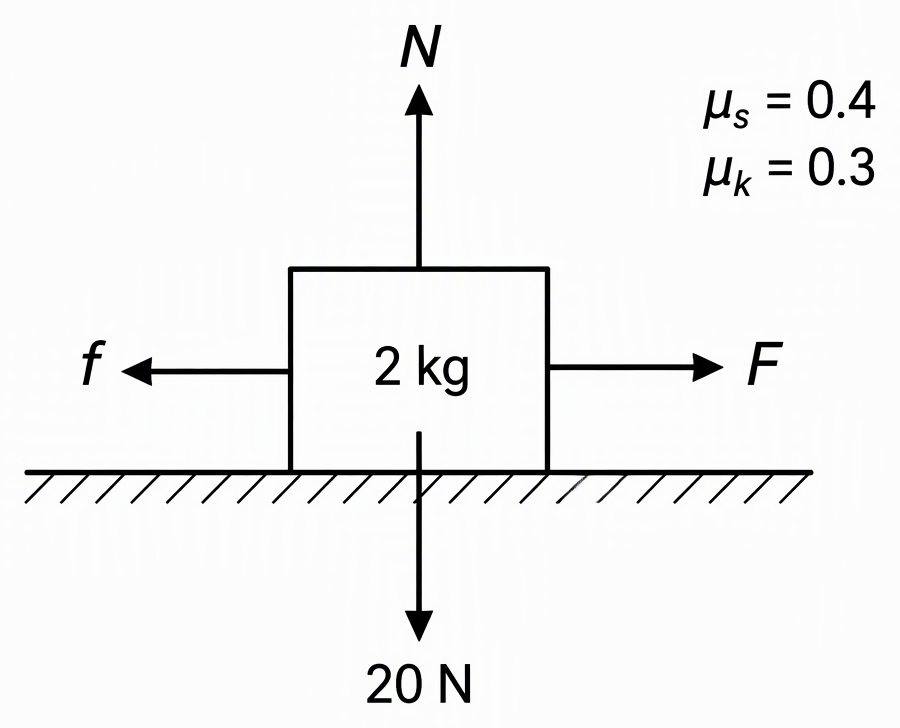
Case A: a 6 N pull. Rest requires 6 N friction, within the 8 N limit. The block stays at rest.
Case B: a 12 N pull from rest. Static friction cannot balance the pull. Once sliding begins:
Wrong turn: using 8 N as actual friction in both cases, or using kinetic friction before establishing sliding. Maximum static friction is a ceiling, not a compulsory value.
Transfer check: with an 8 N pull, the block can remain at limiting equilibrium. Equality with the static limit does not itself establish sliding.
When should you combine blocks and when should you separate them?
Combine blocks to find their common acceleration, then isolate the block with fewer unknown forces to find contact force. This is a constructed teaching example, not a previous-year JEE question.
Blocks A and B, of masses 2 kg and 3 kg, touch on a smooth horizontal surface. A is left of B, and a horizontal 10 N force pushes A rightward.
For the whole system, contact forces cancel because they are internal. The only external horizontal force is the push.
Now isolate B. Its only horizontal force is the contact force from A.
Check with A: the push acts rightward and contact force acts leftward. The two contact forces are equal and opposite, but belong on different free-body diagrams.
Now push B leftward with 10 N instead. The acceleration magnitude remains unchanged, but contact force must accelerate A:
Wrong turn: calling the applied 10 N force the contact force, or assuming unchanged system acceleration means unchanged internal force. Contact force depends on which block it must accelerate.
For fresh topic practice, JEEnius daily practice problems provide a ten-question set every day, with free sets daily.
How do you solve a rough-table pulley problem without assuming motion?
Test equilibrium before using kinetic friction or solving for acceleration. A hanging mass does not automatically make the system move: static friction may hold it. This constructed teaching example, not a previous-year JEE question, combines that test with tension and the string constraint.
A 4 kg block rests on a rough horizontal table, connected to a hanging 2 kg block. The string is light, taut and inextensible, passes over an ideal smooth fixed pulley, and is horizontal on the table side.
At rest, the hanging block would require 20 N tension. The table block would therefore need 20 N static friction, but:
Equilibrium is impossible. The hanging block moves down and the table block moves towards the pulley; kinetic friction acts away from the pulley.
The table block has weight, normal, tension and friction. The hanging block has only weight and tension; choose positive directions along each block’s acceleration.
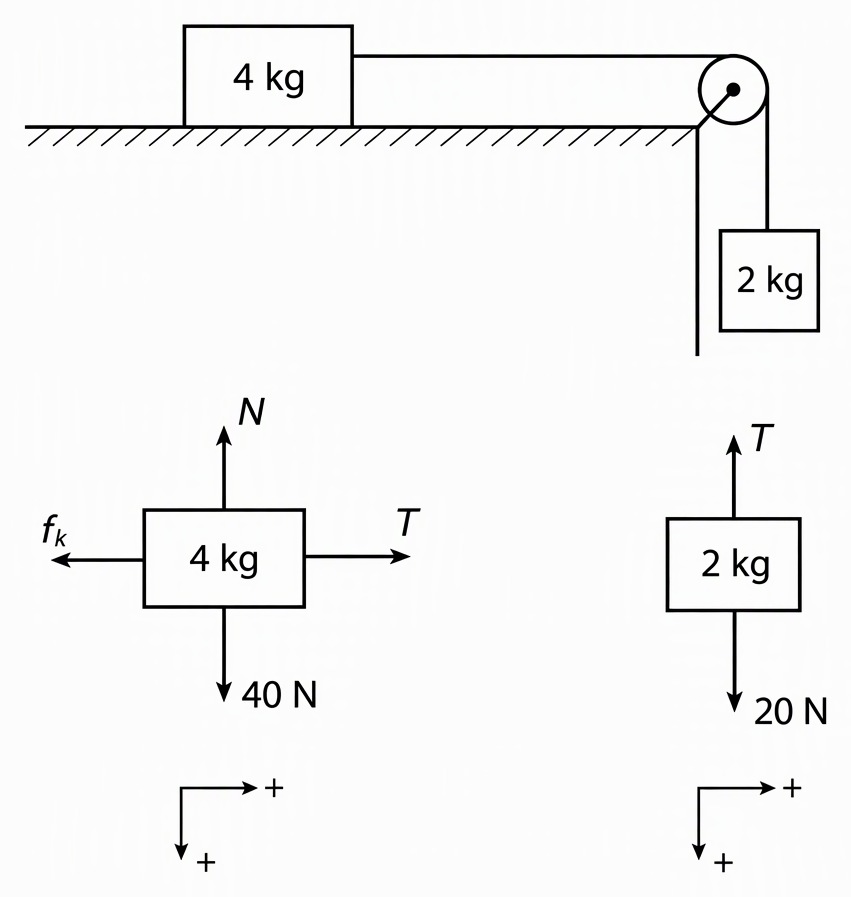
The light string and ideal pulley give common tension. The taut, inextensible string over this fixed pulley gives equal acceleration magnitudes.
Add the equations to eliminate tension. Then substitute the acceleration into the table block’s equation:
Check both equations with these values. Tension is positive and less than the hanging block’s 20 N weight, consistent with downward acceleration.
Variation: replace the hanging mass with 1 kg. Rest now requires only 10 N friction, below 16 N.
Wrong turn: assuming every hanging mass causes motion. Equating tension with weight is also wrong when the hanging block accelerates.
What should you practise next in Laws of Motion for JEE?
Choose your next set by the earliest modelling error you make, not the number of questions completed. Use this progression, returning to the first step you cannot justify:
- Single-body free-body diagrams and equilibrium.
- Smooth and rough inclines.
- Limiting friction and sliding.
- Contact-force systems.
- Fixed pulleys.
- Mixed constraints and accelerating-frame problems.
For inclines, derive the normal force before calculating friction. With contact maintained and no other perpendicular forces:
Calculate the friction required to prevent slipping, then test it against the static limit before assuming sliding. Do not use limiting friction automatically.
Redraw each worked example without looking and reconstruct its equations. Next, change the applied force, the pushed block or the hanging mass. Remembering the numerical answer is not evidence that you can build the model.
Keep an error log using five tags. Tag the first incorrect step, not just the final wrong answer:
- Missing or extra force.
- Wrong component or normal.
- Wrong friction regime.
- Wrong constraint.
- Algebra or sign error.
Before moving to mixed problems, be able to defend every force arrow, justify the motion assumption and explain the constraint. For Main practice, prioritise reliable standard setups; for Advanced preparation, add assumption changes and coupled constraints. Neither exam is restricted to only one level.
Repair a concept briefly from your existing notes or textbook, then attempt topic-wise previous-year questions. You do not need a stack of new books to fix one wrong friction assumption.
For unseen topic sets, JEEnius practice mode skips questions you have already seen, with free sets included. After each set, repair the earliest modelling error before solving more questions.
Next step: practice mode on JEEnius and practise a topic in sets that skip questions you have already seen (free sets included).
Related on JEEnius: Determinants JEE 2024: Row Operations and Chain Rule.
Frequently asked questions
How should I start studying Laws of Motion for JEE?
First check that you can resolve vectors, interpret acceleration and solve simultaneous linear equations. Use a seven-step routine: read conditions and choose a frame, choose the body or system, draw free-body diagrams, resolve forces, decide the friction regime, write equations with constraints, and check assumptions. Start with ground-frame problems before attempting accelerating frames.
When should I use limiting friction in JEE problems?
Calculate the static friction required to prevent slipping, then compare it with the maximum value, μsN. Static friction equals its limiting value only when the required friction reaches that maximum; equality alone does not establish sliding. Use kinetic friction, μkN, only after establishing that sliding occurs.
How do I find the contact force between two blocks?
For blocks moving together, combine them to find their common acceleration because their mutual contact forces cancel within the system. Then isolate the block with fewer unknown forces and apply Newton's second law to find the contact force. Changing which block is pushed can change the contact force even when the system's acceleration magnitude stays the same.
Does a hanging mass always make a pulley system move?
No: static friction on a rough table may hold the connected system at rest. Test equilibrium by finding the tension required by the hanging mass and comparing the required table friction with its static limit. If equilibrium is impossible and sliding begins, use kinetic friction and solve the force equations together with the string constraint.
What should I practise after learning Newton's laws for JEE?
Progress through single-body diagrams and equilibrium, inclines, limiting friction and sliding, contact-force systems, fixed pulleys, then mixed constraints and accelerating frames. Reconstruct worked examples without looking and change one condition to test your modelling. Log the first incorrect step, repair that concept, and then attempt topic-wise previous-year questions.