
How should I study and solve hyperbola questions for JEE?
Put the equation in standard form before choosing a formula when studying hyperbola for JEE. Use this order: repair the essentials, standardise and sketch, classify, solve, then check. The sketch exposes ellipse sign errors; checking the original equation catches algebraic answers that fail the geometry.
- Repair only the prerequisites needed here.
Revise completing the square, straight-line equations and quadratic discriminants. Keep basic differentiation ready for normals later. You do not need to finish all of coordinate geometry before starting hyperbola.
Test these skills through questions. If completing the square is the weak link, repair that operation before adding conic formulas.
- Put the equation in standard form, then sketch.
For an axis-aligned hyperbola with a horizontal transverse axis, use shifted coordinates. Complete the squares before reading off the centre or lengths:
The positive squared term identifies the transverse axis, not whichever denominator is larger. First make the right-hand side positive and equal to one.
Build one compact sketch-and-formula card. Connect the centre, vertices, foci and asymptotes rather than memorising them as unrelated facts.
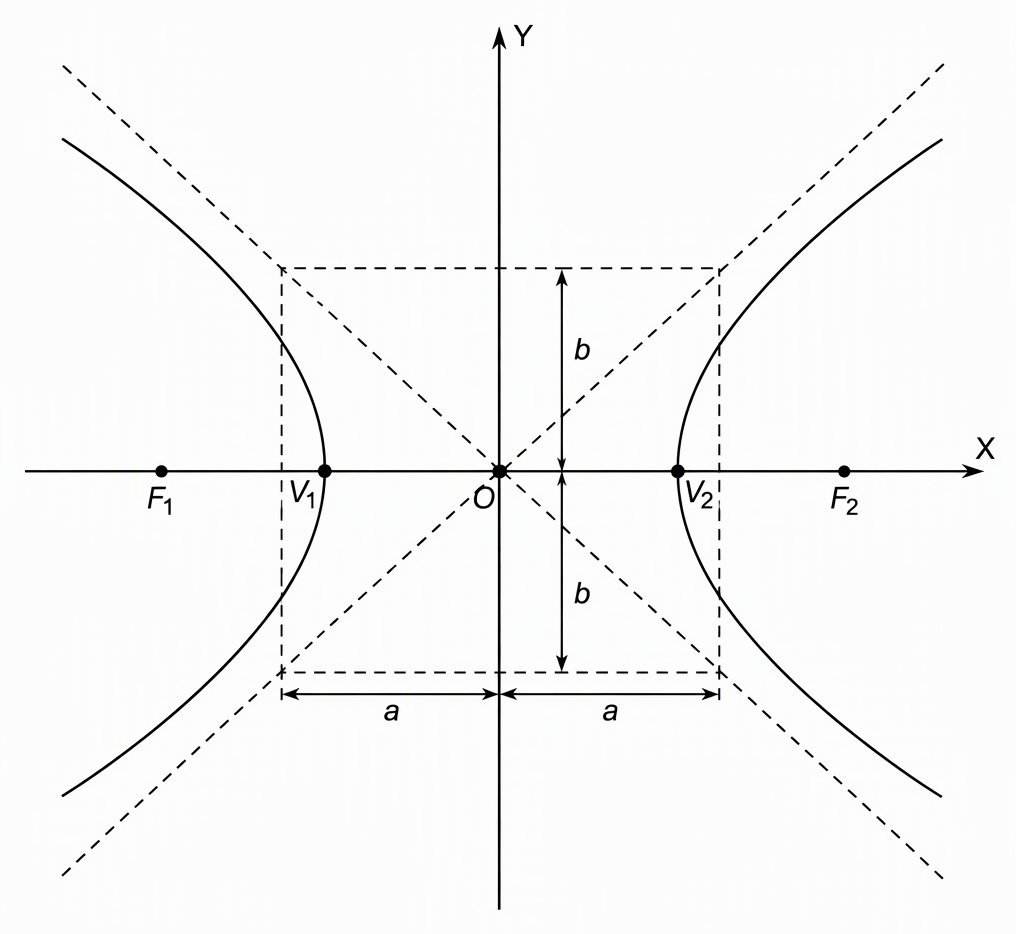
Swap coordinate roles for a vertical transverse axis. Do not transfer the ellipse identity without changing its sign:
- Classify the request before calculating.
Choose the representation from what the question supplies and asks for. Do not start with a general line when the contact point is already known.
- Geometry, such as foci or directrices: use standard form.
- Tangent at a supplied point: use the point-tangent equation below, only after verifying that the point lies on the curve.
- Line intersections: substitute the line into the hyperbola.
- A variable point: consider the sec–tan parametrisation below, excluding angles where cosine is zero.
- Stay with one representation through the calculation.
Once Cartesian substitution gives a manageable quadratic, finish there. Switching repeatedly to parameters and back adds conversions without simplifying that quadratic. Use parameters when they simplify the condition in the question.
- Check the sketch and original equation.
Check orientation, translation and whether a claimed contact point belongs to the curve. Before applying a quadratic discriminant, verify that the quadratic coefficient has not vanished. Slope-form lines also miss the vertical tangents:
How do I find the foci of a shifted hyperbola?
Complete the squares and normalise before reading any lengths. The original coefficients are not the standard-form denominators, and the linear terms move the centre. Find the centre, vertices, foci and asymptotes of:
Keep the negative coefficient attached to the entire second bracket while completing the squares. Then divide by the right-hand side:
The horizontal squared term is positive, so the branches open left and right. Read the centre from the shifts and take square roots of the denominators:
Use the hyperbola addition rule for the focal distance, not the ellipse subtraction rule. The coordinates and lines are:
For the geometric check, each focus is five units from the centre, while its corresponding vertex is four units away. Each focus is therefore farther out than its vertex, and both asymptotes pass through the centre.
Which tangent formula should I use when the contact point is given?
Use the point-tangent equation after checking the supplied point. A general line introduces an unknown intercept and an intersection quadratic that this calculation does not need. Find the tangent to:
First verify that the point lies on the hyperbola. Substitute its coordinates into the left-hand side:
The point-tangent equation now applies. Insert the supplied coordinates and clear the denominators:
Differentiation is valid here, but the supplied contact point makes it unnecessary. Use substitution as a check of repeated contact, not as the longer route to finding the line:
The repeated horizontal coordinate gives the original vertical coordinate, confirming contact at the supplied point. In the sec–tan representation, the same point corresponds to:
For another round of this topic, JEEnius daily practice problems provide a fresh ten-question topic set every day, with free sets daily.
How do I find tangents of a given slope without accepting an asymptote?
Substitute a general line and demand repeated contact, but first confirm that the resulting equation is genuinely quadratic. Find the tangents of slope one to the following hyperbola, then test the proposed line:
Start with a general slope and intercept. Substitute this line into the hyperbola and multiply by the common denominator:
Calculate the discriminant only when the leading coefficient is nonzero. Under that condition, a zero discriminant establishes a repeated root:
The requested slope satisfies the nonzero-coefficient condition. It gives two intercepts and hence two tangents:
Use the repeated-root formula to find each contact point. Substitute that horizontal coordinate into its line:
These points satisfy both their respective lines and the hyperbola. Now test the proposed line:
The shortcut appears to pass. But inspect the full substituted equation before calling the line a tangent:
There is no finite intersection. The equation was no longer quadratic, so its discriminant could not establish repeated contact. This line is an asymptote, not a tangent at a finite point.
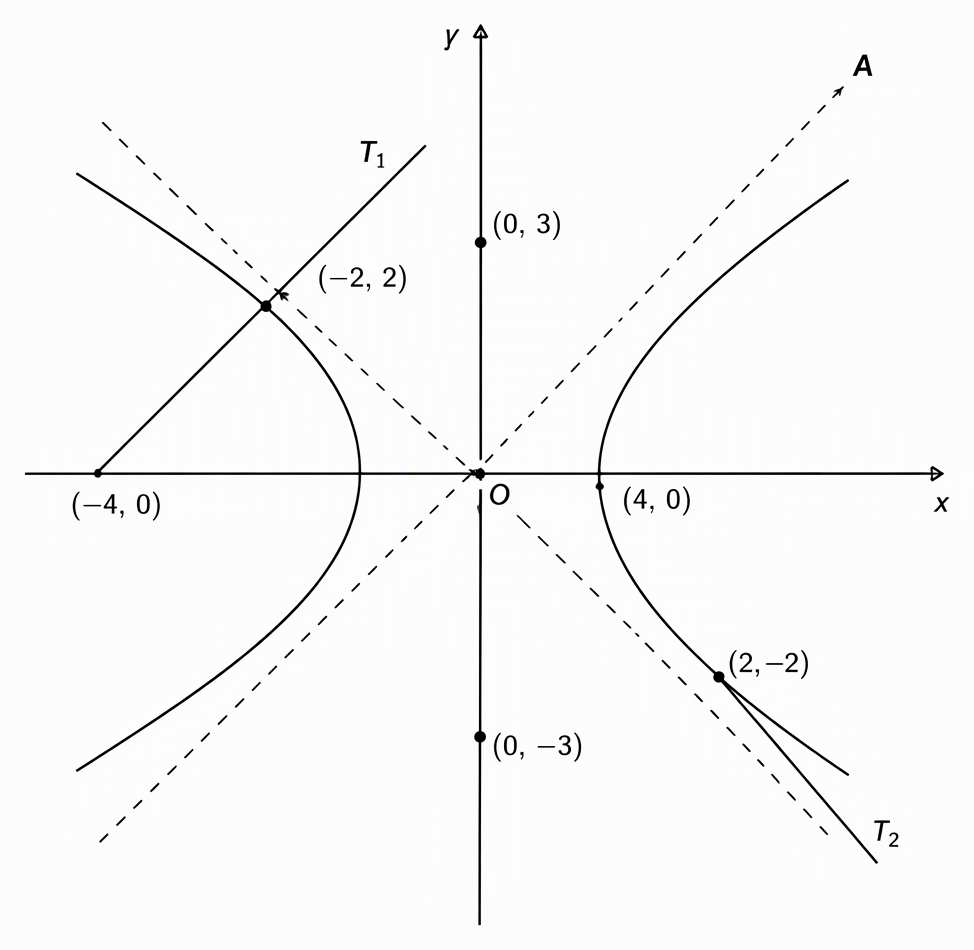
Check for degree loss before using discriminants in any conic–line intersection problem. If the leading coefficient vanishes, inspect the remaining equation directly.
What should I practise after these hyperbola examples?
Begin with standard-form recognition, then move to tangents and intersections before variable-point problems. Progress when you can reconstruct the geometry from a sketch without copying formulas. Use your errors, not a fixed timetable, to decide what needs another set.
- Reconstruct the geometry. Practise shifts of origin, horizontal versus vertical transverse axes, foci, directrices and asymptotes.
- Choose the tangent or intersection method. Mix supplied-point tangents, supplied-slope tangents and intersection counts. Deliberately include lines parallel to asymptotes and vertical tangents.
- Handle variable points. Practise sec–tan parametrisation, then extend to normals and rectangular hyperbolas once the core routine is reliable. These three examples are a foundation, not the entire chapter.
- Move to previous-year questions. Use JEE Main questions for direct applications, then JEE Advanced questions for combined conditions.
Keep an error log using these labels. Record the failed decision, not just the correct answer:
- Ellipse sign confusion.
- Missed translation.
- Incorrect method choice.
- Algebra error.
- Unchecked special case.
For a missed translation, write that you extracted the foci before completing the squares. Re-solve the failed question without notes before attempting a fresh question of that type.
For fresh topic sets after that correction, JEEnius practice mode skips questions you have already seen, with free sets included.
Next step: practice mode on JEEnius and practise a topic in sets that skip questions you have already seen (free sets included).
If that step was the hard part, work through Free JEE Chemistry Question Bank: PYQs, PDFs and Mocks.
Frequently asked questions
What should I revise before studying hyperbola for JEE?
Revise completing the square, straight-line equations and quadratic discriminants. Keep basic differentiation ready for normals later. You do not need to finish all of coordinate geometry before starting hyperbola.
How do I find the foci of a shifted hyperbola?
Complete the squares and make the right-hand side positive and equal to one before reading the centre and lengths. For (x-h)^2/a^2 - (y-k)^2/b^2 = 1, calculate c using c^2 = a^2 + b^2; the foci are (h-c, k) and (h+c, k). For a vertical transverse axis, the foci lie above and below the centre instead.
Which hyperbola tangent formula should I use when the point is given?
First verify that the supplied point lies on the hyperbola. For X^2/a^2 - Y^2/b^2 = 1 and contact point (X1, Y1), use XX1/a^2 - YY1/b^2 = 1. A general line and discriminant introduce unnecessary algebra when the contact point is already known.
Why can the discriminant method mistake an asymptote for a tangent?
The zero-discriminant test establishes repeated contact only when line substitution produces a genuine quadratic. At an asymptote's slope, the quadratic coefficient vanishes, so you must inspect the remaining equation directly. For x^2/16 - y^2/9 = 1, substituting y = 3x/4 gives -144 = 0, confirming no finite intersection.