
Should I start Limits practice with drills, PYQs or a full mock?
Start with targeted drills, then previous-year questions, not a full mock. Limits practice questions for JEE should help you repair a method before testing it under exam conditions. Six free original questions with worked solutions appear below.
Use concept drills to learn or repair methods, authenticated previous-year questions (PYQs) to check exam-level application, and mixed mocks to test selection and execution. If you already solve unfamiliar Limits questions correctly and can explain your steps, move to PYQs rather than repeat elementary drills.
How do concept drills, JEE PYQs and mixed mocks compare?
Drills isolate a method, PYQs check application against actual exam questions, and mocks test execution across a paper. Choose by the problem you need to diagnose. The six drills here are free; that does not mean every external PYQ collection or mock provider is free.
- Original topic-wise drills
- Purpose: Learn or repair one method.
- Readiness: Suitable while learning.
- Topic isolation: Focus on factorisation, standard limits or another skill.
- Authenticity: Original teaching questions, not evidence of what appeared in an exam.
- Diagnosis: Isolate the step you cannot perform.
- Limitation: Grouping can give away the intended technique.
- Authenticated JEE previous-year questions
- Purpose: Apply methods to questions actually asked.
- Readiness: Best after unfamiliar basic questions are independently solvable.
- Topic isolation: Chapter-wise collections isolate Limits but may combine methods.
- Authenticity: Check against the actual paper and answer key.
- Diagnosis: Expose gaps in recognising and combining methods.
- Limitation: Remembered solutions can exaggerate readiness.
- Mixed or full-length mocks
- Purpose: Test selection, pacing and execution.
- Readiness: Useful when methods can be used without prompts.
- Topic isolation: Require switching between topics and subjects.
- Authenticity: Simulate an exam; they are not actual past papers.
- Diagnosis: Expose selection errors and execution problems under time pressure.
- Limitation: A full paper does not guarantee useful Limits coverage.
Which practice format should Class 11, Class 12 and dropper students choose?
Choose by the first step you cannot justify, not your class or attempt number. A Class 11 student may be ready for PYQs, while a dropper may need a repair drill. Knowing a method, recognising when to use it and executing it in a mixed paper are different skills.
- Choose drills if substitution produces zero divided by zero and you cannot identify a valid next step. Also choose them if left-hand and right-hand limits remain unclear.
- Choose PYQs if you solve unfamiliar drills without hints and explain why each transformation is valid.
- Choose mixed practice if topic-wise answers are usually correct, but you struggle to recognise which Limits questions deserve time inside a broader paper.
- Class 11, first exposure to standard limits: Practise matching the function’s argument to its denominator before moving to PYQs. One memorised example is not enough evidence.
- Class 12, revision after a gap: Use the diagnostic below to locate the forgotten step. Repair it rather than automatically restarting the chapter.
- Dropper, memorised PYQ solutions: Use unfamiliar original questions to check independence. Recognising an answer is not the same as generating the method.
Advanced preparation needs reasoning about domains, cancellation and existence, not merely longer algebra. Parents can ask the student to explain the first valid transformation rather than judge progress by pages completed.
Can I attempt six free Limits practice questions for JEE now?
Attempt all six statements before reading the solutions below. These are original practice questions, not previous-year questions, and all trigonometric arguments are in radians. Write your first transformation beside each attempt to separate method errors from arithmetic slips.
This short diagnostic samples selected skills. It does not cover the complete Limits chapter.
Question 1. Evaluate:
Question 2. Evaluate:
Question 3. Evaluate:
Question 4. Evaluate:
Question 5. Determine whether the two-sided limit exists:
Question 6. Evaluate this cancellation challenge:
What are the answers and decisive steps for these six questions?
Questions 1–4 and 6 have finite limits; Question 5 has no two-sided limit. Check the reasoning, not just the final value. These solutions use algebra, standard limits and expansions rather than making L’Hôpital’s rule the default.
Question 1: Factorise before substituting again.
The difference of squares exposes the common factor. Cancel it only away from the approach point:
- Decisive step: Cancellation is valid near the approach point, though not at the point itself. A limit concerns nearby values, so being undefined at the point does not prevent a limit.
- Likely error: Treating zero divided by zero as proof that the limit does not exist. It means direct substitution has not resolved the question.
Question 2: Multiply by the conjugate.
Rationalisation removes the square-root subtraction. The square root is defined throughout a sufficiently small neighbourhood of zero.
- Decisive step: Multiply numerator and denominator by the same conjugate, then cancel the common factor.
- Likely error: Multiplying only the numerator, which changes the expression.
Question 3: Expose both scaling factors.
Rewrite tangent using sine and cosine, then match each sine argument to its denominator. Keep the different multipliers explicit:
- Decisive step: Preserve the scaling factors when applying the standard sine limit in radians. Both arguments approach zero.
- Likely error: Replacing both trigonometric expressions by the variable and losing their different multipliers.
Question 4: Build two standard-limit ratios.
The logarithm requires a positive argument. This condition holds on both sides sufficiently close to zero:
Each of the last two ratios tends to one. The outside constant therefore gives the limit:
- Decisive step: Match each standard-limit ratio to its argument while retaining the outside constant.
- Likely error: Reversing the constant ratio or ignoring the logarithm’s domain.
Question 5: Separate the two sides.
For negative inputs, the quotient is negative one; for positive inputs, it is positive one. These values do not approach a common number.
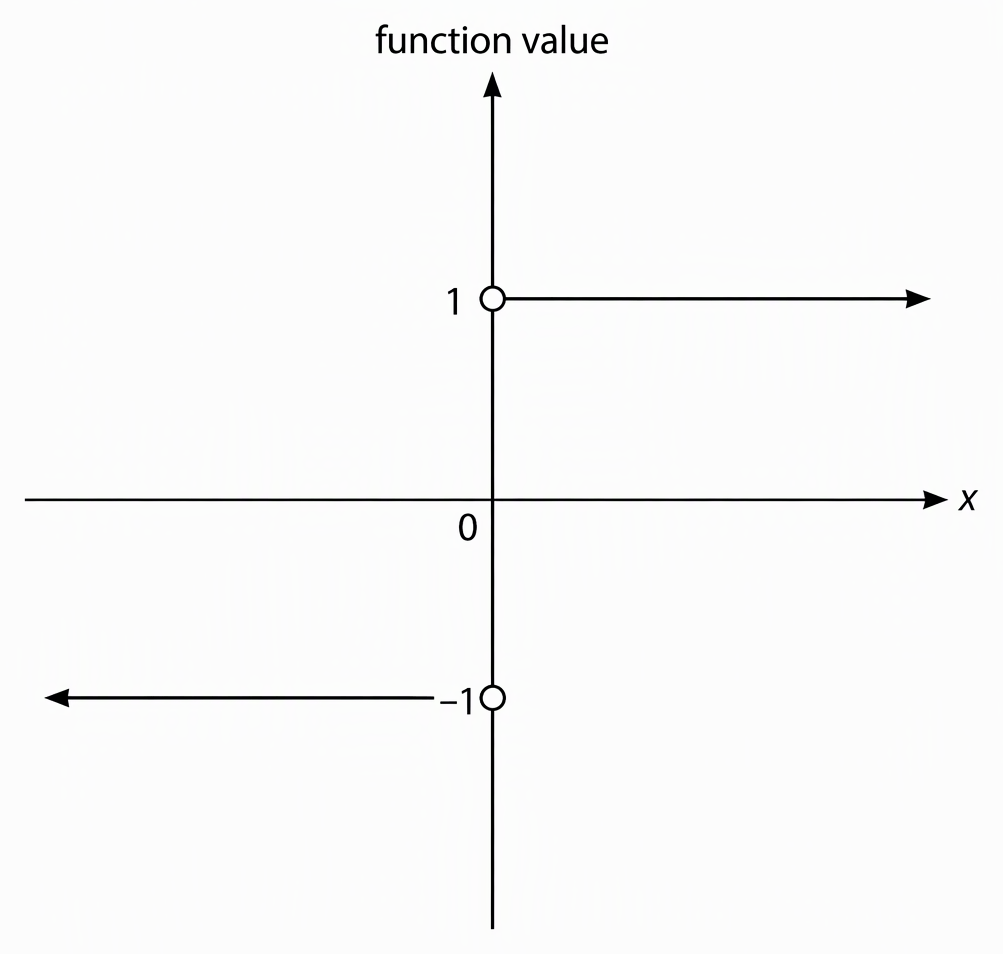
- Decisive step: Compare the one-sided limits. Since they differ, the two-sided limit does not exist.
- Likely error: Replacing the modulus by the variable on both sides, silently discarding negative inputs.
Question 6: Retain terms through cubic order.
These sine and cosine expansions hold near zero in radians. The remainder terms vanish after the numerator is divided by the cubic denominator.
Multiply the cosine expansion before subtracting. This makes the linear cancellation explicit:
- Decisive step: Keep enough terms to find the first surviving power after cancellation.
- Likely error: Keeping only the linear sine term and constant cosine term, then reporting zero. This is a cancellation challenge, not a claim about settled JEE Advanced difficulty.
What should I practise next based on my mistakes?
Repair the failed step rather than assign yourself a score band. Record where your reasoning broke down, not just whether the answer matched. Six answers cannot produce a predicted percentile or an exam-readiness score, even if every answer is correct.
- Questions 1–2 caused difficulty: Choose algebraic simplification drills involving factorisation and conjugates before harder mixed sets. Identify what prevents direct substitution.
- Questions 3–4 caused difficulty: Rewrite expressions into standard-limit forms. Track constants explicitly and check that the expression is defined near the approach point.
- Question 5 caused difficulty: Prioritise one-sided, modulus and piecewise-function limits. Routine substitution exercises do not address the missing distinction between the two sides.
- Question 6 caused difficulty: Practise cancellation and deciding how many expansion terms to retain. This error alone does not show that all your basic Limits concepts are weak.
If you reached an answer only after seeing a hint, mark the method as not yet independently usable. Later, attempt a fresh variant without the hint; repeating the just-seen solution mainly tests memory.
Keep a compact error log with five entries: expression, attempted first step, reason it failed, corrected method, fresh variant to attempt later. Record the cause, not a vague label such as “careless”.
If you solved this set independently, move to authenticated JEE Main PYQs. For an Advanced target, add reasoning questions involving domains, existence and cancellation rather than merely searching for longer calculations.
When does a full mock help with Limits, and what can it miss?
A full mock becomes useful when you need to recognise and execute a Limits method inside a complete paper. It tests question selection, switching between topics and execution under time pressure. It is not the best tool for learning rationalisation from scratch.
A full paper does not guarantee useful Limits coverage. Even a scored per-subject breakdown cannot identify a Limits misconception by itself: inspect the relevant attempts and separate failure to recognise the method from failure to execute it.
Once that is your next need, JEEnius offers full-length mock tests with 75 questions, 300 marks and 180 minutes, a scored per-subject breakdown, and free tests included. These are JEE Main-format numbers, not an Advanced pattern; JEE Advanced question types and marking schemes vary by year.
For your next session, apply one rule: repair the method with drills, test unfamiliar application with PYQs, then test execution in a mixed paper.
Next step: full-length mock tests on JEEnius and sit a full 75-question, 300-mark, 180-minute paper and get a scored per-subject breakdown (free tests included).
Keep going with Skew Lines JEE 2024: Why These Equations Give 81.
Frequently asked questions
Should I start Limits practice with drills, PYQs or mocks?
Start with targeted drills if you cannot identify and justify the next step after substitution fails. Move to authenticated JEE PYQs when you can solve unfamiliar drills without hints. Use mixed mocks to test question selection and execution once the methods are independently usable.
Are these six Limits questions actual JEE PYQs?
No, these are free original teaching questions with worked solutions, not previous-year questions. They sample selected skills and do not cover the complete Limits chapter. Use authenticated PYQs afterwards to check application against actual exam questions.
Does getting 0/0 mean a limit does not exist?
No, 0/0 means direct substitution has not resolved the limit. You may need factorisation, rationalisation, standard limits or expansions to evaluate it. For a two-sided limit, the left-hand and right-hand limits must agree.
What should I practise after making mistakes in Limits?
Repair the specific failed step: algebraic simplification, standard-limit scaling, one-sided reasoning or cancellation. Record your attempted first step, why it failed and the corrected method. Then attempt a fresh variant without hints rather than repeat a solution you have just seen.
Can six correct Limits answers show that I am JEE-ready?
No, six answers cannot establish exam readiness or predict a percentile. If you solved them independently and can justify each step, move to authenticated JEE Main PYQs. For an Advanced target, add reasoning questions involving domains, existence and cancellation.