What must be found in the skew lines JEE 2024 question?
The supplied equations give 81, but the supplied key says 0. This skew lines JEE 2024 entry needs source reconciliation, not algebra forced to match its key. The calculation below corrects the supplied cross-product arithmetic and completes the positioning step. It is not the supplied official solution.
The common perpendicular meets the first line at A and the second at B. The required point P lies on the full line through these feet, not necessarily on the shortest connecting segment.
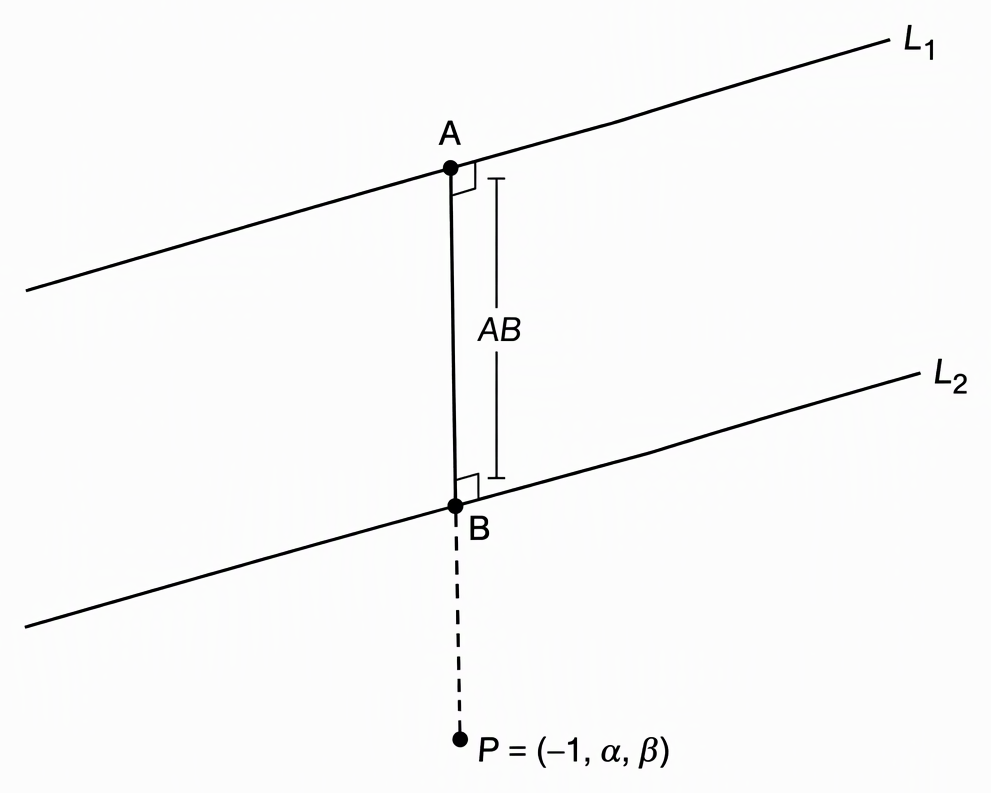
Use the two given lines to find the requested quantity:
The attribution also conflicts: the entry states 2024, but lists 2023-01-24, Morning. Hold publication as an authenticated JEE 2024 solution until the question, key and paper attribution are reconciled. Do not guess a replacement date or shift attribution.
How do you find the perpendicular direction correctly?
Take the cross product of the two direction vectors, then check it against both originals using dot products. This gives a direction perpendicular to both lines, but does not locate the perpendicular line.
Read the directions directly:
The zero direction ratio means the first line has a constant third coordinate. Parametric form requires no division by zero:
Expand the cross product component by component:
Reduce the direction ratios and verify:
The supplied determinant expansion gives incorrect first and second components. Its resulting vector fails both perpendicularity checks:
That arithmetic error invalidates the supplied working. Even a correct direction leaves infinitely many parallel lines, so we must locate the feet.
How do you locate the feet of the common perpendicular?
Choose one general point on each given line using independent parameters. Require their connecting vector to be perpendicular to both original directions. These two conditions determine the feet, rather than an arbitrary pair of points.
Write the points and subtract:
The first perpendicularity condition gives
hence
The second gives
Substitute from the first equation:
Substituting these parameters into their respective lines gives the feet:
Check their connecting vector against the cross-product result:
This confirms that the connecting segment is perpendicular to both lines. We now have both a verified direction and a known point, enough to write the common perpendicular.
How does the first coordinate give the requested answer?
Substitute the given first coordinate into the positioned perpendicular to determine its parameter. Then calculate the other two coordinates. No extra shortest-distance assumption is needed.
The common perpendicular is
Use the first coordinate of P:
Now calculate both remaining coordinates:
Therefore,
The parameter at P exceeds its value at B:
Thus P lies beyond B on the extension, consistent with “line of shortest distance”. The supplied answer 0 cannot be justified without correcting some part of the source. These equations do not reveal which original datum was intended.
Why does perpendicularity not make the last two coordinates equal?
Shortest distance imposes two dot-product conditions on the connecting vector, not equality of an arbitrary point’s second and third coordinates. The supplied solution’s leap to the following claim has no geometric basis:
That unsupported equality produces 0. It follows from neither the given lines nor their common perpendicular.
Keep these errors separate:
- A direction is not a positioned line. A cross product must be paired with a valid point.
- Skew lines have no common point. Their common perpendicular intersects them at separate feet.
- Arbitrary zero parameters do not locate the feet. They select base points whose connecting vector need not satisfy either perpendicularity condition.
This is a numerical-answer question, and no multiple-choice options were supplied. The incorrect result is 0, not an invented option.
Which two original drills test the same method?
Use these original drills, not additional verified PYQs, to distinguish finding a length from locating a line. Both use the same two given lines, so reuse the verified feet and perpendicular equation.
What is the shortest distance between these lines?
Take the magnitude of the vector between the perpendicular feet. The checked connecting vector gives
This asks for a scalar length. It does not ask for a point on the perpendicular.
Where does their common perpendicular meet the plane with zero third coordinate?
Use the fully positioned perpendicular and set its third coordinate to zero. A direction alone cannot determine this intersection.
Substitute into the other coordinates:
The intersection is
Before accepting a common-perpendicular solution, check its proposed direction against both original directions. Then verify that its claimed feet lie on their respective lines.
Next step: photograph a doubt on JEEnius and photograph any question you are stuck on and get a step-by-step solution, with a free-body diagram when the question needs one (20 free).
For a worked example of the same idea, see Properties JEE 2017: FCC Density Question Solved.
Frequently asked questions
Is the answer to the skew lines JEE 2024 question 0 or 81?
The supplied equations give (α − β)² = 81, not the supplied key's 0. The key and paper attribution remain unresolved, so this calculation should not be treated as an authenticated JEE 2024 official solution.
How do I find the common perpendicular of two skew lines?
Choose a general point on each line using independent parameters. Set the dot product of their connecting vector with each line's direction vector equal to zero, then solve for the two perpendicular feet. Use either foot and the cross product of the original directions to write the common perpendicular.
Can a point on the common perpendicular lie outside the shortest-distance segment?
Yes, the common perpendicular is a full line, while the shortest-distance segment joins its two feet. For the supplied equations, P = (−1, −23/24, 193/24) lies beyond the foot on the second line.
What is the shortest distance between the two supplied skew lines?
The shortest distance is 1/√30. The vector between the perpendicular feet is (2, 1, 5)/30, whose magnitude is √30/30.