
What is the oil-covered-surface question in Laws of Motion JEE 2018?
The Laws of Motion JEE 2018 oil-layer question gives a displacement of 6.30 m: use impulse to find the starting velocity, then integrate the decreasing velocity. This is JEE Advanced 2018, Paper 2, Physics, a numerical-answer question, not JEE Main and not an MCQ.
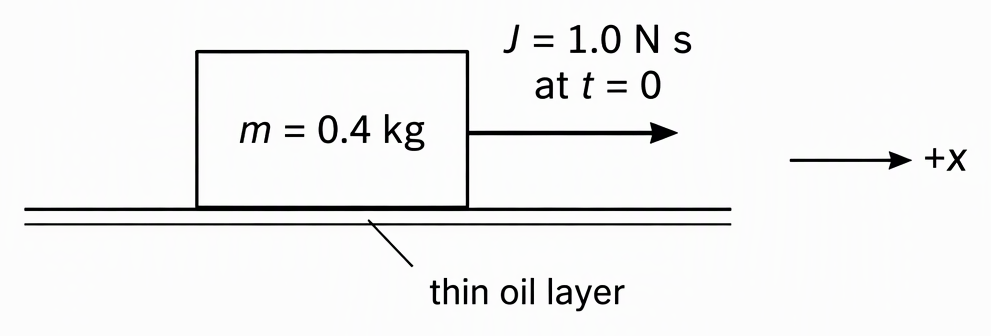
A rectangular block of mass 0.4 kg rests on a horizontal solid surface coated with a thin oil layer. At time zero, it receives an impulse of 1.0 N s towards positive x.
Its subsequent velocity follows:
Find the displacement over the first time constant, four seconds. The question bank rates this medium, with an expected solving time of 90 seconds, not an official exam time limit.
How does the impulse give the starting velocity?
The impulse produces an immediate velocity of 2.5 m/s. The block is at rest just before the push; the initial velocity in the exponential law is its velocity immediately after that push.
Apply the impulse-momentum theorem along positive x:
Dividing the impulse by the mass gives:
The units confirm that impulse divided by mass is a velocity:
The impulse sets the initial velocity; it does not keep that velocity constant during the next four seconds. The supplied exponential function determines the motion after the instantaneous push.
How do you integrate the velocity to find displacement?
Integrate the given velocity from zero to the time constant. The starting velocity is a constant multiplier, but the exponential changes with time. Keep the time-constant factor in the antiderivative and evaluate both limits.
Define displacement without assuming that the starting coordinate is zero:
Insert the velocity function:
Take the constant starting velocity outside the integral:
Differentiating the exponential produces a factor of negative one divided by the time constant:
The antiderivative therefore needs a compensating factor:
Evaluate both endpoints, including the lower limit:
The exponential at the lower limit is one:
Hence,
The supplied velocity law already specifies the post-impulse motion. You need neither an assumed coefficient of friction nor a constant-acceleration equation: either would replace the given model with an unsupported one.
Why is the displacement 6.30 m, and how can you check it?
Substituting the starting velocity, time constant and supplied exponential approximation gives 6.30 m. Use 0.37 as instructed, not a different decimal approximation.
Enter 6.30 in the numerical-answer field. For an independent physical check, calculate the final velocity:
Velocity stays positive and decreases throughout the interval. The displacement must therefore lie between travelling at the final speed throughout and travelling at the starting speed throughout:
These bounds check the result. They do not calculate the displacement exactly; that comes from the integral.
Why does using the final velocity give the wrong answer of 3.70 m?
The error is treating the final velocity as the average velocity over all four seconds. This is a numerical-answer question with no supplied options: 3.70 m is a derived wrong entry, not an official distractor.
The incorrect calculation starts with a correct endpoint speed:
It then wrongly claims:
Every earlier velocity is greater than the final velocity. This product is therefore the lower-bound rectangle under the velocity-time curve, not its full area.
Repair the method by integrating velocity. If you use average velocity, calculate it from that same integral before multiplying by time:
How can you practise the same impulse-momentum method?
Practise the velocity jump from an impulse, the force found by differentiating velocity, and the later impulse found from momentum change. These are original practice variations based on the given model, not additional verified JEE 2018 questions.
- What if the block is already moving?
The same 0.4 kg block moves at 1.0 m/s along positive x before receiving a 1.0 N s impulse in that direction. Find its immediate new velocity.
The impulse adds a velocity change; it does not erase the previous velocity.
- What is the net force after the original impulse?
Find the force for positive times and immediately after the push. Differentiate the original velocity function, then multiply by mass.
With time measured in seconds:
This excludes the instantaneous applied impulse. The negative force slows the rightward motion.
- What is the retarding impulse during the next four seconds?
Find the net impulse from immediately after the initial push to four seconds, excluding that push. Use the momentum change between these endpoints.
The negative sign means the impulse acts opposite to positive x.
Continue with Laws of Motion Practice Questions JEE: 5 Solved Drills.
Frequently asked questions
Was the JEE 2018 oil-layer question from Main or Advanced?
The oil-layer question appeared in JEE Advanced 2018, Paper 2, Physics. It was a numerical-answer question, not a JEE Main question or an MCQ.
How do you find the block's velocity immediately after the impulse?
Apply the impulse-momentum theorem: J = m(v_after - v_before). Since the 0.4 kg block starts at rest, the 1.0 N s impulse gives v_after = 1.0/0.4 = 2.5 m/s.
How do you get 6.30 m in the JEE 2018 oil-layer question?
Integrate v(t) = v0 exp(-t/tau) from zero to tau to obtain displacement = v0 tau [1 - exp(-1)]. With v0 = 2.5 m/s, tau = 4 s and the supplied exp(-1) = 0.37, the displacement is 2.5 × 4 × 0.63 = 6.30 m.
Why is 3.70 m wrong for the oil-layer question?
Multiplying the final velocity, 0.925 m/s, by four seconds incorrectly treats it as the average velocity. The block moves faster at every earlier instant, so 3.70 m is only a lower bound. Integrating the changing velocity gives the correct displacement of 6.30 m.