
What is the answer to the JEE Advanced 2017 FCC density question?
The required integer in the JEE Advanced 2017 FCC density question is 2, not the full atom count. This is JEE Advanced 2017, Paper 1, Chemistry, Q.30, filed under the chapter-bank label Properties of Solids and Liquids. It is a single-digit integer-answer question, not an MCQ; no answer options are supplied.
A pure crystalline substance has an FCC unit cell with edge length 400 pm and density 8 grams per cubic centimetre. Find the atom count in a 256 g sample and express it in the form given below. The cube has atom centres at its eight corners and six face centres.
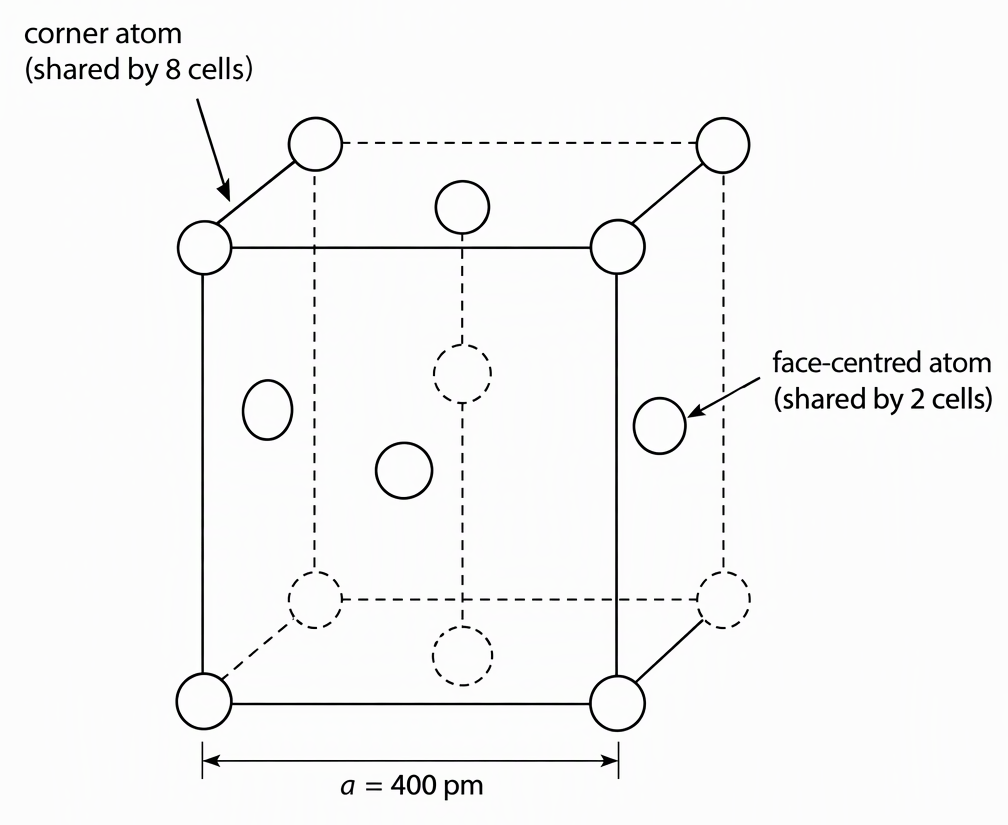
Why does an FCC unit cell contain four atoms?
An FCC cell owns four effective atoms, although fourteen atom centres lie on its boundary. Boundary atoms are shared with neighbouring cells, so counting every centre as a whole atom overcounts the cell’s contents.
Each corner atom belongs to eight cells. Each face-centred atom belongs to two cells.
The density equation uses these symbols:
One mole contains Avogadro’s number of atoms. Dividing molar mass by that number gives one atom’s mass; multiplying by the effective atom count gives the cell’s mass. The volume of a cubic cell is the cube of its edge length.
Divide cell mass by cell volume to obtain the formula used in the official solution. Keep molar mass in grams per mole and edge length in centimetres to match the supplied density.
How do you convert 400 pm and calculate the molar mass?
The official calculation gives a molar mass of 76.8 grams per mole, using the Avogadro constant approximation shown below. Convert the edge to centimetres before substitution because the supplied density uses cubic centimetres. When calculating volume, cube both the coefficient and the power of ten.
The coefficient becomes 64, while the exponent becomes minus 24. Changing only one gives the wrong volume.
The official solution begins with this numerical substitution in matching units:
It then explicitly adopts the approximation:
Use that approximation consistently for the remaining calculations. The denominator simplifies because the powers of ten cancel:
How does the atom count give the integer 2?
The answer-field entry is 2, the coefficient of the power of ten supplied in the question. Follow the official sequence: density to molar mass, then moles, then atoms. First divide sample mass by molar mass.
Multiply by the same Avogadro constant used above, then compare the result directly with the required form:
Enter 2, not 20, and not the full atom count shown above. Consistently using a different Avogadro constant changes the calculated molar mass proportionally, but leaves the final atom count unchanged: that constant was itself used to calculate the molar mass.
Why does using the BCC atom count give the wrong entry 1?
Using two effective atoms gives the wrong entry 1, even if every later arithmetic step is correct. Two belongs to BCC, whereas the stated FCC structure requires four. This is a structural-model error, not a rounding error.
The following molar-mass and atom-count calculations are deliberately incorrect for this question:
Here, 1 is an illustrative wrong entry, not an official wrong option. Choosing the wrong cell model doubles the calculated molar mass and therefore halves the atom count. Count corner and face contributions before substituting into the density formula.
How do the answers change if the sample mass or cell edge changes?
Halving the sample mass halves its atom count. Halving the cell edge at fixed density and FCC structure makes the calculated molar mass one-eighth as large. These are original practice variations, not additional verified JEE PYQs.
How many atoms are in a 128 g sample of the original substance?
Variation 1: Keep the original FCC structure, density and edge length, but use a 128 g sample. Molar mass stays unchanged because only the sample size changes.
How many atoms are in 256 g of a different FCC substance with a 200 pm edge?
Variation 2: For a different hypothetical substance with density 8 grams per cubic centimetre, the atom count is:
There is no single-digit answer restriction. Convert the new edge, then calculate molar mass and atom count:
At fixed density and effective atoms per cell, halving the edge divides cell volume and molar mass by eight. The same sample mass therefore contains eight times as many atoms; this does not describe shrinking the original substance while preserving its density.
Redo both variations without looking. Write the cubed edge conversion before substituting any numbers.
Next step: the past-paper archive on JEEnius and search every JEE Main paper from 2002 and every Advanced paper from 2007, by year, subject or chapter, each with a worked solution (free).
If that step was the hard part, work through Laws of Motion JEE 2018: Oil-Layer Displacement Solved.
Frequently asked questions
What is the answer to the JEE Advanced 2017 FCC density question?
The required integer is 2 in JEE Advanced 2017, Paper 1, Chemistry, Q.30. The 256 g sample contains 2 × 10^24 atoms, and the question asks for N in N × 10^24. Enter 2, not 20 or the full atom count.
Why does an FCC unit cell contain 4 atoms?
Each of the eight corner atoms contributes one-eighth to the cell, giving one effective atom. Each of the six face-centred atoms contributes one-half, giving three more. The total is therefore four effective atoms, not fourteen.
How do I convert 400 pm to cm for the density formula?
Since 1 pm = 10^-10 cm, 400 pm = 4 × 10^-8 cm. Cubing the edge gives a³ = 6.4 × 10^-23 cm³. Cube both the coefficient and the power of ten before substituting into the density formula.
Why do I get 1 instead of 2 in the 2017 FCC question?
Using the BCC effective atom count of 2 instead of the FCC count of 4 produces the wrong entry 1. This doubles the calculated molar mass and halves the final atom count. Count the corner and face contributions before substituting into the density formula.