What does the hyperbola JEE 2024 latus-rectum question actually determine?
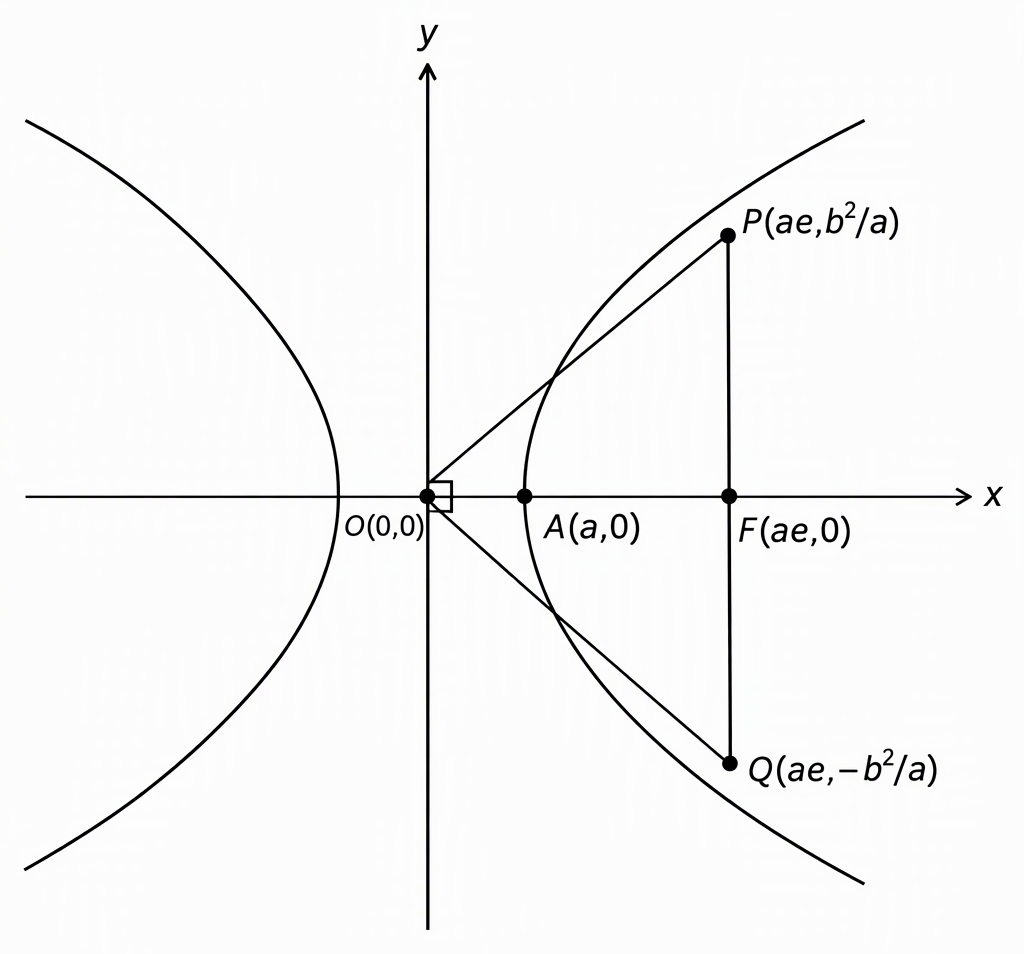
A horizontal hyperbola has a latus rectum through its right focus, and the segments joining its endpoints to the centre meet at a right angle. The hyperbola JEE 2024 question has official answer 30 under an implicit normalisation: the angle fixes the ratio of the squared semi-axes, not their absolute size.
The given hyperbola is
Identify the coprime positive integers and the radicand in the supplied form, then calculate their squared sum:
This is a numerical-answer question, with no answer options supplied. Its Hard question-bank tag does not measure observed student performance.
Source note: 2024 is the supplied question-bank label; its date field reads 2023-01-24, or 24 January 2023. These fields do not establish confirmed 2024 shift provenance.
How does the right angle become a dot-product equation?
The position vectors of the endpoints are perpendicular, so their dot product is zero. First derive the endpoints: the focus is the midpoint of the latus rectum, not one of its ends.
For this horizontal hyperbola,
The right focus and the line containing its latus rectum are
Substitute this horizontal coordinate into the hyperbola:
Hence the endpoints are
Each vertical coordinate has magnitude equal to half the full latus-rectum length. The full length is
Apply the right-angle condition to the endpoint vectors, not to vectors drawn from the focus:
The opposite signs of the vertical coordinates give
How do you solve for eccentricity and reject the invalid root?
Only the larger quadratic root is valid because a hyperbola’s eccentricity exceeds one. A real root alone is not enough.
Square the earlier relation between the semi-axes and eccentricity:
Substitute into the dot-product result and divide by the strictly positive fourth power:
Set
Expanding and collecting terms gives
Apply the quadratic formula:
Reject the smaller root because it cannot represent the squared eccentricity of a hyperbola:
Retaining the larger root gives
This ratio is the result determined by the geometry. No absolute semi-axis length has entered the calculation.
Why is the official answer 30, and where did the squared semi-axis go?
The official coefficient matching treats the radical expression as the squared-axis ratio, equivalently normalising the squared transverse semi-axis to one. Neither condition is explicit in the supplied question text.
The actual consequence of the geometry is
Enlarging both semi-axes by the same positive factor preserves the angle and their squared ratio. It changes the absolute squared conjugate semi-axis:
Thus the literal statement leaves the scale unspecified. The official matching effectively uses
or, equivalently for its displayed expression, the normalisation
Under that stated interpretation,
Therefore,
30 is the official answer under this interpretation. The right angle does not prove the scale assumption.
How can a sign error in the square produce a wrong numerical answer?
Changing the squared constant from positive to negative produces a different quadratic that still has an admissible-looking root. This is a constructed wrong numerical-answer route, not an actual option or a documented student response.
Compare the correct expansion with the incorrect one:
The incorrect route proceeds as follows:
The same coefficient matching would then wrongly give
The squared constant must be positive. Checking only that eccentricity exceeds one cannot detect a wrongly derived quadratic.
Check the expansion at one: the correct square gives zero, but the incorrect expression does not.
How do you apply these checks to two related coordinate-geometry questions?
A specified semi-axis fixes the scale; the sign of the endpoint dot product determines the angle type. Both questions below are original practice from the same chapter, not additional verified PYQs.
Question 1: For the following hyperbola, a latus rectum subtends a right angle at the centre. Find the squared conjugate semi-axis.
Worked answer: Use the derived ratio with the specified scale:
Unlike the supplied question, this equation fixes the squared transverse semi-axis. The absolute value is therefore determined.
Question 2: Find the endpoints of the right latus rectum and decide whether their angle at the centre is acute, right or obtuse:
Worked answer: Calculate the focus coordinate before writing the endpoints:
Their endpoint-vector dot product is
The angle is obtuse. Before submitting a related answer, make two separate checks: confirm that the scale is specified for an absolute squared semi-axis, then check the endpoint dot-product sign for the angle type.
Next step: the past-paper archive on JEEnius and search every JEE Main paper from 2002 and every Advanced paper from 2007, by year, subject or chapter, each with a worked solution (free).
For a worked example of the same idea, see Thermodynamics JEE 2017: Graphite–Diamond Equilibrium.
Frequently asked questions
How do I find the latus rectum endpoints of a hyperbola?
For x²/a² − y²/b² = 1, the right focus is (ae, 0), so its latus rectum lies on x = ae. Substituting this into the hyperbola gives the endpoints (ae, b²/a) and (ae, −b²/a). The full latus-rectum length is 2b²/a.
What happens when a hyperbola's latus rectum subtends a right angle at the centre?
The position vectors of its endpoints have zero dot product, giving a⁴e² = b⁴. Combining this with b² = a²(e² − 1) gives e² = (3 + √5)/2 and b²/a² = (1 + √5)/2. The angle fixes this ratio, not the absolute semi-axis lengths.
Why is the official answer to the hyperbola JEE 2024 question 30?
The official coefficient matching implicitly uses b²/a² = (l/m)(1 + √n), or equivalently normalises a² to 1 in the displayed expression for b². This gives l = 1, m = 2 and n = 5, so l² + m² + n² = 30. The supplied wording does not explicitly fix that scale.
Why do we reject the smaller root when finding eccentricity?
A hyperbola requires e > 1, so u = e² must also exceed 1. The root (3 − √5)/2 is less than 1 and must be rejected. The admissible root is (3 + √5)/2.