
What does the JEE Advanced 2018 wire-and-vernier question ask?
In the JEE Advanced 2018 Units and Measurements question, the third vernier division coincides with a main-scale mark, so the numerical entry is 3.00. This Paper 2, Physics numerical-answer question is classified as medium difficulty by the question bank, not by an official exam rating.
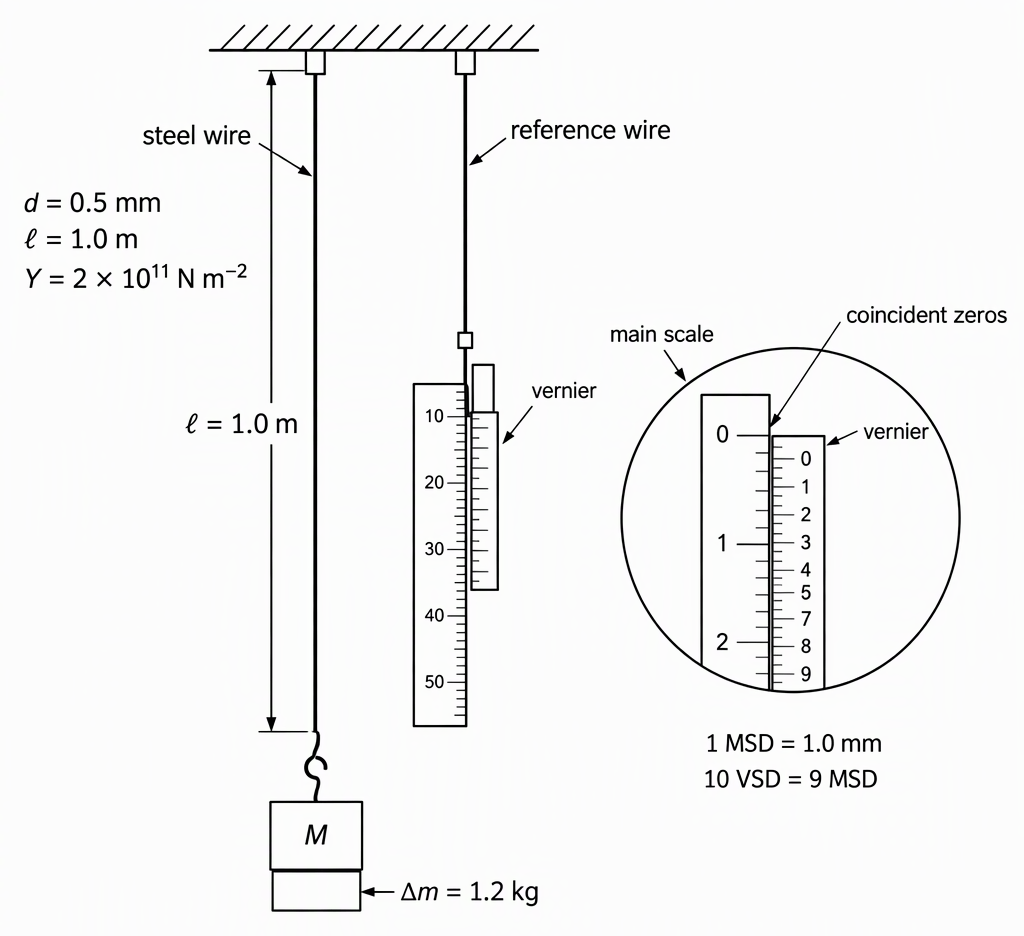
A steel wire supports an initial mass M. Its loaded length is 1.0 m and its diameter is 0.5 mm. The wire’s lower end carries the vernier scale; a neighbouring reference wire carries the main scale. Adding mass stretches the steel wire further and moves the attached vernier relative to that reference.
The supplied Young’s modulus, gravitational acceleration and value of pi are:
Initially, both scale zeros align. Ten vernier divisions span nine main-scale divisions, each main-scale division being 1.0 mm. The load then increases by 1.2 kg.
Find which vernier division aligns with a main-scale mark, not merely how many millimetres the wire extends. No multiple-choice options are provided.
How do you calculate the additional extension, and why does the initial mass drop out?
Only the added force matters because the initially loaded position is already the zero reference. The initial mass M has already stretched the wire before the zeros are aligned. Following the official solution, use the supplied loaded length of 1.0 m to calculate the extra extension caused by the added mass.
The increase in force is:
Start with Young’s modulus and rearrange for extension:
The wire has a circular cross-section. Substituting its area gives:
Convert the diameter to metres before squaring it. This keeps the calculation consistent with the SI unit of Young’s modulus.
Substitute the added force, supplied length, squared diameter and Young’s modulus:
Using the total load would calculate extension from the unloaded state, not the change from the aligned-zero position. That is why the unknown initial mass is not needed.
Keep metres throughout the elasticity calculation. Convert to millimetres only at the end, to compare the extension with the scale divisions.
How do you derive the vernier’s least count?
The least count is 0.1 mm, not 0.9 mm. MSD means one main-scale division, and VSD means one vernier-scale division. Their difference follows from the given scale relation:
The least count is the difference between these division widths:
The 0.9 mm value is the physical spacing between neighbouring vernier marks. The 0.1 mm value is the difference in spacing between the two scales.
Each successive pair of corresponding marks changes the mismatch by that difference. The least count, not the width of a vernier division, therefore links the zero displacement to the coincidence number.
Why does the third vernier division coincide, giving 3.00?
The vernier zero moves by the additional extension, 0.3 mm. Since this shift is smaller than one main-scale division, the main-scale reading remains 0 mm. The entire reading therefore comes from the vernier contribution.
The final numerical entry is 3.00. Check the actual positions: measured from the original main-scale zero, the third vernier mark lies at
That is exactly the position of the third main-scale mark. Keep the three results separate:
- Additional extension: 0.3 mm.
- Least count: 0.1 mm.
- Requested division number: 3.
Dividing the full displacement by the least count works here because the zero shift is below one MSD. For a larger reading, first separate the main-scale contribution; do not use this shortcut on an arbitrary total displacement.
Why is dividing by 0.9 mm the wrong method?
Dividing by the vernier spacing gives a wrong numerical response, about 0.33. It measures the displacement in units of vernier spacing, whereas the question asks which vernier mark catches up with a main-scale mark.
The incorrect calculation is:
Each successive pair of corresponding marks reduces the initial mismatch by:
Three such differences account for the 0.3 mm zero shift. That is why the third pair aligns.
The position check rejects the wrong calculation: the third vernier mark is exactly 3.0 mm from the main-scale zero. Use actual mark positions to check a coincidence number, rather than accepting a ratio merely because its units cancel.
Which three practice checks help you reproduce this solution?
These original practice questions, not additional verified PYQs, test unit conversion, vernier reading and dimensional analysis. Solve each before reading its working.
Practice 1: Express the least count in metres. Use the same scale: ten vernier divisions span nine main-scale divisions, and one main-scale division is 1.0 mm.
Practice 2: Find the reading when the main-scale reading is zero and the third vernier division coincides. Add the main-scale reading to the vernier contribution.
Here, three is the division number; 0.3 mm is the measured reading. They are not interchangeable answers.
Practice 3: Find the dimensions and SI unit of Young’s modulus. Start from the same elasticity equation.
Length and extension cancel dimensionally, leaving force per area. Now cover the worked solution and reproduce the chain: added force, extension, least count, coincidence number, then the mark-position check.
Next step: photograph a doubt on JEEnius and photograph any question you are stuck on and get a step-by-step solution, with a free-body diagram when the question needs one (20 free).
Read next: How to Study Laws of Motion JEE: A Seven-Step Method.
Frequently asked questions
What is the answer to the JEE Advanced 2018 wire-and-vernier question?
The third vernier division coincides with a main-scale mark, so the numerical entry is 3.00. The additional wire extension is 0.3 mm and the least count is 0.1 mm, giving a coincidence number of 0.3/0.1 = 3.
Why is the initial mass M not needed to calculate the wire’s extension?
The scale zeros are aligned while the wire already supports the initial mass M. Only the added load changes the reading from this reference position. Use the added force, 1.2 × 10 = 12 N, and the supplied loaded length of 1.0 m to calculate the additional extension.
How do you find the least count when 10 vernier divisions equal 9 main-scale divisions?
With one main-scale division equal to 1.0 mm, one vernier division is 0.9 mm. The least count is their difference: 1.0 − 0.9 = 0.1 mm, or 1 × 10⁻⁴ m.
Why do we divide the extension by 0.1 mm instead of 0.9 mm?
The 0.9 mm value is the spacing between vernier marks, while 0.1 mm is the difference between main-scale and vernier spacing. That difference determines which pair of marks aligns. Here the 0.3 mm shift is below one main-scale division, so the main-scale reading is zero and the coincidence number is 0.3/0.1 = 3.