
What does the magnetism JEE 2018 galvanometer question ask?
Only one-tenth of the full-scale ammeter current passes through the coil in this magnetism JEE 2018 question; the remaining nine-tenths passes through the shunt. The source is JEE Advanced 2018, Paper 2, Physics, and the format is numerical answer, not multiple choice.
The task is to find the shunt resistance needed to convert a moving-coil galvanometer into an ammeter with the specified range. The shunt connects across the galvanometer, so the incoming current divides between two parallel branches and recombines at the other junction.
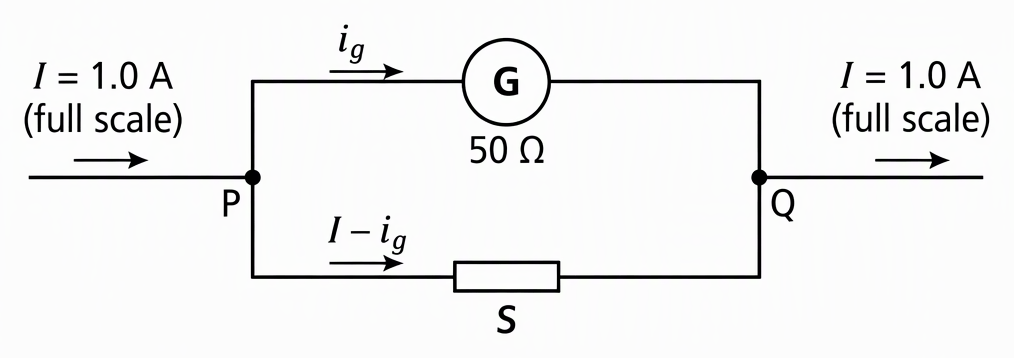
The given values are:
Give the required shunt resistance in ohms. The question bank assigns medium difficulty and a 180-second practice target; neither is an official exam classification.
How do you find the current that produces full-scale deflection?
The coil reaches full scale at one-tenth of an ampere. Find this from torque balance: the suspension’s restoring torque balances the magnetic torque on the coil. The desired ammeter range does not enter this calculation.
Define the symbols:
At equilibrium, magnetic torque equals restoring torque:
Rearrange and substitute:
Keep the powers of ten visible. The numerator is torque; the denominator is torque per ampere.
Dividing gives:
The supplied rotation belongs in the restoring torque. It is not an extra sine factor in the moving-coil galvanometer torque relation.
In the standard radial-field arrangement, the magnetic torque is already given by the expression above. Do not multiply it by the sine of the deflection.
How do equal branch voltages give the shunt resistance?
Divide the coil’s full-scale voltage by the shunt current, not the total current. The shunt carries only what remains after the coil takes its full-scale current. Because the branches are parallel, this resistance must produce the same voltage as the coil branch.
Define the total ammeter current, coil resistance and shunt resistance:
At the required full-scale reading, the coil current remains:
Current conservation at the junction gives:
The two branches connect the same junctions, so their potential differences are equal:
Rearrange to isolate the shunt resistance:
Substitute:
The numerator is the voltage across either branch. The denominator is the current through the shunt alone. Retain the unrounded value until the final step:
How can you check the answer against both branches?
Both branches have the same voltage, and their currents add to the required full-scale current. Use the unrounded shunt resistance for this check.
The coil voltage is:
The shunt voltage is:
The branch currents add correctly:
The shunt carries nine times the coil current, so its resistance must be one-ninth of the coil resistance. This gives another check:
The requested shunt resistance is not the complete ammeter’s equivalent resistance. The latter uses total current:
Why does dividing by the total current give the wrong result?
Dividing the coil voltage by total current calculates the complete ammeter’s resistance, not the shunt resistance. This numerical-answer question has no supplied options. The following is an incorrect calculation, not an official distractor:
The denominator wrongly uses all the incoming current. At the junction, the coil takes its share, leaving only the difference for the shunt:
Check the contradiction at the coil’s full-scale voltage. The incorrect shunt itself carries:
Adding the coil current gives:
That is a different full-scale range from the one requested. The error is using total current where branch current is required.
What three related galvanometer questions should you practise?
Change the range, the suspension stiffness and the shunt separately. These are original practice variations based on the supplied question, not additional verified PYQs. Use torque balance first, then equal branch voltages.
- Keep the original galvanometer but extend the range to two amperes. Find the shunt.
The coil and suspension are unchanged, so the full-scale coil current and branch voltage stay fixed. Only the required shunt current increases.
- Double the torsional constant, keeping all other original values and the one-ampere range unchanged. Find the shunt.
Twice the restoring torque requires twice the coil current for the same full-scale rotation. Recalculate the branch voltage too; it no longer stays at its original value.
- Connect a ten-ohm shunt to the original galvanometer. Find the new full-scale ammeter current.
Start at the coil’s full-scale voltage, find the shunt current, then add the branches. The shunt current alone is not the instrument’s reading.
Before calculating any variation, identify what changed. Changing the desired range changes the shunt current; changing the torsional constant changes the coil’s full-scale current.
Next step: the past-paper archive on JEEnius and search every JEE Main paper from 2002 and every Advanced paper from 2007, by year, subject or chapter, each with a worked solution (free).
Read next: How to Study Limits JEE: Seven Steps and Worked Examples.
Frequently asked questions
What is the shunt resistance in the JEE Advanced 2018 galvanometer question?
The required shunt resistance is 50/9 Ω, approximately 5.56 Ω. At the required 1.0 A full-scale reading, the galvanometer carries 0.1 A and the shunt carries 0.9 A, with 5 V across each branch.
How do I calculate the galvanometer's full-scale current?
Balance the magnetic torque against the restoring torque: Ni_gAB = Cθ. This gives i_g = Cθ/(NAB), where C is the torsional constant and θ is the full-scale deflection. Substituting the question's values gives 0.1 A, or 100 mA.
Why is 5 Ω the wrong shunt resistance?
Dividing the 5 V branch voltage by the total current of 1.0 A gives the complete ammeter's equivalent resistance, not the shunt resistance. The shunt carries only 0.9 A, so its resistance is 5/0.9 = 5.56 Ω.
Should I include sin θ in the moving-coil galvanometer torque formula?
No extra sin θ factor is needed in the standard radial-field arrangement; the magnetic torque is Ni_gAB. The supplied deflection θ enters the restoring torque Cθ, not an additional sine factor in the magnetic torque.