
What are the seven steps for solving JEE limits?
Study Limits for JEE by diagnosing the form before choosing a formula. Learn which transformations fit each structure, then check whether they preserve the domain and approach conditions. Use these seven steps in order.
- Check the prerequisites and repair only the gap.
You need factorisation, conjugates, trigonometric identities, logarithm laws, modulus and piecewise functions. If rationalisation blocks a solution, practise conjugates. Do not restart all of algebra because one manipulation failed.
- Mark the approach point, domain and side.
Check where the expression is real near the approach point. Identify whether the question asks for a left-hand, right-hand or two-sided limit. The value assigned at the point does not determine the limit: nearby values do.
- Substitute where continuity allows it.
If the relevant functions are continuous there and the denominator is nonzero, direct substitution gives the limit. Otherwise, record the form before manipulating. Common indeterminate forms include:
Zero divided by zero is not an answer. It means substitution has not resolved the limit.
- Choose a tool from the structure, not just the form.
Expressions with the same indeterminate form can need different tools. Use this map:
- Algebraic zero-over-zero: factorise and cancel common factors only where they are nonzero.
- Difference of radicals: multiply by a conjugate.
- Small trigonometric arguments: use identities, then standard limits.
- Rational functions at infinity: divide by the highest relevant power.
- Modulus or piecewise expressions: split by approach side.
- Vanishing factor times bounded oscillation: consider the squeeze theorem.
- Transform into a known limit.
Match the trigonometric argument with the denominator. Angles must be in radians:
The logarithmic expression requires:
For a variable power, the base must be positive nearby:
Taking logarithms reduces the power to a product:
At zero values of the auxiliary variable, use the ratio’s continuous extension.
- Check whether leading terms cancel.
Before using an approximation, inspect every subtraction. Replacing separate terms by leading equivalents inside a difference can erase the contribution that determines the answer.
- Verify direction, domain and sign.
Accept a finite two-sided limit only when both one-sided limits agree. Check whether the sign of your answer fits the simplified expression nearby.
L’Hôpital’s rule is unnecessary for all three examples below. It has validity conditions and is not a universal shortcut; these examples build a method that does not depend on differentiation.
How do I solve a limit containing both a square root and sine?
Rationalise first, then use the standard sine limit. The answer is one-half. Removing the radical difference exposes the trigonometric ratio needed for the next step.
With angles in radians, evaluate:
Substitution gives:
The diagnosis is a radical difference in the numerator and a trigonometric denominator. Multiplying numerator and denominator by the conjugate gives:
The first factor matches the reciprocal of the standard sine ratio. The second is continuous at the approach point:
Therefore:
These transformations are legitimate for nonzero inputs sufficiently close to zero. The radical is real there, and both the sine denominator and conjugate are nonzero. The original expression being undefined at zero does not affect its limit.
Transferable cue: remove the radical difference first, then match the remaining expression to a standard limit.
Why can first-order approximations give the wrong limit?
First-order approximations are insufficient when the linear terms cancel and a smaller term controls the quotient. Here, replacing each sine by its argument discards the information needed. An exact trigonometric identity preserves it without requiring a series expansion.
Evaluate, in radians:
The tempting reasoning is:
This does not establish that the limit is zero. Those approximations ignore errors that matter after division by a cubic denominator.
Use the triple-angle identity instead:
The quotient becomes exactly:
Hence:
The linear terms cancel, and the cubic contribution survives. Recognising the order of that surviving term matters more than memorising more formulas. Check subtraction before approximating: the identity works because it keeps the cancellation exact.
For continued topic practice, JEEnius daily practice problems provide a fresh ten-question set on a topic every day, with free sets daily. Use each solution to practise stating why your first transformation fits.
How do I check whether a modulus limit exists?
Split the expression by side before simplifying. Here the right-hand limit is two and the left-hand limit is zero, so the two-sided limit does not exist. Do not average the two values.
Examine:
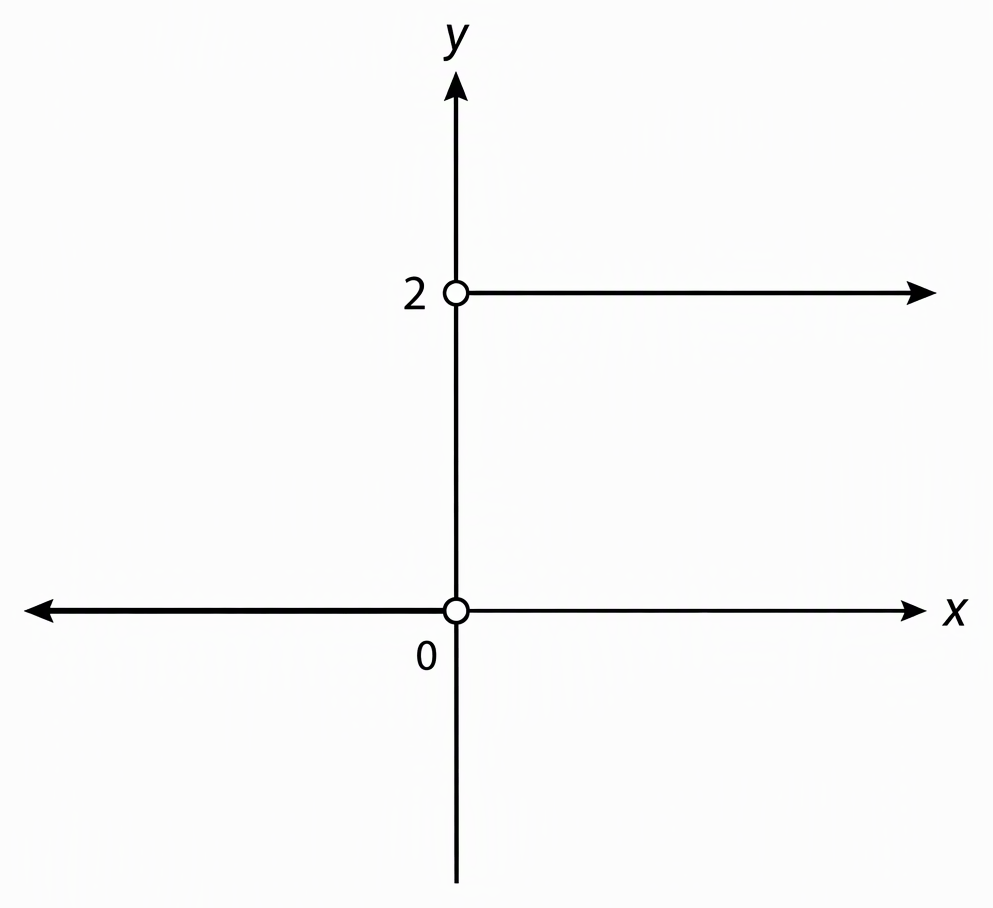
On the right:
On the left:
Thus:
The unequal one-sided limits rule out a two-sided limit. The incorrect shortcut is treating the following ratio as one without checking the sign:
The modulus cannot be cancelled as though it were the same as its input on both sides. Assigning any value to the function at zero cannot repair the mismatch: that changes one point, not the behaviour nearby.
Transferable cue: resolve modulus signs on each side before simplifying.
What should I practise after learning standard limits?
Start with labelled drills, then move to unlabelled mixed sets when you can justify your tool choice without having just seen the solution. Reproducing a method immediately after reading it is not enough. Progress should depend on demonstrated skill, not a fixed number of days.
Follow this order:
- Direct substitution and algebraic simplification.
- Standard trigonometric limits and argument scaling.
- Exponential, logarithmic and variable-power forms.
- Rational limits at infinity.
- One-sided, modulus and piecewise questions.
- Cancellation, squeeze and mixed-technique questions.
Assemble an initial ten-question diagnostic yourself: two algebraic, two trigonometric, two exponential/logarithmic/power, two infinity and two one-sided questions. This is a suggested distribution, not a guarantee about the composition of a JEEnius set.
For every question, record four items:
- Initial form: what substitution or inspection showed.
- Chosen tool: why it fits this expression.
- Decisive transformation: the line that exposed a known limit.
- Condition: any domain restriction, nonzero factor or approach side.
After an error, classify it as a missing identity, wrong tool choice, algebra slip or unchecked condition. Repair that cause, then re-solve the question later without looking at the solution.
Use JEE Main previous-year questions to test reliable execution and JEE Advanced previous-year questions to test combinations and conditions. This is a practice emphasis, not a claim that either exam contains only one difficulty level.
Keep fresh-question practice separate from revision: unseen questions test transfer, while previously missed questions check whether a specific error is repaired. JEEnius practice mode offers topic sets that skip questions already seen, with free sets included; use those for transfer, and revisit your missed-question list separately.
Next step: daily practice problems on JEEnius and get a fresh ten-question set on a topic every day (free sets daily).
Related on JEEnius: Kinematics Practice Questions JEE: Drills, PYQs and Mocks.
Frequently asked questions
What should I know before studying limits for JEE?
You need factorisation, conjugates, trigonometric identities, logarithm laws, modulus and piecewise functions. Repair the specific prerequisite that blocks a solution rather than restarting all of algebra. Before manipulating a limit, identify the approach point, domain and approach side.
Why does replacing sin x with x sometimes give the wrong limit?
The leading approximation can discard the term that determines the answer when subtraction cancels the linear terms. For example, sin(3x) − 3sin x equals −4sin³x exactly, so dividing by x³ gives a limit of −4 as x approaches zero in radians. Use an exact identity when leading terms cancel rather than assuming the remaining contribution is zero.
How do I check whether a modulus limit exists?
Resolve the modulus separately on each approach side, then calculate the left-hand and right-hand limits. A finite two-sided limit exists only when both are finite and equal. For (|x| + x)/x as x approaches zero, the left-hand limit is 0 and the right-hand limit is 2, so the two-sided limit does not exist.
What should I practise after learning standard limits?
Start with direct substitution and algebra, then practise trigonometric, exponential, logarithmic and variable-power forms. Follow with limits at infinity, one-sided questions, cancellation, squeeze and mixed techniques. Move from labelled drills to unlabelled mixed sets once you can justify your tool choice without seeing the solution. Record the initial form, chosen tool, decisive transformation and relevant condition for each question.